

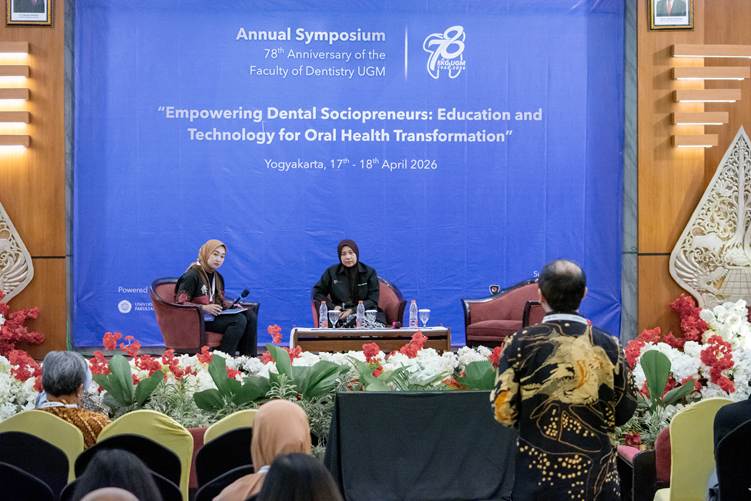
The rapid development of dentomaxillofacial radiology has entered a new era marked by the integration of digital technology and artificial intelligence (AI). However, alongside these advancements, several critical issues have emerged, demanding vigilance from medical and academic communities. This topic was discussed in the scientific presentation entitled “Advances in Dentomaxillofacial Radiology” delivered by Prof. Dr. Norliza Ibrahim, an oral and maxillofacial imaging expert from the University of Malaya , moderated by drg. Isti Rahayu Suryani, M.Biotech., Sp.Rad.OM., Subsp.RDP., Ph.D.
From X-Rays to Digital Sensors: An Evolution Transforming Clinical Practice
Dental radiology originated from the discovery of X-rays in 1895, which were adopted into dental practice within just a few weeks. In its early stages, imaging processes were highly manual, requiring long exposure times and carrying significant radiation risks.
A major transformation occurred in 1982 when Francis Mouyen introduced RadioVisioGraphy (RVG), the first digital radiography system. This innovation became a crucial milestone in overcoming delays associated with conventional film processing and paved the way for digital sensor technologies such as Photostimulable Phosphor (PSP) and CMOS.
“Digitalization is not merely about accelerating processes, but also about creating opportunities for image manipulation and improving diagnostic accuracy,” Prof. Norliza explained in her presentation.
Nevertheless, digital systems are not entirely free from limitations. The role of dental radiologists as human practitioners remains essential for final validation.
Technological Limitations: When Resolution Misleads Diagnosis
In practice, digital radiography faces technical challenges such as the Partial Volume Effect (PVE) and Partial Object Effect POE), both of which can obscure anatomical boundaries. These phenomena arise due to suboptimal voxel sizes or (Field of View/FOV) settings.
Research has shown that: Large FOVs increase coverage but reduce resolution and Small FOVs improve focus but may amplify artifacts, especially when metallic objects are present outside the scanning area .
As a result, image quality becomes a compromise between coverage and sharpness. This directly affects diagnostic accuracy, particularly in complex cases such as root resorption or hidden lesions.
“Advanced technology does not automatically guarantee accurate diagnosis. Without understanding its limitations, it can actually become misleading,” she emphasized.
AI in Dental Radiology: High Accuracy, Real Risks
The emergence of artificial intelligence in radiology has generated new optimism. Systems such as the Clinical Decision Support System (CDSS) and Integrated Dental Management System (IDMS) can assist with image interpretation, digital recordkeeping, and data-driven treatment recommendations.
In one recent AI project, the system achieved an accuracy rate of up to 95,61% in identifying mandibular bone resorption patterns in posterior regions.
However, behind these achievements lie several serious risks: Dependence on data quality: AI is only as good as its training data. Algorithmic bias: Potentially leading to unfair or inaccurate decisions. Privacy concerns: Patient data are vulnerable to breaches. Incidental findings: AI may detect abnormalities unrelated to the examination objective, creating ethical dilemmas. Legal responsibility: Questions arise regarding liability in cases of AI misdiagnosis
“The greatest risk lies not in the technology itself, but in how we use it without critical understanding,” Prof. Norliza stated.
Lessons from the Past: Radiation and Negligence
The history of radiology also records the harmful consequences of neglecting radiation safety. In the early twentieth century, technicians often tested machines by exposing their own hands to radiation—practices that later resulted in tissue damage and cancer.
Cases of radiographers developing thumb carcinoma after fifteen years of work serve as reminders that technological advancement must always be accompanied by safety principles.
Between Innovation and Ethics: The Need for Balance
Advancements in dentomaxillofacial radiology are inevitable. Technologies such as CBCT, AI, and digital systems have improved healthcare quality and diagnostic efficiency. However, without critical and ethical approaches, these innovations also carry the potential to create new risks.
The key principles that must be maintained are: Justification: Every radiation exposure must have a clear medical indication. Optimization: Radiation doses must be kept as low as reasonably achievable while maintaining optimal results
“True progress is not merely about technology, but about ensuring that technology and safety move forward together,” she concluded.
Dentomaxillofacial radiology continues to evolve as one of the clearest representations of technological advancement in dentistry. On one hand, technology opens opportunities for more precise diagnoses. On the other hand, increasing complexity demands stronger competence, ethics, and regulatory frameworks.
Reporter: Andri Wicaksono, S.Sos., M.I.Kom.; Photography: Fajar Budi Harsakti, SE