
Amid growing demands that universities not merely produce knowledge but also generate tangible societal impact, the debate over the direction of flagship research has resurfaced. The fundamental question is simple, yet its implications are significant: how can a faculty with numerous departments and strong scholarly traditions move under one shared research umbrella without undermining academic autonomy?
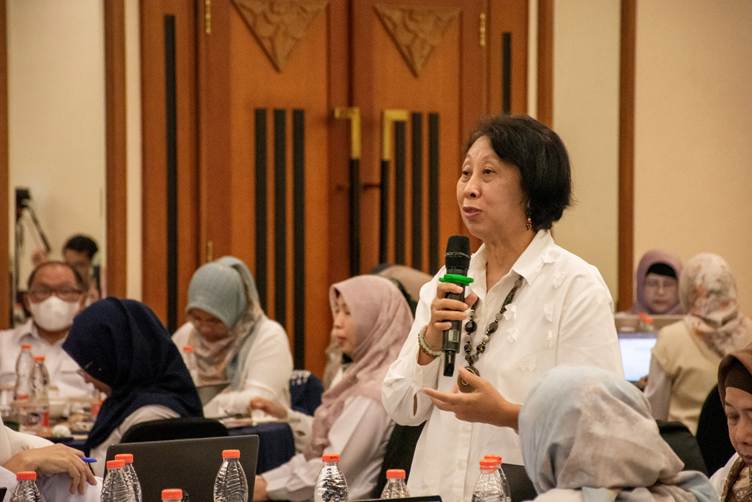
This question emerged during an academic forum when Prof. Dr. drg. Widowati Siswomihardjo, M.S., affectionately known as Prof. Bundi, highlighted the strong research polycentrism within the Faculty of Social and Political Sciences as presented by Iwan Mas’udi, Ph.D.—a condition in which each department develops its own agenda and focus. In her view, this strength simultaneously becomes a challenge when the faculty is expected to establish coordinated and sustainable flagship research.
“Is it possible for departmental research to be integrated into a faculty flagship umbrella on democracy, climate change, or Yogyakarta’s special status, and become a shared source of pride?” Prof. Bundi asked during the forum.
NOT EASY, BUT PURSUED
Faculty leadership acknowledges that aligning cross-departmental research agendas is no simple task. Academic traditions, individual faculty expertise, and diverse scholarly interests often make a single “grand umbrella” feel abstract. Precisely for that reason, the faculty has chosen a structural approach rather than merely issuing normative appeals.
One step has been establishing annual macro research themes that are translated into faculty grant schemes. These themes are designed to be interdisciplinary and relevant to public issues, such as climate change, digital transformation in the social sciences, and social inclusion and democracy.
This approach does not merely guide topics; it also intervenes in how research teams are formed. Under the competitive grant scheme, research teams are required to involve at least three departments. Collaboration with other faculties and international partners is given additional value.
“The intervention is not only in the theme, but also in the formation of research teams,” faculty leadership explained, describing the strategy to break down departmental silos.
MULTI-YEAR RESEARCH, PHASED OUTPUTS
To ensure depth and continuity, the faculty applies a multi-year research principle, administratively structured over two years. The first year focuses on data collection, mapping, and preliminary findings. The second year is directed toward scientific publications or measurable conceptual outputs.
This model is considered more realistic than demanding instant results within a single fiscal year. Administrative processes, according to faculty leadership, are no longer obstacles because outputs are rationalized according to research stages.
This approach also reflects a shift in perspective among international institutional partners. Whereas previously research topics and funding were often determined unilaterally by foreign partners, research is now developed jointly through matching fund schemes—a model that requires conceptual readiness from the faculty in defining its own research agenda.
FROM CAMPUS TO REGION
Efforts to build flagship research do not stop within academic spaces. The faculty has also positioned regional development planning as a strategic strength cultivated for more than a decade. Through technocratic research, faculty members and researchers assist local governments in mapping development potentials and challenges.
This assistance is long-term—averaging five years, and even up to six years in regions such as Balikpapan. A cross-faculty approach is applied according to regional characteristics, involving experts in agriculture, forestry, geography, engineering, and data science.
“If the region is agricultural, we invite agricultural experts. If it’s forestry, forestry and geography are involved. We even engage engineering and natural sciences,” faculty leadership explained.
This model not only strengthens the social relevance of research but also builds trust among local governments in the university’s academic capacity.
MAINTAINING BALANCE
Although the faculty has established flagship research areas, leadership emphasizes that academic freedom remains respected. Researchers are still free to develop their individual topics. Flagship research is positioned as a shared space, not a boundary fence.
Here lies the real challenge: maintaining balance between academic freedom and institutional needs for a clear strategic direction. In the context of a research university, this question will remain relevant—not merely about producing publications, but about ensuring research addresses national challenges.
Reporter: Andri Wicaksono, Photographer: Fajar Budi Harsakti

