

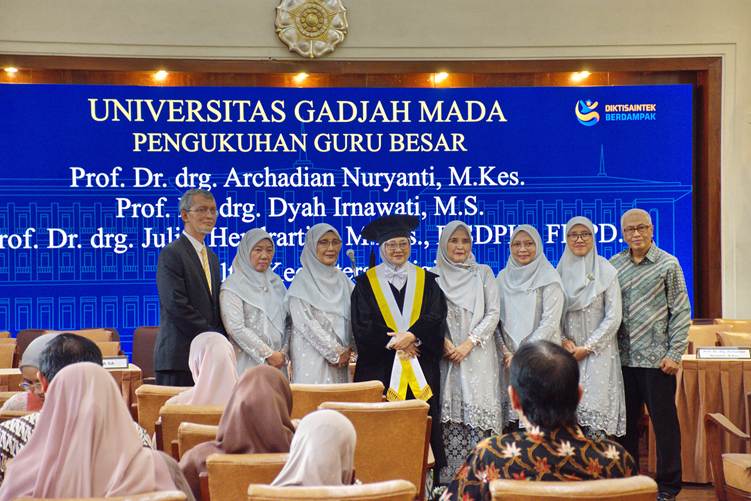
Inaugural Professorial Address of Prof. Dr. drg. Dyah Irnawati, M.S. in Dental Polymer Biomaterials at FKG UGM
Amid the persistently high prevalence of dental and oral diseases in Indonesia, an inaugural professorial speech at Universitas Gadjah Mada revealed a major irony: advances in dental biomaterial technology are progressing rapidly, while fundamental public oral health problems continue to lag behind.
Through her speech titled “The Journey of Dental Polymer Biomaterials: From Conventional Polymers to Smart Polymers”, delivered on April 7, 2026, Prof. Dr. drg. Dyah Irnawati, M.S. described a fundamental transformation in the world of dental materials—from passive substances into intelligent systems capable of responding to biological environments. Yet behind this scientific optimism lies a critical question: to what extent do these innovations truly address Indonesia’s national oral health crisis?
A Persistent Crisis
The data presented in the speech reflected an alarming situation. The prevalence of dental caries reached 88.8% according to Indonesia’s 2018 Basic Health Research (Riskesdas). Meanwhile, the 2023 Indonesian Health Survey showed that 43.6% of the population experienced damaged or painful teeth, 21% had tooth loss, and 7.3% suffered from gingival abscesses.
These figures are not merely statistics, but indicators of systemic failure in oral health prevention and treatment. Ironically, Indonesia is among the countries with the second-highest dental care expenditures in Southeast Asia. This means that high spending does not necessarily translate into better health outcomes. The core problem appears to lie not only in technological availability, but also in unequal access distribution, weak preventive education, and the lack of integration between research and public policy.
The Evolution of Biomaterials: A Major Scientific Leap
The speech traced the long history of polymer biomaterials in dentistry: 1853: vulcanized rubber as denture base material, 1936: polymethyl methacrylate (PMMA), the modern era: Bis-GMA–based composite resins.
Today, polymers are used in nearly every clinical aspect of dentistry—from dentures and fillings to orthodontic materials. However, the most revolutionary development lies not in their application, but in the paradigm shift behind them.
For decades, biomaterials were designed as inert substances that did not react with the body. Today, that approach is considered outdated. Modern materials are instead expected to: actively interact with tissues, inhibit microbial growth, release therapeutic agents, and even repair themselves (self-healing).
This concept has given rise to the term "smart biomaterials.” Nevertheless, this paradigm shift remains largely concentrated within laboratories and academic environments. Broader implementation in healthcare services—especially in regions with limited access—still requires significant effort.
Local Innovation: Great Potential Often Overlooked
One of the most interesting aspects of the speech involved research based on local materials: natural zeolite from Wonosari, combined with copper ions (Cu(II)-zeolite), which demonstrated significant antimicrobial effects.
This finding shows that Indonesia possesses tremendous potential for developing biomaterials based on local resources. Unfortunately, such research often stops at academic publication stages and rarely progresses into mass production or national policy implementation.
A New Era: Materials That Can “Think”
Recent developments in biomaterials include: antimicrobial polymersthat actively kill bacteria. shape-memory polymersthat return to their original form. pH-responsive materialsthat release ions under acidic conditions. self-healing polymers that repair their own cracks, and smart peptides targeting specific bacteria without damaging ecosystems. These are no longer merely materials, but miniature biological systems that appear almost “alive.”
Between Hope and Reality
The speech emphasized that the future of dentistry will heavily depend on smart biomaterials. However, several critical issues remain: Technology vs. Accessibility Gap
Advanced innovation does not necessarily reach the broader population. Long-Term Biological Risks
Active materials may disrupt microbiome balance if not properly controlled. Regulation and Clinical Trials Every innovation requires rigorous validation, which often takes considerable time. Cost Issues, Smart materials tend to be expensive, potentially widening healthcare inequalities.
A Scientific Revolution That Requires Social Commitment
This speech was not merely a scientific report, but a reflection on the future direction of dentistry. The transformation from conventional polymers to smart polymers represents a major leap in scientific knowledge.
However, without inclusive policies, equitable technology distribution, and community-based preventive approaches, such innovation risks becoming merely an academic luxury rather than a real solution to Indonesia’s national oral health crisis.
Ultimately, the most important question is not how intelligent the materials become, but how meaningful their impact is for the people who need them most.
(Reporter: Andri Wicaksono | Photography: Dody Hendro Wibowo)