
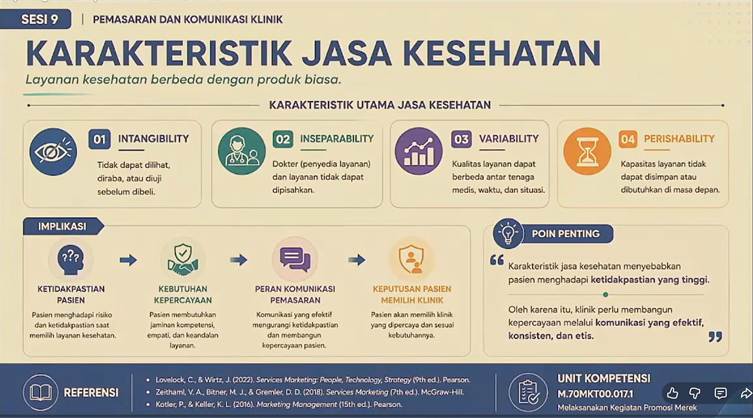
Amid increasingly intense competition in healthcare services, many clinics remain trapped in an outdated assumption: that competent dentists and adequate facilities will automatically attract patients. In reality, this assumption is becoming increasingly irrelevant.
During the “Clinic Marketing and Communication” training session delivered by healthcare business and marketing practitioner Rachmat W. Suryo, a fundamental question emerged: Why do some clinics have highly competent dentists and good operational systems, yet still struggle to attract patients? at the Dental Clinic Operational Management Workshop (13 June 2026)
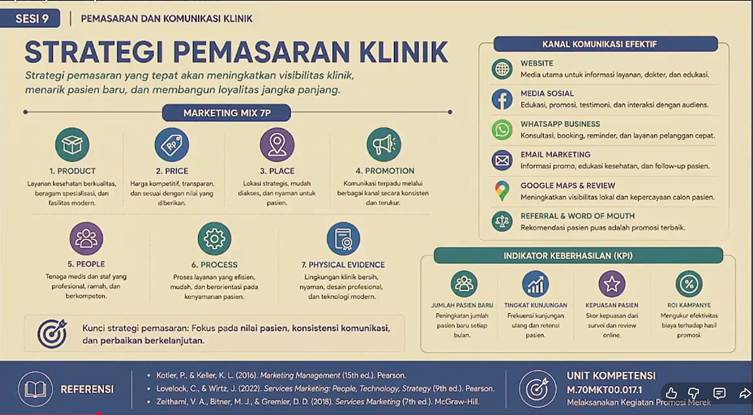
The answer, it turns out, is not simply related to medical quality. "Patients' decisions are influenced not only by the quality of medical services, but also by how clinics build trust, communicate the value of their services, and engage effectively with patients," Rachmat emphasised.
The Real Competition Does Not Take Place in the Treatment Room
According to Rachmat, many clinic owners become trapped in a classic conflict between marketing and operations. Marketing teams work hard to attract patients, but the actual patient experience fails to meet expectations.
"Even the best marketing strategy will not work if the operations are poor. Patients will not return," he said. "We spend a lot of effort promoting the clinic, patients come in, but they end up dissatisfied because the operational side only focuses on completing tasks rather than providing a meaningful experience."
This statement serves as a strong criticism of healthcare providers who still view marketing merely as promotional activities. In healthcare services, however, marketing actually begins from the moment a patient first contacts the clinic until they leave the treatment room.
This creates a paradox. Many clinics spend significant budgets on social media advertising but fail to consistently manage the patient experience.
Why Do Indonesian Patients Seek Treatment Abroad?
The phenomenon of Indonesian patients choosing to seek treatment in Penang or Singapore provides an interesting example.
Rachmat explained that many patients are not necessarily looking for doctors who are more skilled. Instead, they are seeking certainty in diagnosis, faster services, easier administrative processes, and more personalised communication.
Based on various patient testimonials presented during the session, many patients felt that healthcare services abroad provided faster processes, more communicative doctors, and a more human-centred experience compared with their previous experiences.
This serves as a wake-up call for Indonesia’s healthcare industry.
The primary issue is not always medical competence, but rather the experience gap, the difference between patients’ expectations and the experiences they actually receive.
"Patients want to be heard. They want clear explanations. They want to feel that the money they spend is truly worth the service they receive," said Rachmat.
A Clinic Is a Human-Centred Business
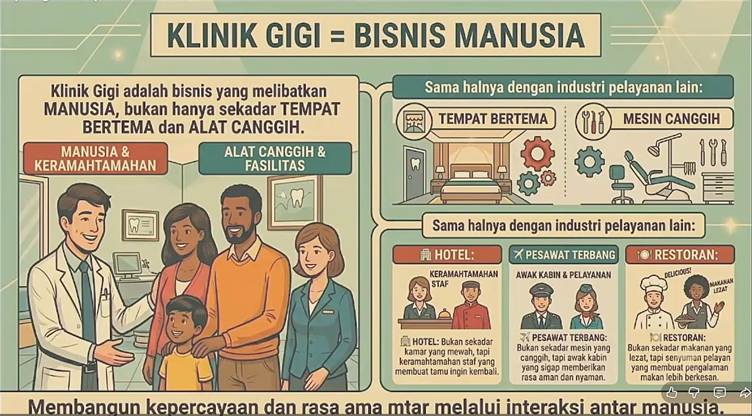
One of the strongest messages in the presentation was the idea that clinics are not merely healthcare businesses.
"A clinic is a human service business. It is a business built around people," Rachmat stated.
Therefore, dentists cannot be separated from the overall service experience. Patients do not distinguish between the quality of the dentist, the friendliness of reception staff, administrative efficiency, or the comfort of the waiting room. All of these elements merge into a single perception of the clinic.
This perspective is particularly relevant because many patient complaints are not related to medical procedures, but rather to simple service issues: unclear waiting times, poor communication, and healthcare workers who are perceived as lacking empathy.
In the modern business environment, one negative patient experience can quickly develop into a digital reputation crisis through Google Reviews, social media, and online forums.
Branding Is Not a Logo—It Is a Perception
Another key topic discussed was the common misunderstanding of branding.
Many clinics still assume that branding is limited to a new logo, corporate colours, Instagram design, or an attractive slogan.
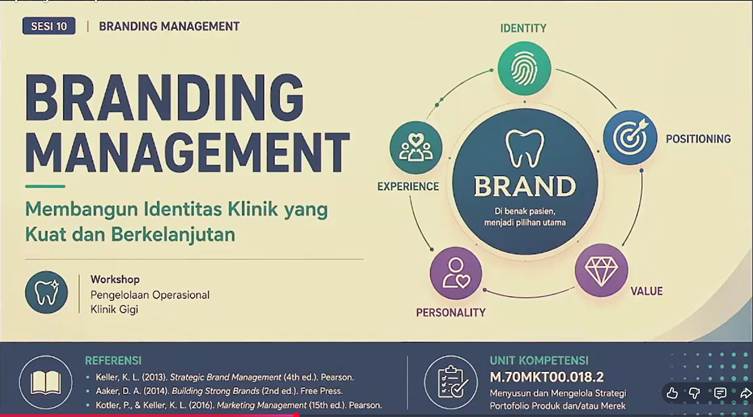
However, according to Rachmat: "A brand is not what a clinic says about itself, but what patients think about the clinic."
In other words, true brand identity is reflected through patient reviews, testimonials, word-of-mouth recommendations, and public perception.
A clinic may position itself as a “family clinic”, but if most patients perceive it as rigid, expensive, and unfriendly towards children, then the actual brand is shaped by that patient perception.
In the digital era, branding success is measured more transparently than ever: Google Reviews, social media comments, and online reputation have become mirrors that cannot easily be manipulated.
Doctors’ Personal Branding Has Become a Key Strategic Asset
The training also highlighted a shift in patient behaviour, where people increasingly choose doctors rather than healthcare institutions.
Patients search for health information through Google, YouTube, TikTok, and other social media platforms. They often build trust in a particular doctor before deciding to visit a clinic.
Rachmat even shared his own experience of travelling a long distance because he felt comfortable with a specific doctor.
"The doctor made me feel comfortable. I wanted to be treated by that particular doctor," he said.
This phenomenon demonstrates that healthcare professionals’ personal branding has become a strategic asset for clinics. Doctors who communicate effectively, provide educational content, and maintain a presence in digital spaces can become far stronger patient attractions than conventional advertising.
The Biggest Threat for Clinics: Becoming Ordinary
The most important lesson from the training was not about digital marketing techniques or social media strategies.
The central message was much deeper: clinics that fail to differentiate themselves will eventually disappear in an increasingly competitive market.
Rachmat explained that institutions often require decades to build strong and consistent differentiation. A brand is not created through a short-term campaign, but through repeated experiences that are continuously demonstrated and proven to the public.
Therefore, clinics that rely solely on medical competence without developing communication, patient experience, and reputation management will face significant challenges in the future.
"Patients do not simply appear. There is a process behind every patient decision. There are recommendations, reputation, previous patient experiences, and ease of access," Rachmat explained.
The Future of the Dental Healthcare Industry
The healthcare industry is undergoing major transformation. Patients are no longer only purchasing medical services; they are seeking security, trust, comfort, and meaningful experiences.
Excellent dentists remain essential. Modern technology remains necessary. However, both will not be sufficient if clinics fail to build genuine human relationships with their patients.
In an era where one negative review can be read by thousands of people and one positive experience can become the most effective form of free promotion, the question every clinic must answer is no longer:"How good are our dentists?"Instead, the more important question is:"How do patients feel after leaving our dental clinic?"
Because ultimately, patients may forget the name of the treatment they received. But they will always remember how they were treated as a person in a dental clinic.
Reporter: Andri Wicaksono & Dody Hendro Wibowo