
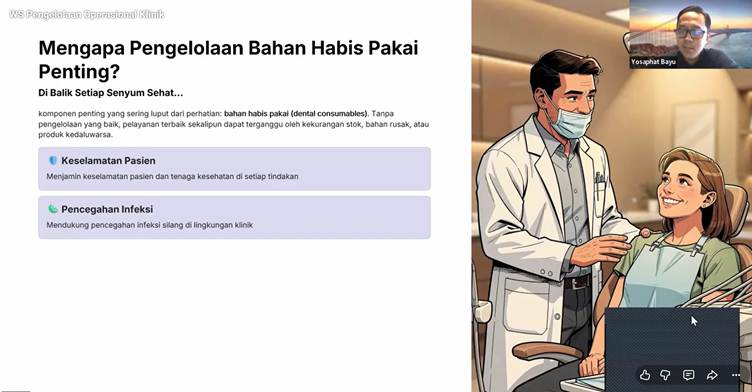
When a patient sits in a dentist’s treatment chair, attention is usually focused on the dentist, advanced equipment, or the expected treatment outcome. However, there is one aspect that often remains unseen but plays a crucial role in determining whether healthcare services can run smoothly: the management of consumable supplies.
Gloves, masks, anaesthetic materials, composite resin, sterilisation materials, and surgical sutures may appear to be simple components. Yet behind these items lies a complex management issue that is often overlooked by clinic managers.
A lecturer at the Faculty of Dentistry, Universitas Gadjah Mada (FKG UGM), and the owner of a specialist oral surgery dental clinic, drg. Yosaphat Bayu Rosanto, MDSc., Sp.BMM., Subsp.IDM(K), commonly known as drg. Yosi, believes that consumable supply management is often viewed merely as an administrative matter. In reality, its impact can be directly felt by patients.
"Behind every healthy smile a patient has, there is a component that is often overlooked: consumable supplies. Without proper management, even the best healthcare services can be disrupted by stock shortages, damaged materials, or expired products," Yosi explained during the Clinic Operational Management Workshop (13 June 2026).
His statement reflects a reality faced by many clinics in Indonesia. Many healthcare facilities already have competent dentists and adequate equipment, yet still encounter fundamental challenges in logistics management.
When Patients Have to Wait
For many dentists, few situations are more frustrating than when a patient has arrived, a diagnosis has been established, but treatment cannot proceed because the required materials are unavailable.
This phenomenon, known as stock-out , continues to occur frequently.
"The patient is already there and the procedure should normally be possible, but it cannot be performed that day because the required materials are unavailable. This is something that greatly concerns dental clinic owners," Yosi said.
The problem does not only affect patient convenience. In the long term, it may reduce public trust in healthcare providers.
From a healthcare management perspective, stock-out indicate weaknesses in demand planning. Clinics become reactive, addressing problems only after they occur rather than preventing them in advance.
The Hidden Danger That Comes Silently
However, stock shortages are not the only issue. According to Yosi, many clinics actually face the opposite problem: excessive inventory caused by over-purchasing. Discount offers from suppliers or product promotions often encourage managers to purchase large quantities without considering actual needs.
As a result, some materials eventually end up being discarded because they have passed their expiry dates.
"The loss is not only the cost of the discarded products. The potential healthcare services and revenue that could have been generated must also be considered," he explained.
He gave the example of composite resin that remains unused until it expires. The financial loss is not limited to the cost of the material itself but also includes the potential income from procedures that could have been performed using that material.
This perspective demonstrates that inventory management is not merely a warehouse issue, but an essential part of a healthcare business sustainability strategy.
Sterility Cannot Be Compromised
Beyond financial considerations, consumable supply management has an even more important dimension: patient safety.
Gloves, masks, disinfectants, and various disposable medical supplies serve as the first line of defence against cross-infection.
Yosaphat emphasised that maintaining sterility must be the highest priority in every dental healthcare service.
"Whether it is the simplest clinic or the most advanced clinic, none of it matters if sterility cannot be maintained. The number one priority must always be sterility," he stated.
His statement serves as a reminder that healthcare quality is not always determined by luxurious facilities. Even small clinics can provide high-quality services as long as they maintain proper patient safety standards.
A Culture of Relying on Assumptions
Another issue highlighted during the discussion was the continued reliance on intuition-based decision-making.
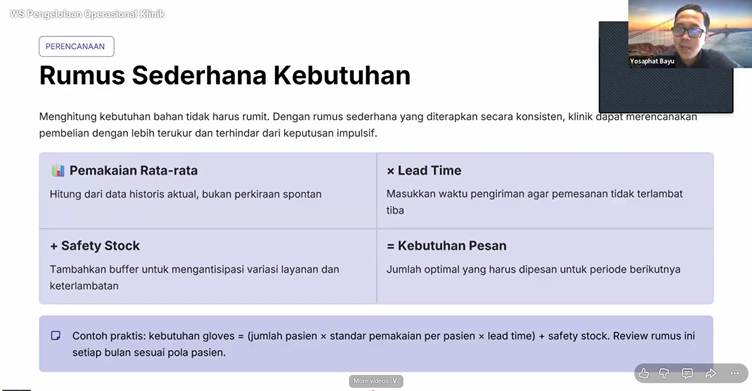
Many clinics determine their supply purchasing volumes based solely on experience or personal estimates. In reality, factors such as patient volume, treatment types, supplier delivery times, and seasonal service patterns can be calculated and analysed.
"Good planning must always begin with actual clinic data, not subjective assumptions or old habits that have never been evaluated," Yosi said.
According to him, clinics without usage data will struggle to understand their actual needs. As a result, the risks of stock shortages and waste will continue to recur.
In the digital era, these challenges can actually be addressed through simple record-keeping systems such as spreadsheets or more integrated clinic management software.
Cheap Does Not Always Mean Safe
In recent years, the convenience of purchasing products through digital platforms has made access to healthcare supplies increasingly open. However, this development has also introduced new challenges.
Yosaphat emphasised the importance of ensuring the legality and regulatory approval of products used in healthcare services.
"Never compromise on legality. Dental products without official distribution approval pose risks not only to patients but also to clinics and healthcare professionals from both legal and ethical perspectives," he warned.
Products without proper approval may create various problems, ranging from uncertain quality to difficulties in tracing products if complications occur in patients.
Amid increasingly competitive healthcare business conditions, choosing cheaper products without considering legal compliance may ultimately become a liability.
"A clinic's reputation is priceless. Do not allow the clinic's reputation to be damaged simply because of the wrong product choices," he stated.
Building a Professional Culture
Consumable supply management may not be the most attractive topic for many people. It does not involve spectacular technology or cutting-edge medical innovation.
However, it is precisely through these seemingly simple aspects that service quality is often determined.
Clinics that can ensure supply availability, maintain proper storage conditions, implement disciplined record-keeping systems, and select reliable suppliers will have stronger foundations for sustainable growth.
Ultimately, healthcare is not only about a dentist’s expertise. It is also determined by the systems operating behind the scenes.
Within that system, consumable supply management is one of the most critical elements—despite often remaining invisible to patients who visit clinics seeking a healthy smile.
Reporter: Dody Hendro Wibowo & Andri Wicaksono