
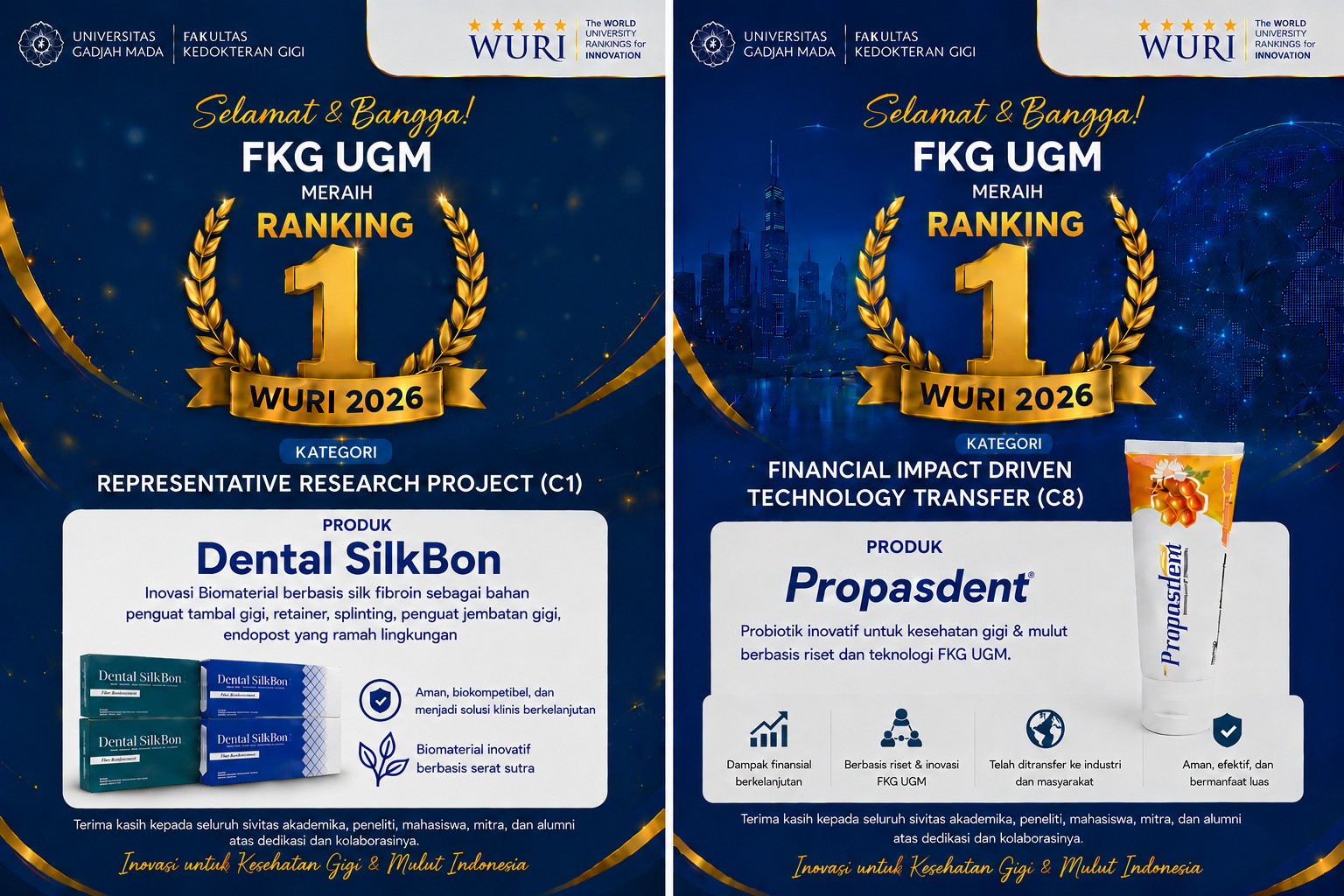
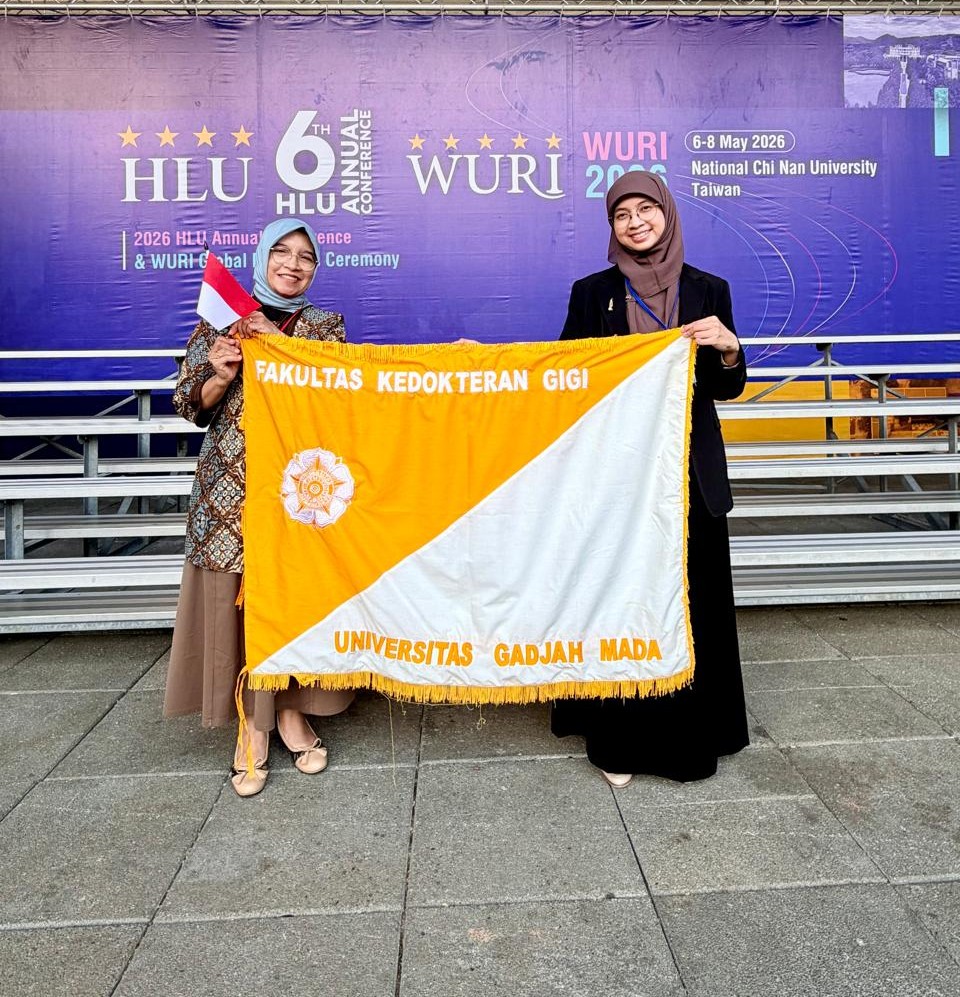
The Faculty of Dentistry at Universitas Gadjah Mada (FKG UGM) once again achieved an internationally prestigious accomplishment. At the World University Rankings for InnovationWorld University Rankings for Innovation (WURI) 2026 event held at National Chi Nan University (NCNU), Puli, Nantou County, Taiwan (06/05/2026), FKG UGM successfully placed eight innovation programs in global rankings, with two innovations simultaneously achieving World No. 1 rankings in different categories. Representing FKG UGM at the event were Vice Dean for Research, Community Service, and Collaboration, drg. Trianna Wahyu Utami, MDSc., Ph.D., and Head of the Collaboration Unit, drg. Raras Ajeng Enggardipta, MDSc., Sp.KG., Ph.D., who witnessed the historic achievement at WURI 2026.
This accomplishment marks an important milestone for FKG UGM in strengthening its position as a dental education institution that not only excels academically, but also delivers innovations with real global societal impact through approaches aligned with the Sustainable Development Goals (SDGs) and principles of Environmental, Social, and Governance (ESG).
Building an Innovation Recognition Strategy
The success at WURI 2026 began with an internal reflection process regarding how FKG UGM’s innovations could be understood internationally. Vice Dean drg. Trianna Wahyu Utami, MDSc., Ph.D., explained that the key was not the number of innovations, but the ability to understand the perspective of global evaluators.
“We realized that FKG UGM’s innovations are actually very strong. The challenge lies in mapping the right case and building narratives so evaluators can immediately recognize their impact and global relevance,” she explained.
From the earliest stages of casemapping, narrative direction, and final proposal evaluation, the process was conducted systematically to ensure each innovation not only excelled scientifically, but also demonstrated real contributions to social, economic, and environmental sustainability.
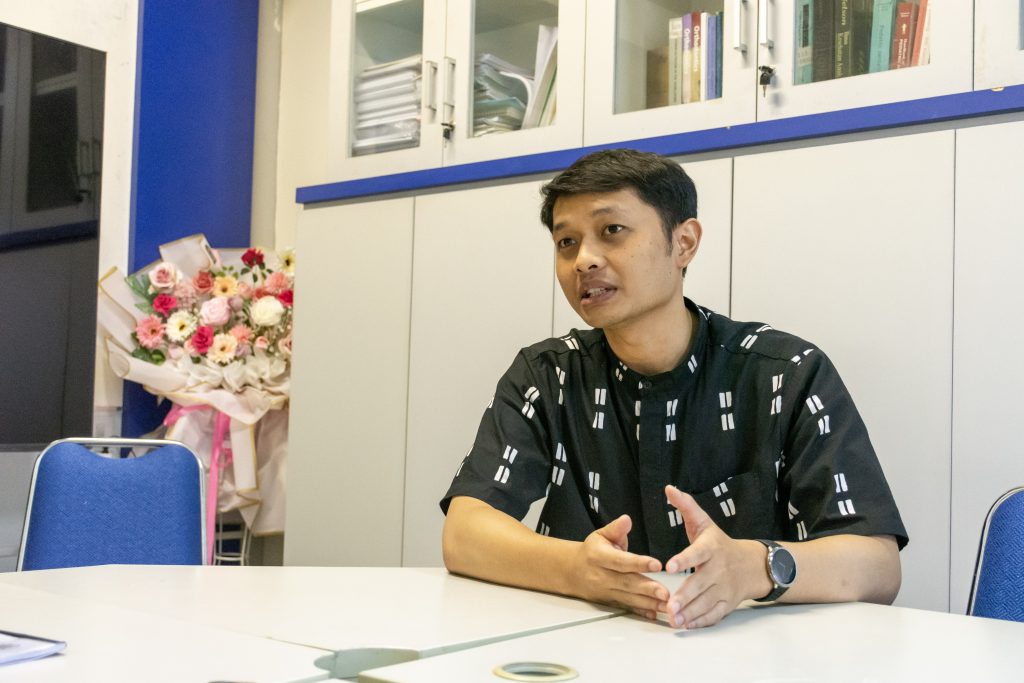
This strategic approach became the foundation for the team’s preparation of the WURI 2026 submissions . Chairman of the WURI 2026 Submission Team, drg. Arif Rahman Setyawan, explained that clear strategic direction enabled the team to work more effectively. “With the direction already mapped from the beginning, the team could move quickly. We simply needed to ensure every innovation was written using international evaluation language,” he said.
Two FKG UGM Innovations Ranked World No. 1
Out of 16 case innovation submitted, 13 categories passed international selection and eight categories entered the WURI 2026 Top 100 list. Most notably, two categories achieved World No. 1 rankings:
Dental SilkBon – World No. 1 in Representative Research Project (C1)
Created by Prof. Dr. drg. Siti Sunarintyas, M.Kes., this innovation received high recognition for successfully bridging academic research with industrial collaboration readiness. Inside a biomaterials laboratory at the Faculty of Dentistry UGM, a fine fiber from silkworm cocoons has slowly transformed Indonesia’s vision for the future of dental materials. Rather than imported metals or petroleum-based synthetic fibers, the natural thread of Bombyx mori has been developed into a modern dental restoration reinforcement called Dental SilkBon.
This innovation is not merely a laboratory product. It emerged from long-standing concerns regarding Indonesia’s dependence on expensive imported medical materials that are vulnerable to global supply chain disruptions and insufficiently environmentally sustainable. In response, the FKG UGM research team developed a new approach: transforming local biological resources into high-value strategic biomaterials.
Dental SilkBon is described as the world’s first natural dental fiber developed from Bombyx mori silk proteins for dental restoration applications. The technology is designed to strengthen restorative composites so fillings and tooth structures possess greater mechanical durability while remaining biocompatible and environmentally friendly.
Prof. Siti Sunarintyas emphasized that the innovation is not only about healthcare technology, but also national sovereignty.
“We want Indonesia to stop continuously depending on imported dental materials. Dental SilkBon is an effort to build national biomaterial independence using sustainable local resources,” she stated.
The innovation journey was lengthy. Research began with basic exploration of fibroin and sericin proteins in silk cocoons, before progressing toward fiber engineering, mechanical testing, biocompatibility testing, and limited clinical trials. Throughout the process, researchers had to ensure the natural fibers could withstand chewing pressure, bond optimally with dental resin, and remain safe for human oral tissues. According to drg. Trianna, Dental SilkBon’s greatest strength lies in demonstrating the moment when university research becomes ready to create tangible societal impact.
“We chose to highlight the most important point in the research journey — the moment when innovation meets industry and becomes ready for implementation. That is where the sustainability and impact become clearly visible,” explained drg. Arif. The approach demonstrated a concrete implementation of SDG and ESG principles in healthcare research.
Propasdent – World No. 1 in Financial Impact Driven Technology Transfer (C8)
This innovation, created by Prof. drg. Suryono, S.H., M.M., Ph.D., was considered outstanding because it demonstrated successful technology transfer leading to global commercialization. The product has already entered international distribution and serves as a concrete example of how university innovation can create economic impact while expanding access to healthcare technology. Propasdent is not simply another herbal toothpaste. It is the result of a long journey involving academic research, scientific validation, industrial collaboration, and technology downstreaming, which has now entered the national market as one of Indonesia’s leading healthcare innovations.
Behind the product lies the story of a university daring to build national healthcare industry independence based on local resources.
Indonesia continues to face serious oral health problems. High rates of cavities and gum inflammation remain major challenges, especially among communities with limited access to preventive healthcare services.
In that context, the FKG UGM research team recognized the enormous potential of propolis — a natural substance produced by bees — as an oral healthcare active ingredient. Through nanotechnology approaches, propolis was processed into extremely small particles to work more effectively within the oral cavity.
Dean of FKG UGM, Prof. Suryono, stated that Propasdent was created from the desire to produce healthcare innovations that are not only scientific, but also directly beneficial to society.
“We want to prove that Indonesian university research can become real products that are competitive, safe, and widely beneficial for public health,” he said.
According to him, innovation should not stop at laboratory prototypes. Universities must dare to enter industrial and market ecosystems so research outcomes can truly benefit the public.
“Evaluators want to see concrete evidence that university innovations are alive within society and global markets. Therefore, we emphasized the product’s journey until it successfully penetrated the international industrial ecosystem,” added drg. Trianna.
New Energy from Young Lecturers
One of the most appreciated achievements during the WURI 2026 process was the emergence of new strength from FKG UGM’s younger generation of academics. Drg. Trianna specifically praised the young lecturers actively involved in proposal preparation.
“I am very proud of the writing abilities of FKG UGM’s young lecturers. They have excellent sensitivity in capturing the essence of innovation and translating it into global language,” she said.
She added that this success demonstrates that FKG UGM does not lack innovation, but is instead entering an important phase of building a new academic culture — the ability to narrate innovation and sharpen the understanding of what makes a substance uniquely impactful on the global research stage. Drg. Arif also viewed intergenerational collaboration as the team’s greatest strength. “The team’s solidarity was extraordinary. Many young talents developed very quickly when given the right opportunities and guidance,” he said.
WURI and the New Direction of Global Recognition
The WURI 2026 forum reflected a changing paradigm in international rankings. Universities are now evaluated based on their ability to provide real solutions aligned with global sustainability agendas. For FKG UGM, participation in the forum became an important experience in understanding the future direction of world higher education.
“If university innovations are capable of addressing societal needs sustainably, then global recognition will naturally follow,” said drg. Trianna.
More Than Just Rankings
The achievement of two World No. 1 rankings at WURI 2026 marks a new milestone in FKG UGM’s journey. This accomplishment demonstrates that Indonesian oral healthcare innovations are capable of actively contributing to the global innovation ecosystem. More than merely awards, these successes provide a foundation for strengthening innovation culture, research downstreaming, and developing a generation of academics ready to bring Indonesian creations onto the world research stage.
FKG UGM is now present not only as an educational institution, but also as part of the global movement of impactful universities that place SDGs and ESG principles at the center of future innovation.
Writer: Andri Wicaksono | Photographers: Fajar Budi Harsakti & FKG UGM Archives