
Amid the unstoppable surge of digital information, public relations in higher education institutions plays a central role in maintaining institutional reputation, particularly through news coverage and press releases. Public relations is no longer limited to merely announcing faculty or university agendas; instead, it is expected to transform information into journalistic narratives that carry public value, accuracy, and broad impact.
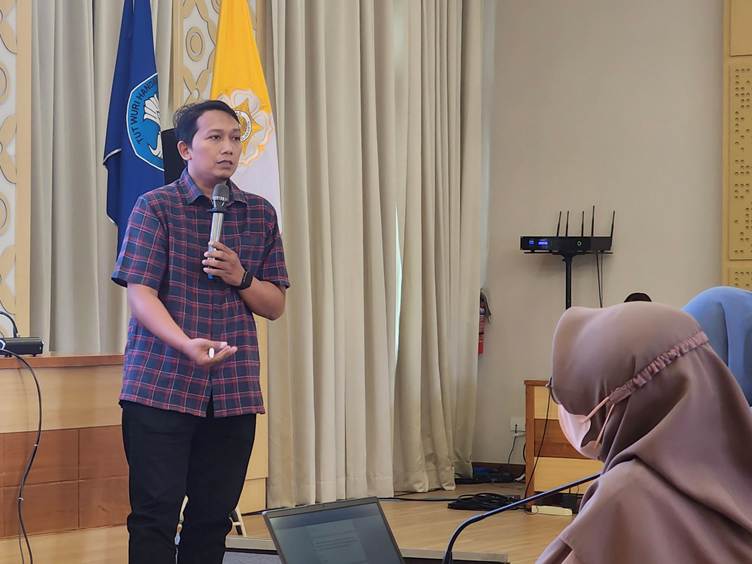
This issue emerged during a journalism workshop organized by UGM’s Bureau of Digital Transformation, featuring the Head of the Central Java–Yogyakarta Bureau of Harian Kompas, Haris Firdaus, who emphasized the importance of a journalistic approach in institutional communication through official institutional websites.
“Not all information deserves to become news. There are parameters and values that must be fulfilled for information to be attractive and relevant to the public,” he explained.
From Information to News: A Complex Process
In journalistic practice, raw information must undergo a long process: verification, cross-confirmation, and editing. Even in major media organizations, a single news article may pass through three to four stages of review before publication.
“One person should not write a news article and immediately publish it without verification. The risk of error is extremely high, especially when representing an institution,” he stressed.
He added that mistakes in institutional publications do not only affect internal matters but may also lead to broader consequences when cited by the media.
“Media outlets may quote information from official websites. If there is an error, the process of clarification or correction is not easy,” he noted.
News Value and Public Interest
The training also highlighted the importance of news value. Internal campus information does not automatically attract public interest unless it is connected to broader issues.
For example, the construction of campus facilities should not merely be reported as a routine activity, but should instead be linked to issues such as sustainability, renewable energy, or community impact.
“If you only report internal activities, outsiders will not be interested. But if it is connected to public interest, then it becomes news,” he explained.
The Dominance of Straight News and 5W1H Discipline
Most public relations products still take the form of straight news—brief, concise, and direct reporting. In this context, the principle of 5W1H remains the main foundation.
“At minimum, the 4Ws —what, who, when, where— must never be omitted. That is the basic principle,” he stated.
In addition, the inverted pyramid technique was emphasized as the primary writing structure, where the most important information is placed at the beginning.
Between Press Releases and News: An Increasingly Blurred Boundary
An interesting phenomenon has emerged as public relations products are now often treated like news by media organizations. The line between press releases and journalistic products is becoming increasingly blurred.
“A press release is an institutional statement, while news is the result of journalistic activity. But today, the two are often mixed together,” the speaker explained.
He stressed the importance of source quotations in news writing to maintain credibility.
“In news reporting, it is individuals—not institutions—who speak. Quotations must have clear sources,” he emphasized.
Strategies for Navigating the Flood of Information
In the digital era, media organizations no longer compete only with one another, but also with platforms such as social media.
“We compete with TikTok, Instagram, and even Twitter. All of them are competing for audience attention,” he remarked.
Therefore, public relations practitioners are encouraged not to passively wait for institutional agendas, but to actively respond to developing issues.
“If there is a major issue, immediately look for its relevance to academic expertise on campus. Interview lecturers and highlight academic perspectives,” he advised.
Introducing Experts Through Narrative
One effective strategy is introducing lecturers as experts through media exposure.
“I became familiar with several experts through public relations releases. After that, they became media references,” he said.
This approach is considered important in strengthening the position of universities as centers of knowledge in the public sphere.
AI Enters the Public Relations Newsroom
Digital transformation also became a major focus, particularly with the emergence of artificial intelligence in the news-writing process.
UGM introduced an AI-based system that assists public relations officers in drafting news articles, managing structure, and categorizing content according to the Sustainable Development Goals (SDGs).
“AI helps, but it does not replace humans. It has no intuition,” another speaker emphasized during the session.
The system allows writers to quickly generate two versions of an article while accelerating the content production process.
“If we can accelerate the process, that is already a success,” he stated.
SDGs as a New Narrative Framework
Interestingly, every news article is now encouraged to be linked to the 17 Sustainable Development Goals (SDGs). However, this approach serves more as categorization rather than restriction.
“Whatever we do can actually be connected to the SDGs. It simply depends on how we package it,” he explained.
Maintaining Credibility Amid the Flow of Opinion
Amid the rise of sensitive issues and public opinion, public relations practitioners face the challenge of balancing positive narratives with objectivity.
“Continue reporting positive things, but remain factual and data-driven. Do not be reactive, but do not remain silent either,” he advised.
Journalism as the Foundation of Institutional Public Communication
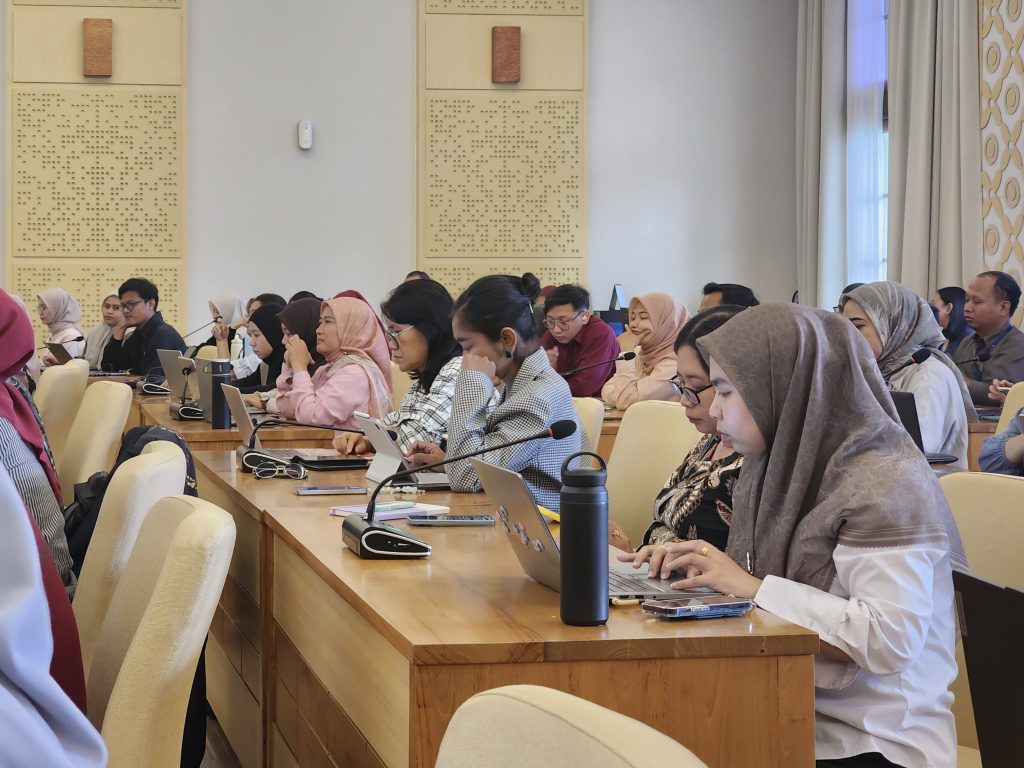
For the Public Relations Unit of the Faculty of Dentistry UGM, this training reaffirmed that journalism is not merely a technical writing skill. More importantly, it cultivates skepticism, sharpens the ability to identify reality, and enhances sensitivity to the dynamics of faculty life—all aimed at building the credibility of the Faculty of Dentistry UGM.
Today, everyone can become a producer of information. However, quality, accuracy, and depth remain the key differentiators.
Good communication not only supports a positive institutional image, but also provides meaning and value to the public.
Reporter: Andri Wicaksono, S.Sos., M.I.Kom.; Photography: Fajar Budi Harsakti, SE