
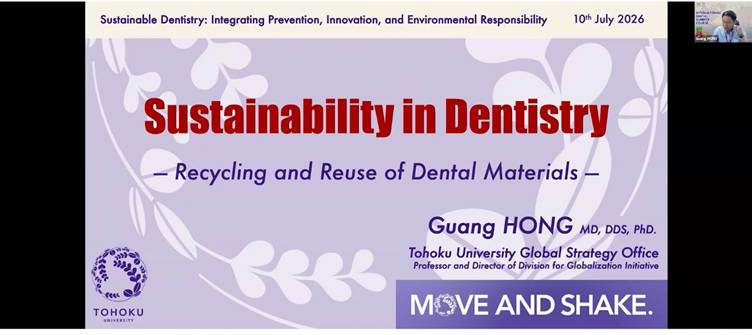
Who would have thought that behind the brilliant smiles made possible by modern dental restorations lies a significant ecological cost for the planet? This surprising reality was explored in depth during the international webinar International Dental Summer Course (IDSC) 2026, organized by the Faculty of Dentistry, Universitas Gadjah Mada (FKG UGM) on Thursday (9 July 2026).
The virtual event, held from 9:00 to 10:30 a.m. Western Indonesian Time (WIB), attracted 461 dental academics and practitioners from around the world. They gathered to hear a groundbreaking presentation by Prof. Guang Hong, MD, DDS, PhD, a leading prosthodontics expert from Tohoku University, Japan.
The Dark Side of Zirconia: Luxurious Aesthetics, Abundant Waste
In a presentation titled “Sustainability in Dentistry: Recycle and Reuse of Dental Materials,” Prof. Guang Hong exposed the unintended environmental consequences of modern clinical dentistry. Zirconia has become a material of choice for dental crowns because of its strength and highly natural tooth-like appearance. However, its production using digital CAD/CAM technology leaves behind a significant environmental footprint.
“Imagine that from a single intact zirconia disc cut in a dental laboratory, only 20% ends up in the patient’s mouth as a dental crown. The remaining 80%? It becomes block and fine powder waste. Globally, from a zirconia market valued at US$280 million, more than US$200 million is simply discarded in landfills as permanent waste,” Prof. Guang Hong explained.
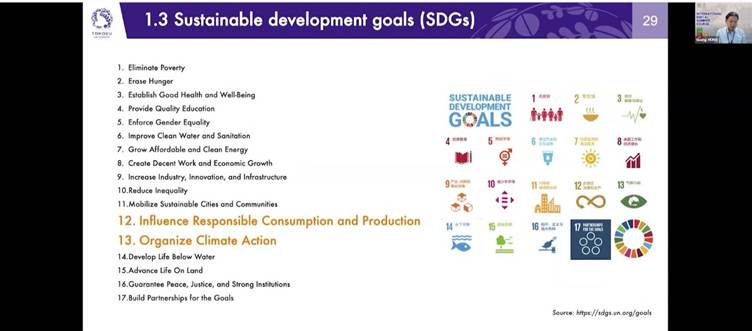
Motivated by this concern, which is also aligned with the United Nations Sustainable Development Goals (SDGs), particularly Goals 12 and 13, Prof. Guang Hong’s research team has developed a remarkable scientific solution. Through a mechanical grinding process known as ball milling for six hours, previously coarse and unusable zirconia waste was transformed into a fine powder measuring just 0.6 micrometers.
After being re-fired, the recycled zirconia demonstrated an impressive fracture strength of more than 600 MPa, along with the same level of aesthetic translucency as expensive new zirconia. In other words, the material was shown to be safe and ready for reuse in patient dental care.
From Acid-Rain Pollution to Calcium Carbonate
Zirconia is not the only material targeted by Prof. Guang Hong. He also addressed the second-largest source of waste in dental clinics: gypsum, or dental stone. Nearly 100% of used dental impression gypsum is currently discarded. When conventionally incinerated, gypsum waste releases sulfur dioxide gas, which contributes to acid rain and air pollution.
Once again, the research team offered an innovative solution. In collaboration with the Faculty of Environmental Science, the researchers engineered a carbonation process to convert the calcium sulfate in used gypsum into pure calcium carbonate. This approach not only eliminates solid waste but also effectively locks away carbon emissions in pursuit of net-zero emissions targets.
Not Just Dentists, but Leaders of the Future
The 90-minute interactive lecture became even more engaging during the question-and-answer session moderated by Dr. Kad. Prof. Guang Hong emphasized the importance of Multimodal Education, noting that his university, Tohoku University, had recently been ranked No. 1 in Japan by Times Higher Education and receives an impressive US$100 million in annual research funding from the Japanese government.
“The future of dentistry cannot be self-centered. Students should not be educated merely to fill cavities in the clinic. They must also develop a global perspective, be sensitive to cultural differences, and understand how to navigate environmental policy,” he stressed in response to a critical question from a UGM student.
The event concluded with an important reflection from the moderator: sustainable dentistry is not merely a trendy movement aimed at reducing waste, but a science-based commitment grounded in rigorous validation to protect patient safety while helping heal an increasingly aging planet.
(Reporters: Nanda, Any, Andri)