
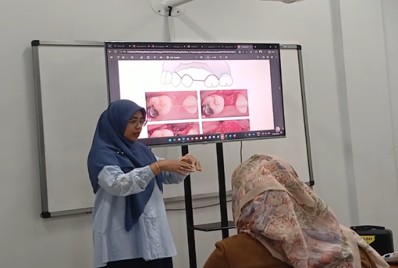
The success of dental implant treatment is determined not only by the quality of the supporting bone but also by the condition of the surrounding soft tissues. This was the central topic presented by Dr. drg. Rezmelia Sari, M.Sc., Sp.Perio., Subsp.RPID(K) during the Dental Implant Course held on the second floor of the Margono Soeradji Building, Faculty of Dentistry, Universitas Gadjah Mada (FKG UGM), on Wednesday (24 June 2026).
During the session, the periodontics and periodontal reconstruction specialist explained that implant treatment planning must carefully consider various biological factors, particularly the condition of the soft tissue surrounding the implant site. According to her, successful modern implantology is measured not only by successful implant placement but also by the ability to maintain healthy peri-implant tissues over the long term.
"An implant should not only be successfully placed but also remain healthy and functional for many years. Therefore, the condition of the soft tissue and keratinized gingiva must be carefully assessed from the very beginning of treatment planning," she explained.
Drg. Rezmelia stated that keratinized gingiva serves as one of the primary protective barriers against inflammation around dental implants. An insufficient width of keratinized tissue increases the risk of peri-implant inflammation, potentially leading to complications and compromising treatment outcomes.
Beyond discussing soft tissue management, participants were introduced to various flap design techniques used in implant surgery, including the envelope flap, tissue pouch, triangular flap, hingga trapezoidal flap . The selection of each design depends on the required surgical access, visibility of the operative field, and the complexity of the clinical case.
According to Drg. Rezmelia, selecting an appropriate flap design is crucial for preserving blood supply, minimizing tissue trauma, and reducing the risk of postoperative necrosis.

"Every incision must serve a clear purpose. Surgeons should not simply pursue wider access but must also preserve tissue vascularization to promote optimal healing," she said.
She also emphasized the importance of preserving the interdental papilla in aesthetically demanding cases. Poor incision design may result in papilla loss and the formation of black triangles negatively affecting both function and appearance.
Furthermore, Drg. Rezmelia reminded participants to recognize the limits of their own clinical competence. She stressed that not all implant cases can be considered straightforward. Some require advanced soft tissue and hard tissue augmentation procedures and often necessitate collaboration with other dental specialists.
"The most important aspect is appropriate case selection. Once a case becomes complex, dentists must determine whether they are capable of managing it independently or whether collaboration with another specialty is required," she emphasized.
Through this session, participants were expected to gain a more comprehensive understanding of the importance of surgical planning, soft tissue management, and appropriate case selection in implantology to maximize long-term treatment success.
Reporter: Anny Anggraini, Photographer: Anny Anggraini, Editor: Andri Wicaksono