
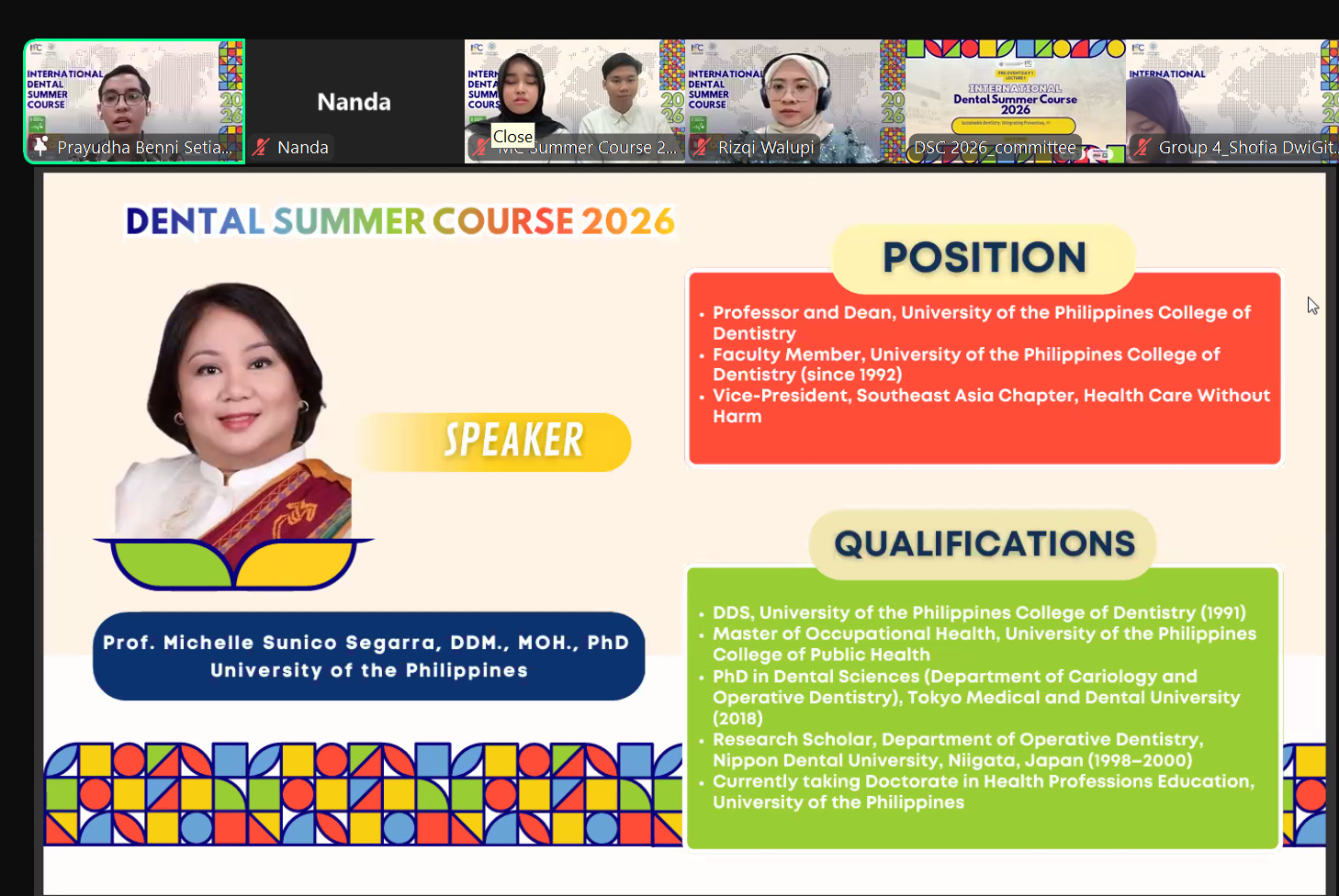
Efforts to establish environmentally friendly dental practices were among the key focuses of the International Dental Summer Course 2026, organized by the Faculty of Dentistry, Universitas Gadjah Mada (FKG UGM). During the second session of the program, Dr. Michelle Sunico Segarra, DDM., MOH., PhD, from the University of the Philippines College of Dentistry, delivered a lecture entitled “Towards a Sustainable and Resilient Green Dentistry,” highlighting the importance of transforming dental education and healthcare delivery toward more sustainable systems.
In her presentation, Dr. Michelle Sunico Segarra, DDM., MOH., PhD, explained that the healthcare sector, including dentistry, has a major responsibility to reduce its environmental impact. According to her, modern dental practice should not focus solely on the quality of patient care, but must also take environmental sustainability into account by reducing waste, improving energy efficiency, and adopting more environmentally friendly technologies.
“There can be no healthy people if the planet we live on is sick. Therefore, healthcare professionals have a moral responsibility to protect public health while also protecting the environment,” Dr. Michelle Sunico Segarra, DDM., MOH., PhD, said during her presentation.
As Dean of the University of the Philippines College of Dentistry and a member of the Health Care Without Harm organization, Dr. Michelle Sunico Segarra, DDM., MOH., PhD, shared her institution’s experience in implementing the Green Dentistry concept. Various measures have been introduced, ranging from reducing the use of single-use plastics and phasing out mercury-containing amalgam to expanding the use of digital medical records and digital radiography and improving medical waste management systems.
She emphasized that the transition toward Green Dentistry must begin with a shift in organizational culture. Consistent leadership, education for the academic community, and the involvement of all members of an institution are essential foundations for ensuring that environmentally friendly practices can be implemented sustainably.
Dr. Michelle Sunico Segarra, DDM., MOH., PhD, also highlighted the importance of applying the 4R principles—Reduce, Reuse, Recycle, and Rethink—to every aspect of dental healthcare delivery. According to her, much of the waste generated by healthcare services is actually non-infectious waste that can be managed more efficiently when proper waste segregation is implemented.
She further explained that the use of digital technologies, such as digital radiography, electronic patient records, and intraoral scanning (digital impressions), can significantly reduce the use of disposable materials, chemical waste, and paper consumption. These measures not only improve service efficiency, but also contribute to reducing the carbon footprint of the healthcare sector.
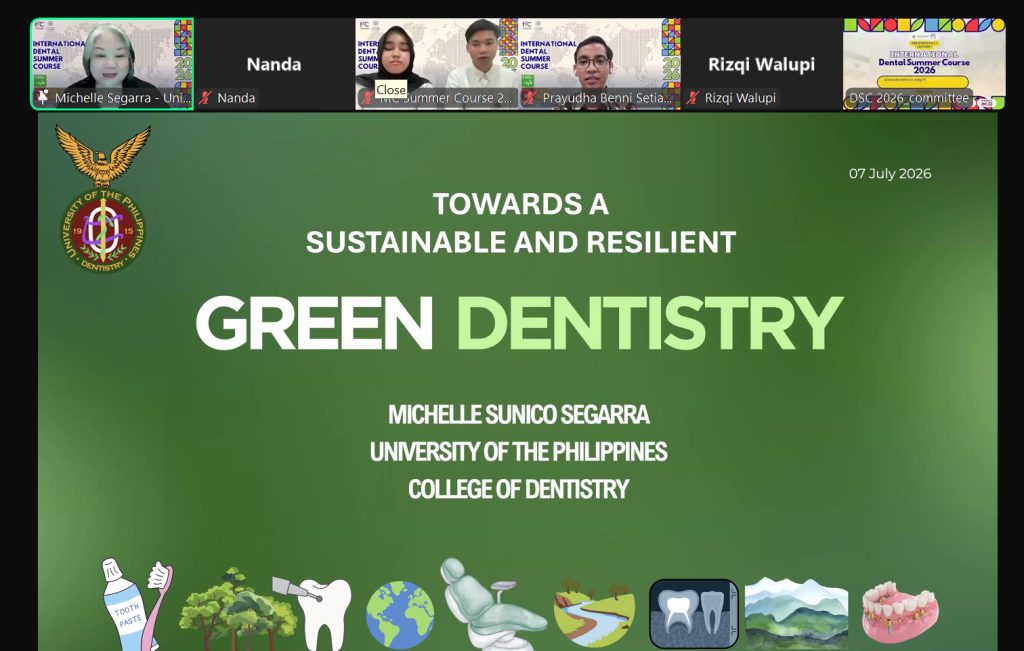
Through the lecture, participants were encouraged to understand that Green Dentistry is not merely a trend, but part of a global strategy to support One Health, an approach that views human, animal, and environmental health as interconnected. Cross-disciplinary collaboration is key to addressing the challenges posed by climate change, environmental pollution, and the growing burden of disease in the future.
Dr. Michelle Sunico Segarra, DDM., MOH., PhD, reinforced the commitment of the International Dental Summer Course 2026 as an international forum that seeks to develop dental professionals who are not only academically excellent, but also committed to environmental sustainability and the oral health of communities worldwide.
(Reporters: Nanda Ayu, Any, Andri Wicaksono)