
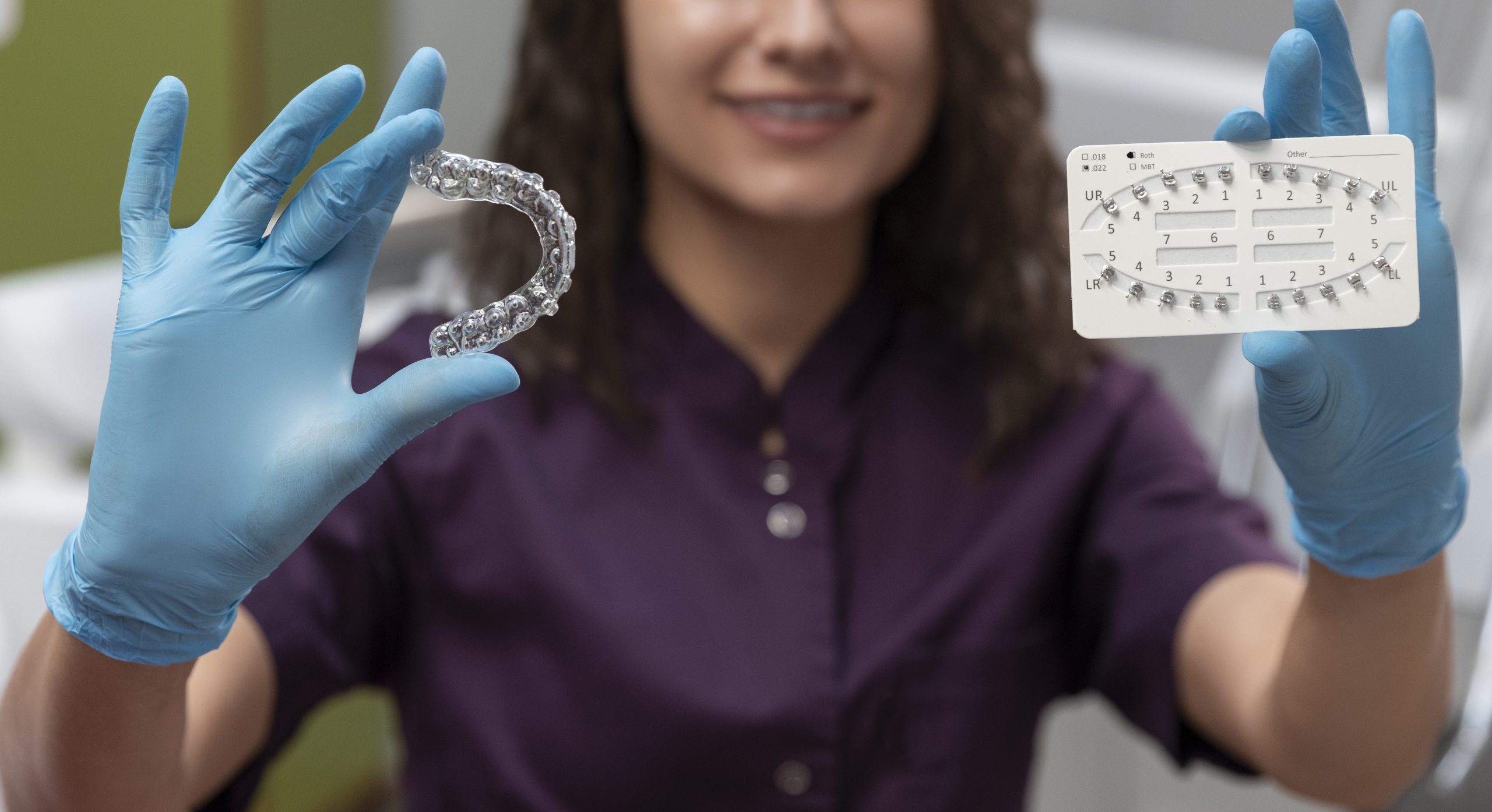
Imagine wearing a transparent plastic appliance that gently embraces your teeth each day, gradually moving them into better alignment. Although it appears simple, almost invisible, it raises an important biomechanical question that has long remained unanswered: How thick should a clear aligner be, and which attachment design most effectively moves teeth?
Researchers from the Department of Orthodontics at the Faculty of Dentistry, Universitas Gadjah Mada (FKG UGM), drg. Ananto Ali Alhasyimi, DDS, MDSc, Ph.D., Sp.Ort., drg. Aulia Ayub, Sp.Ort., and drg. Cendrawasih Andusyana Farmasyanti, addressed this question using finite element analysis (FEA) simulations. Their findings were published in the European Journal of Dentistry in 2024.
When the Aligner Is Too Thick, Teeth Bear Excessive Stress
Clear aligner treatment (CAT) has become increasingly popular in modern orthodontics because it is removable, nearly invisible, and generally more comfortable than conventional braces. However, its effectiveness in complex tooth movements—particularly anterior retraction, in which the front teeth are moved backward following premolar extraction—remains a topic of debate.
One factor that has received relatively little attention is the thickness of the aligner material itself. The FKG UGM research team constructed a three-dimensional model using cone-beam computed tomography (CBCT) data from an adult patient with Class II Division 1 malocclusion. Five aligner thicknesses were evaluated: 0.75 mm, 0.85 mm, 0.95 mm, 1.05 mm, and 1.15 mm.
The results were clear. As aligner thickness increased, so did thestressexperienced by the teeth and surrounding periodontal tissues. The 0.75 mm aligner generated a maximum stress of 0.85425 MPa, with stress distributed evenly across the crown and root, indicating relatively light and balanced loading. By contrast, the 1.15 mm aligner produced a maximum stress of 0.97170 MPa, with high-stress regions extending toward the tooth root, suggesting a substantially greater risk of tissue damage.
The researchers concluded that aligners 1.05 mm and 1.15 mm thick or greater may increase the risk of crown damage, root resorption, periodontal tissue injury, and attachment debonding.
The 0.95 mm aligner represented an intermediate option. While still clinically usable, the researchers recommended limiting its use to cases requiring greater orthodontic force and only for a limited number of aligner trays rather than long-term treatment.
Three Attachment Designs, One Superior Performer
The study also compared three composite attachmentdesigns—small resin structures bonded to the tooth surface that enable aligners to apply orthodontic forces more effectively. The evaluated designs were rectangular, ellipsoid, and pyramidal, each bonded to the labial surface of the maxillary central incisor.
Numerically, the differences in maximum von Mises stress among the three designs were relatively small: 0.93593 MPa for the rectangular attachment, 0.93807 MPa for the ellipsoid, and 0.93166 MPa for the pyramidal design. However, visual stress distribution analysis revealed more meaningful differences.
The rectangular attachment concentrated stress unevenly within the tooth crown. The pyramidal design produced high-stress regions in both the crown and root, indicating a less favorable force distribution. In contrast, the ellipsoid attachment generated a more uniform distribution across the crown while maintaining lower stress levels at the root, representing the most biomechanically favorable pattern for anterior tooth retraction.
These findings support previous work by Costa et al., cited in the publication, which demonstrated that ellipsoid and cylindrical attachments provide superior mechanical performance. They generate sufficient orthodontic force while distributing stress more evenly across the tooth surface.
Small Differences, Significant Clinical Implications
A difference of just 0.1 mm in aligner thickness may appear insignificant. However, biomechanically, such a small variation can determine whether tooth movement proceeds in a controlled manner or gradually leads to periodontal damage.
The study concludes that an aligner thickness between 0.75 mm and 0.85 mm provides the optimal balance for anterior retraction, generating sufficient orthodontic force while remaining below the threshold associated with destructive responses in the periodontal ligament and tooth root.
The researchers acknowledged that the study simulated movement of only a single incisor and did not account for the complex biomechanics of the entire dental arch or the influence of mastication. Further research involving more comprehensive clinical scenarios is therefore warranted.
Nevertheless, for orthodontists making daily decisions about aligner specifications, these findings from Yogyakarta provide evidence-based guidance that extends beyond clinical intuition. Behind what appears to be a simple transparent sheet of plastic lies a level of precision that can determine whether teeth move safely, or silently accumulate damage over time.
Source DOI: https://doi.org/10.1055/s-0043-1761452
Authors: Nanda Ayu, drg. Achmad Zam Zam Aghasy, M.Kes.
Photo: Freepik