
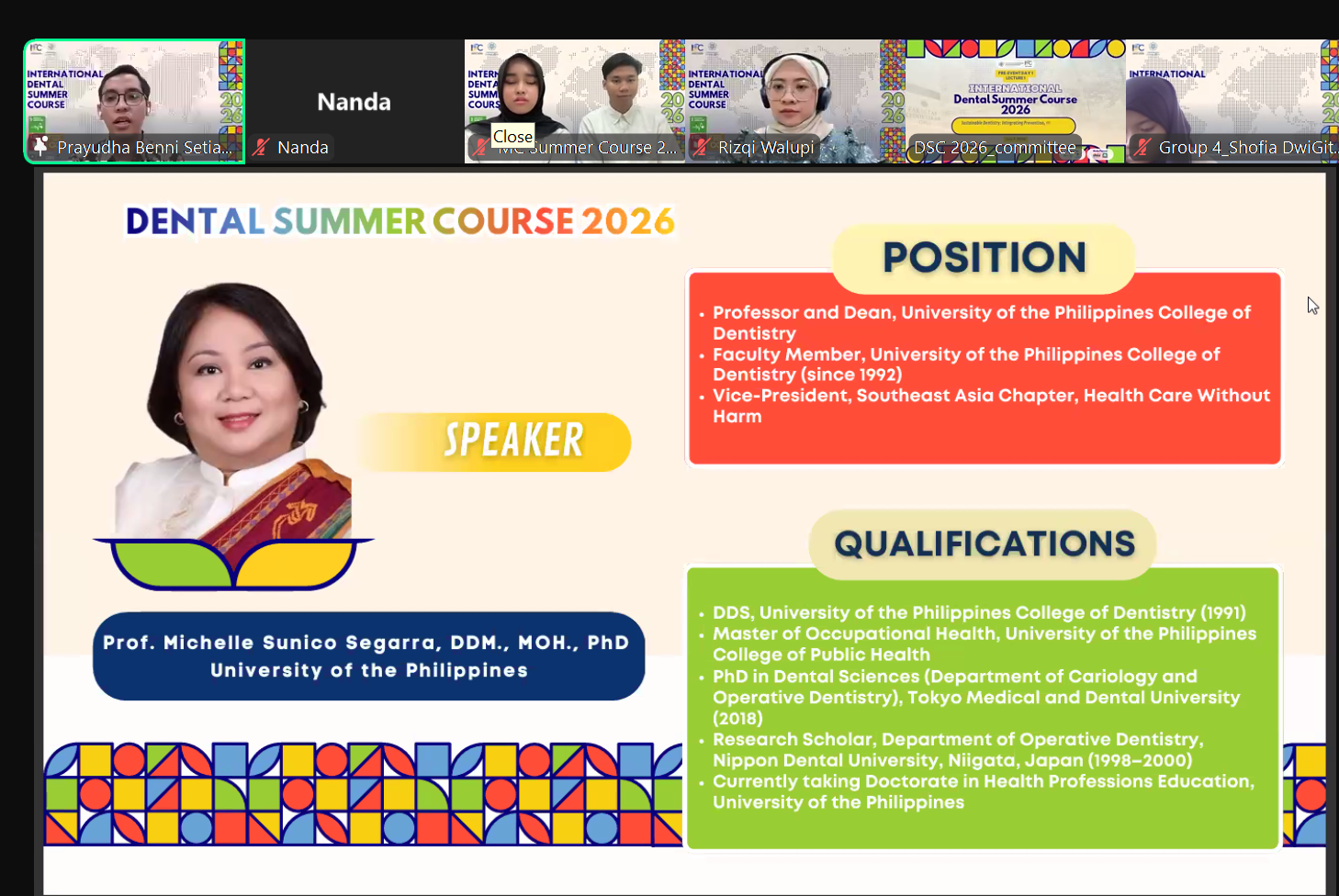
Dental practice has long been associated with high levels of sterilization that generate mountains of single-use medical waste, ranging from plastic protective materials and latex gloves to hazardous chemical waste. However, a new paradigm is now being promoted to transform dentistry into a more environmentally friendly field without compromising patient safety. This transformative movement toward “Green Dentistry” is one of the main focuses of the International Kintar Summer Parcs 2026 program, jointly organized by Universitas Gadjah Mada (UGM) and the University of the Philippines.
In her presentation, Prof. Michelle Sunico Segara, BDM, MOH, PhD, Dean and Professor at the University of the Philippines College of Dentistry, emphasized a powerful statement from the medical field: “There are no healthy people on a sick planet.” According to her, dental healthcare professionals have a moral responsibility not only to treat disease but also to ensure that the procedures they perform do not harm the planet.
The Transition Challenge and the Plastic Dilemma
As part of the global Green and Healthy Hospitals movement, dental education institutions are beginning to adopt a 10-point environmental sustainability agenda. One major achievement highlighted by Prof. Michelle Sunico Segara, BDM, MOH, PhD, was the Philippines' successful elimination of dental amalgam—silver-colored fillings containing hazardous mercury—by 2023. Dental schools have now fully transitioned to alternative materials such as composite resin.
However, deeper analysis reveals that every environmental solution can create new challenges. Composite resin, which replaces amalgam, is essentially a plastic material. This creates a new waste-management dilemma, requiring the dental sector to find ways to dispose of residual resin without contributing to the accumulation of plastic waste on the planet. The best long-term solution is therefore no longer simply to replace filling materials, but to strengthen preventive efforts so that people do not develop dental caries in the first place.
Digitalization as an Environmental Solution
In addition to replacing hazardous chemicals such as glutaraldehyde with safer alternatives such as peracetic acid and hydrogen peroxide, digital technology has emerged as a major driver of Green Dentistry.
Digital imaging technology (digital X-rays) is increasingly replacing conventional X-ray film. This transition not only reduces plastic waste but also eliminates lead waste and film-processing chemicals that are highly toxic to soil. Furthermore, the use of digital 3D scanning and CAD-CAM systems in the production of dental implants and crowns has helped minimize the use of conventional impression materials such as alginate and gypsum, whose disposal remains subject to regulatory uncertainty due to their potential to contaminate soil.
Although changing organizational culture and everyday practices in dental clinics is not easy, collective awareness built through education is expected to transform interest into concrete advocacy and action. Green Dentistry is no longer merely an option for the future; it is an urgent necessity today for the sustainability of human life and the planet.
Reporter ( Nanda , Andri )
Photo: Zoom Meeting Screenshot