
That morning, a simple question broke the silence in the discussion room.
"What exactly do we mean by being physically and mentally healthy?"
The room fell silent..
Dozens of participants—professionals responsible for managing information, serving students, and developing university policies—looked at one another. The question seemed ordinary. In fact, it commonly appears on application forms, recruitment requirements, and student admission announcements.
As awareness of the rights of persons with disabilities continues to grow, the greatest challenge facing educational institutions today is no longer merely the construction of disability-friendly physical facilities. A more fundamental challenge lies in how institutions communicate: ensuring that information is delivered equitably, respects human dignity, and is genuinely accessible to everyone.
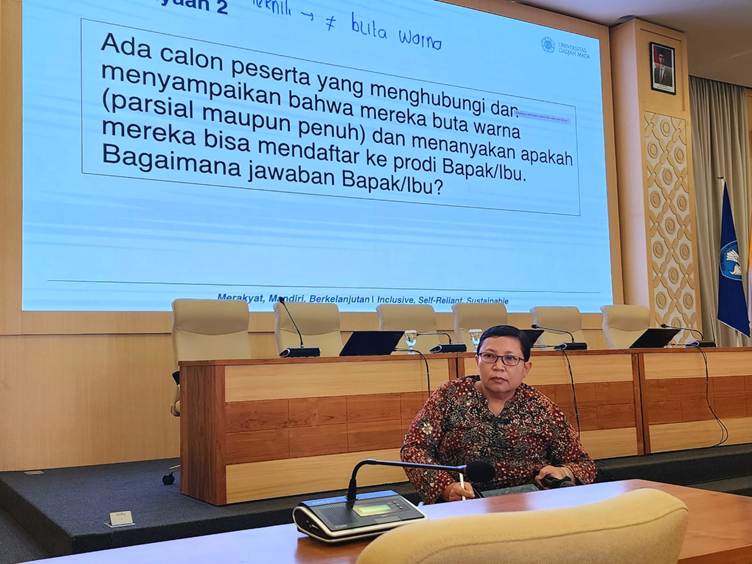
This message became the central theme of the Disability-Inclusive Communication Training , presented by Wuri Handayani, S.E., Ak., M.Si., M.A., Ph.D. The programme brought together information managers, public relations officers across UGM, and members of the Information and Documentation Management Officers (PPID) from sub-districts and urban villages surrounding the UGM campus. The training provided a space for participants to reflect on the persistent biases, stigma, and discriminatory practices that often arise—sometimes unintentionally—in public information services and academic processes.
During her presentation, the speaker emphasised that disability issues are often sensitive because they involve fundamental human rights. Administrative questions or policies that appear routine may inadvertently exclude certain groups of people.
"Inclusivity is a process that enables participation and equality for people from diverse backgrounds. Its goal is to ensure that everyone feels valued, respected, and has the opportunity to contribute," she explained, referring to UNESCO's principles of inclusivity.
Inclusivity and Accessibility: Two Sides of the Same Coin
The discussion highlighted that inclusivity and accessibility are often treated as separate concepts, when in reality they are inseparable. Inclusivity is the objective, while accessibility is the means of achieving it.
This principle applies across many areas of public service. For example, information about student admissions should not merely be published on an official website. It must also be compatible with screen readers for people with visual impairments, include subtitles for individuals who are deaf or hard of hearing, and provide accessible support channels for users who encounter difficulties.
However, barriers to access remain common, even on digital platforms that have long been in use. One example discussed during the training was the continued use of CAPTCHA systems that rely on visual identification, making them difficult or impossible for screen-reader users to access. Participants also noted that many website buttons remain incompatible with assistive technologies.
"If we truly embrace inclusivity, everyone must have an equal opportunity to access information. Accessibility is how we make that equality possible," the speaker emphasised.
When Language Becomes a Barrier
In addition to technology and infrastructure, the training examined the importance of using inclusive language. According to the speaker, disability-inclusive communication begins with the words used in everyday conversations as well as official documents.
Terms such as "disabled" when used pejoratively, "sufferer," or "suffering from" were identified as carrying negative connotations because they portray persons with disabilities as objects of pity. In contrast, person-centred expressions such as "persons with disabilities" or "students with disabilities" better respect individual dignity and are consistent with Indonesia's legal framework.
"Disability should not be viewed as a form of suffering. The words we choose determine whether our communication empowers people or reinforces stigma," she said.
Her remarks underscored the idea that language is not merely a communication tool but also a reflection of an institution's values and attitudes towards diversity.
Rethinking the Requirement of "Physically and Mentally Healthy"
One of the sessions that generated the most discussion centred on the continued use of the requirement "physically and mentally healthy" in student admissions and employment recruitment.
For many participants, the requirement seemed perfectly normal. However, the speaker encouraged them to examine the issue from the perspectives of human rights and the risk of discrimination. She questioned whether there is a clear and measurable definition of what constitutes being "physically and mentally healthy."
Speaking reflectively, she shared her own experience of being rejected from a civil service recruitment process because she used a wheelchair. Despite presenting a medical certificate confirming that she was in good health, she was deemed not to meet the "physically and mentally healthy" requirement.
"Disability is not the opposite of health. Disability is the opposite of non-disability. The spectrum of health and illness is different from the spectrum of disability and non-disability," she stressed.
Her statement offered a powerful critique of administrative practices that implicitly equate disability with illness or incapacity. According to her, such approaches may expose institutions to both legal and reputational risks.
Technology Is Changing Perspectives on Disability
The discussion also explored how technological advancements have challenged many long-held assumptions about the limitations of persons with disabilities.
The speaker cited examples such as screen-reading software that enables students with visual impairments to access learning materials independently, as well as technologies that help individuals with colour vision deficiency accurately identify colours.
She argued that technological progress should encourage institutions to move away from deficit-based thinking and instead adopt an ability-based perspective.
"Technology can remove barriers. The real challenge often lies not in disability itself, but in the way we perceive disability," she said.
For this reason, decisions regarding admission or employment should be based primarily on a person's ability to perform required tasks and achieve learning outcomes, rather than solely on physical condition.
Inclusive Public Information as a Constitutional Right
Another session focused on public information services. A representative from the Information Commission emphasised that access to information is a constitutional right of every citizen. Consequently, public service providers have an obligation to ensure that information is accessible to all members of society without discrimination.
According to the speaker, inclusive information services require far more than ramps, lifts, or other physical facilities. Disability-friendly websites, intuitive search functions, clear document descriptions, accessible online forms, and information that is easy to understand are equally important indicators of accessibility.
"It's not enough to improve the physical infrastructure. The information itself must also be understandable and accessible to everyone. That is the essence of inclusive public information services," he explained.
Building a Campus That Leaves No One Behind
Behind the discussions on websites, regulations, and language choices lay a broader message: creating an educational environment that genuinely respects human diversity.
Inclusivity is not merely an institutional programme or slogan. It is a moral commitment to ensuring that no individual is excluded because of differences in physical ability, sensory conditions, or social background.
Within higher education, this commitment has become increasingly important as universities are expected to provide learning environments that are open to everyone. The quality of a university can no longer be measured solely by its academic achievements but also by its ability to ensure equitable access for all members of its community.
As emphasised throughout the training, the true measure of an institution's success is not the perfection of its facilities, but the extent to which it ensures that every individual feels welcomed, respected, and has equal opportunities to grow and succeed. Ultimately, the essence of inclusivity is ensuring that no one is left behind in the pursuit of a more equitable and humane education.
Reporter: Andri Wicaksono, Photographer: Fajar Budi Harsakti