
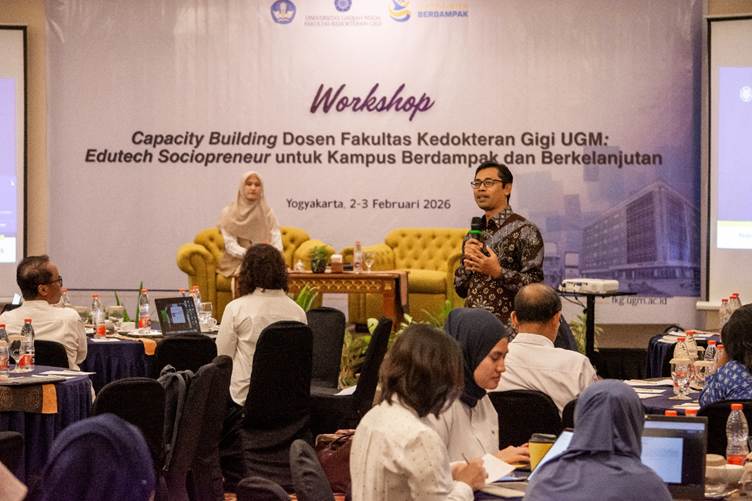
Tension is not unfamiliar within the institutional household of a faculty. As the fiscal year draws to a close, differing voices often converge: faculty priorities, departmental aspirations, faculty concerns, and relentless administrative demands. For some, this is routine bureaucracy. For others, it is the quiet arena of academic leadership. A presentation by Wawan Mas’udi, S.IP., M.P.A., Ph.D. from FISIPOL UGM, moderated by drg. Anrizandy Narwidina, MDSc., Sp.KGA., Ph.D., opened a window into the inner workings of higher education institutions during the Edutech Sociopreneur Workshop for impactful and sustainable campuses at FKG UGM.
“Every year, the tension is always there. Especially regarding priorities,” Wawan said, recalling many long nights spent not giving orders, but listening.
He was not speaking about national politics or regional governance—his academic fields—but about leading a faculty within the complexity of a large university. Here, he said, academic leadership cannot be reduced to a position.
‘LISTENING,’ NOT MERELY HEARING
In academia, the word dialogue often sounds cliché. But for him, dialogue is a demanding yet decisive practice. Not merely hearing, but listening—with a willingness to understand, reflect, and accommodate.
“Many people think they have listened, when in reality the sound simply goes in one ear and out the other,” he said with a slight smile.
He has learned that orders are sometimes necessary. But too many orders can paralyze academic vitality. Knowledge does not grow from instructions, he said, but from safe spaces to think differently.
A UNIVERSITY THAT IS NEVER SIMPLE
A university, in his experience, is neither neat nor linear. It thrives on differences—on disciplinary egos, long histories, seniority, and unwritten personal relationships.
“This is a big house with many heads,” Wawan said.
Within a faculty, some departments feel the oldest, some feel the most relevant, and others quietly feel marginalized. All of this is real. Denying it only breeds deeper conflict.
From the beginning, he chose not to deny reality: that universities are fragmented; that consensus does not arise automatically; that leadership requires emotional endurance.
KNOWLEDGE AND SOCIAL UNEASE
Amid governance matters, another unease persisted: what is the purpose of this knowledge?
Wawan witnessed firsthand social inequality in Yogyakarta—a region often praised for education and tourism, yet bearing social wounds in its peripheral communities. The gap between rich and poor has not narrowed, despite shifting development slogans.
“If knowledge stops at journals, we fail,” Wawan stated firmly.
From this unease emerged a heavy yet simple commitment: knowledge must have impact. Not as a slogan, but in research direction, topic selection, and the courage to take scholarly positions.
Climate change, digital transformation, and social inclusion once seemed distant from social and political sciences. But that is precisely the challenge: bringing knowledge out of its comfort zone.
NETWORKS AND THE ROAD BACK TO SOCIETY
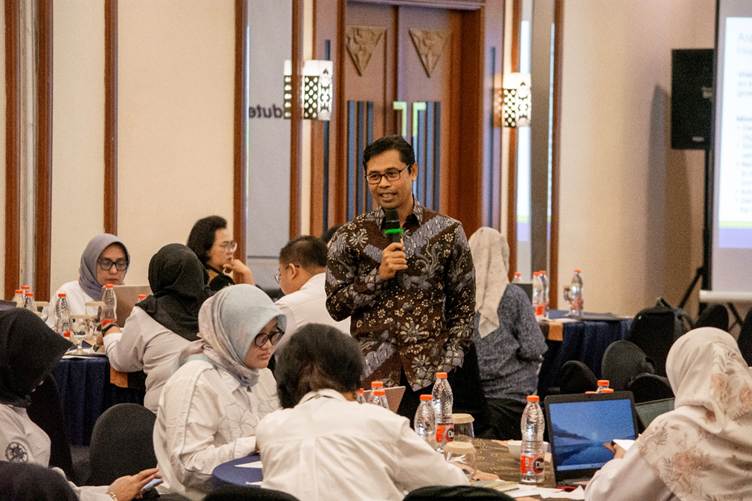
With limited campus funding, he realized that universities cannot survive on their own. They must open themselves outward.
Collaboration with local governments became an entry point—initially simple discussions on planning and policy assistance. Over time, these relationships grew into trust.
“Local governments actually need universities. They often just don’t know where to begin,” he said plainly.
Internationally, another dynamic unfolded. The obligation to send students to partner universities forced him to aggressively build global networks—not for rankings, but so students and faculty could broaden their horizons.
Sometimes exhausting. Sometimes frustrating. But he believes a university that isolates itself will slowly die.
CARING FOR PEOPLE, NOT JUST REPUTATION
Behind publications, international networks, and scholarly reputation lies one essential element: the people within.
He spoke about administrative staff—rarely highlighted in performance reports, yet sustaining daily campus life. About junior faculty pressured by targets, and senior faculty bearing moral responsibilities.
“There is no point in excellence if our community is exhausted and not well,” Wawan said softly.
For him, leadership is not about leaving policy legacies, but ensuring the university remains a livable home.
LEADERSHIP WITHOUT HEROISM
He does not present himself as a model or offer instant formulas. He shares only experience: that academic leadership is quiet work, full of compromise, rarely applauded.
Yet therein lies its meaning. “Knowledge has a long lifespan. We are only temporary guardians,” he concluded.
Amid increasingly noisy campuses filled with targets and metrics, perhaps that is the most human reminder: that academic leadership is ultimately about safeguarding direction—and one another.
Reporter: Andri Wicaksono, Photographer: Fajar Budi Harsakti