
Government data from the 2023 Indonesian Health Survey (SKI) recorded that 56.9% of the population experienced dental problems, yet only 8.1% accessed dental services. This striking gap is not merely a statistic; it is a systemic indication that millions of people are suffering while remaining disconnected from the formal healthcare system.
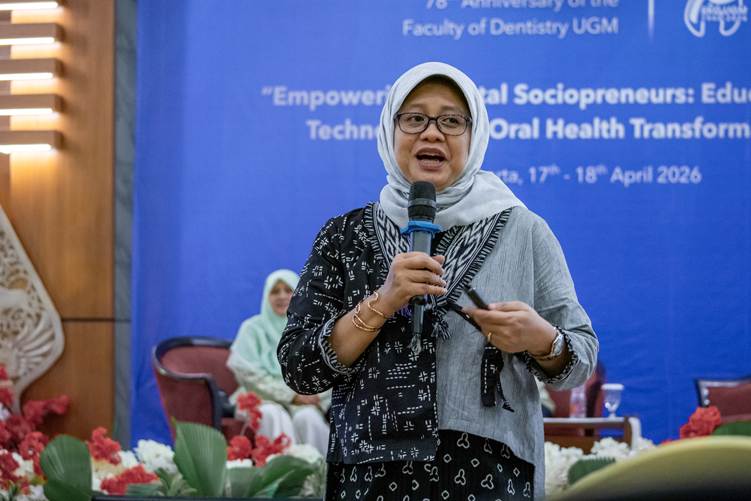
However, that “silence” is only superficial. “They are not truly silent. Their voices exist on social media,” explained Rosa Amalia, Prof., DDS, M.Kes., Ph.D.
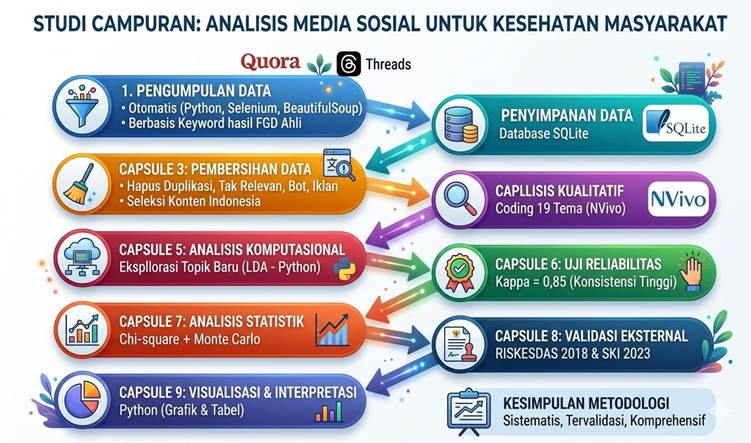
An investigation based on digital data analysis conducted by Prof. Rosa and her team uncovered layers of reality that have long escaped the attention of public policy.
Traces Intentionally Overlooked?
For years, the government has relied on conventional surveys such as RISKESDAS (Basic Health Research) to assess public health conditions. However, this method has a fundamental limitation: it only captures those who are officially recorded, not those who are marginalized.
Social media, on the other hand, captures what never appears in questionnaires: anxiety, confusion, and even despair.
An analysis of hundreds of posts on Quora and Threads (2023–2025) revealed a consistent pattern: people actively seek solutions, but not through official channels.
“They seek information, but not from dentists. They turn to social media and Google,” Prof. Rosa explained. Why?
Hidden Barriers: Cost, Access, and Distrust
Patients’ reluctance to visit clinics is not merely due to lack of knowledge. Deeper structural factors are involved: dental services are still perceived as expensive, the distribution of dentists remains uneven, and communication with healthcare providers is often viewed as rigid and lacking empathy.
Yet the least discussed issue is the crisis of trust.
Social media offers something the formal system does not: anonymity, immediacy, and the feeling of being “heard.”
Ironically, this space is often dominated by voices that may lack professional competence.
“The people responding are not necessarily dentists. Sometimes they are simply sharing personal experiences,” said Prof. Rosa.
Here lies the paradox: society abandons a credible system and instead relies on one that is largely unverified.
Misinformation Flourishing in a Vacuum
Further investigation showed that social media is not only a space for discussion, but also an arena of information contestation, including misinformation.
The analyzed data revealed: Treatment recommendations without medical basis, Product promotions disguised as health solutions, and Personal experiences treated as “universal truths”
Some even led to dangerous practices: self-medication without diagnosis and delays in seeking professional treatment.
“The potential for misinformation is significant. The answers vary; some are accurate, others are not,” Prof. Rosa stated.
When the state is absent, the empty space is filled by algorithms—and algorithms never prioritize accuracy, only engagement.
"Silent Epidemics”: Diseases That Never Enter Official Reports
One of the most concerning findings was the emergence of what researchers called "silent epidemics” —health problems absent from official systems yet widely discussed online. These included: Bruxism caused by stress, Pregnant women’s anxiety regarding medication, Post-tooth extraction care, and Minor trauma triggering pain
These issues rarely appear in national reports, yet they thrive within digital spaces.
“Digital narratives reveal realities invisible in statistics,” the study concluded.
This raises a serious question: have health policies been built upon incomplete data?
Vulnerable Groups: Present in Data, Absent in Policy
Discussions on social media showed strong concern for vulnerable groups such as pregnant women, children, and older adults. However, this concern is not matched by the availability of valid information.
“If they cannot find answers, they will turn to assumptions or myths,” Prof. Rosa explained.
Furthermore, older adults rarely appear as active participants in digital discussions. Instead, they are “represented” by family members—an indication of broader inequalities in access to information.
Critical Analysis: When the Healthcare System Loses Relevance
These findings are not merely a communication phenomenon, but a signal that the healthcare system is losing relevance in the public eye.
Three major failures were identified:
- Failure to reach people: the system is absent from the spaces society actually uses.
- Failure to understand: macro data-driven policies ignore lived individual experiences.
- Failure to respond rapidly: formal systems cannot match the speed of digital information flows.
Under these conditions, society constructs an “alternative healthcare ecosystem” that remains unregulated.
Who Is Responsible?
An unavoidable investigative question emerges:
Is this an individual failure, or a systemic one?
Blaming the public for “trusting the internet” is a dangerous oversimplification. Instead, this phenomenon demonstrates that the system has not adapted sufficiently to behavioral change.
“Social media can serve as an early warning system,” Prof. Rosa emphasized.
Yet until now, no serious integration has been established between digital data and national health policy.
Conclusion: A Visible Crisis That Remains Unacknowledged
This investigation leads to one uncomfortable conclusion:
Indonesia’s oral health crisis is not invisible—it is simply not fully acknowledged.
Social media has exposed what has long been hidden: untreated pain, unanswered anxieties, and unmet needs.
The question is no longer whether the data are valid, but whether the state is willing to listen to voices emerging outside its own system.
If not, this “silent epidemic” will continue to grow—not in dental clinics, but within social media timelines flooded with directionless oral health information across cyberspace.
Reporter: Andri Wicaksono, S.Sos., M.I.Kom.; Photography: Fajar Budi Harsakti, SE