
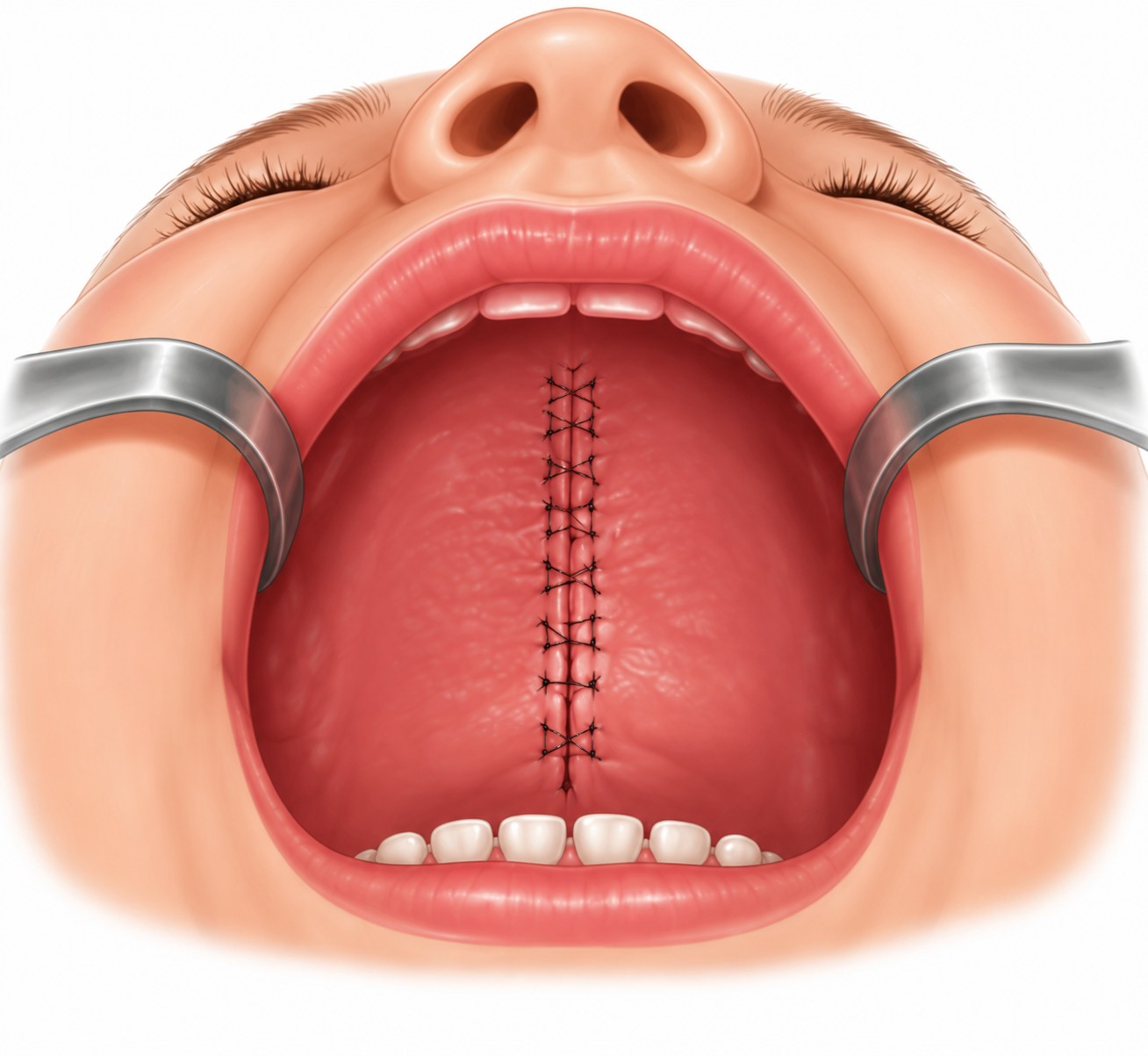
A four-year-seven-month-old boy arrived at the Oral and Maxillofacial Surgery Clinic at Dr. Sardjito Hospital in Yogyakarta with the same problem he had faced for years: a persistent cleft in his palate. He had already undergone four surgeries since the age of four months.
The case later became the subject of a study published by drg. Pingky Krisna Arindra, together with drg. Prihartiningsih and drg. Bambang Dwi Rahardjo from the Department of Oral and Maxillofacial Surgery at FKG UGM. Their findings showed that the Furlow Double Opposing Z-Plasty technique, combined with a lateral relaxing incision, was able to achieve complete closure of the cleft in the soft palate even after previous surgeries had failed.
Four Surgeries, One Persistent Cleft
The patient had a long and complex surgical history. His first surgery was performed in 2009 to approximate the bilateral cleft lip using the lip adhesion technique. One year later, bilateral cheiloplasty was performed using the Barsky technique. The next two procedures addressed the palate: palatoplasty using the pushback technique in 2012, followed by correction with Z-plasty. Neither procedure succeeded in completely closing the cleft in the soft palate.
This complication is not particularly rare. Oronasal fistula, an abnormal opening connecting the oral and nasal cavities, occurs in approximately 10–20% of palatoplasty cases. A persistent cleft is more than an aesthetic concern: food and drinks can enter the nasal cavity, speech may become hypernasal, and the child’s language development can be affected.
Repairing such cases presents additional challenges. Local tissue has already been depleted by previous surgeries, while scar tissue leaves behind thick fibrous tissue that makes the flap difficult to mobilize without risking tearing or excessive tension.
Two-Layer Transposition, One Complete Result
On January 16, 2014, the surgical team redesigned their approach. The Furlow double opposing Z-plasty technique works through a transposition principle: two opposing Z-plasties are created, one in the oral mucosal layer and the other in the nasal mucosa, incorporating the levator palatini muscle. The flap angles were set at 60 degrees. Once the flaps were transposed, the palate was not only closed but also lengthened, bringing it closer to the posterior pharyngeal wall.
Because the postoperative fibrous tissue from previous surgeries had made the flap excessively tight, the team added a lateral relaxing incision posterior to the maxillary tuberosity. This step proved crucial: the flap could be mobilized freely, the sutures were placed without tension, and the risk of postoperative dehiscence was minimized. Two-layer closure was performed using 4-0 Vicryl sutures.
“This technique has been reported to improve velopharyngeal closure by increasing the length of the soft palate, bringing it closer to the posterior pharyngeal wall,” Arindra and colleagues wrote in the case report.
Two weeks after surgery, follow-up showed complete closure. There was no dehiscence and no new fistula.
More Than Closing a Cleft
What makes the Furlow technique particularly interesting is not simply its success rate, but its functional mechanism. Reconstruction of the levator sling changes the orientation of the muscle fibers from vertical to horizontal, improving overall palatal mobility. This means the repair is not merely anatomical but also functional, particularly for speech.
The study emphasizes that for palatoplasty revision cases involving fibrous tissue after multiple previous surgeries, the Furlow technique combined with a lateral relaxing incision may be considered a primary treatment option. For a child who has undergone five surgeries before the age of five, the right suturing technique can make all the difference.
Reporter: Nanda Ayu – Andri Wicaksono