
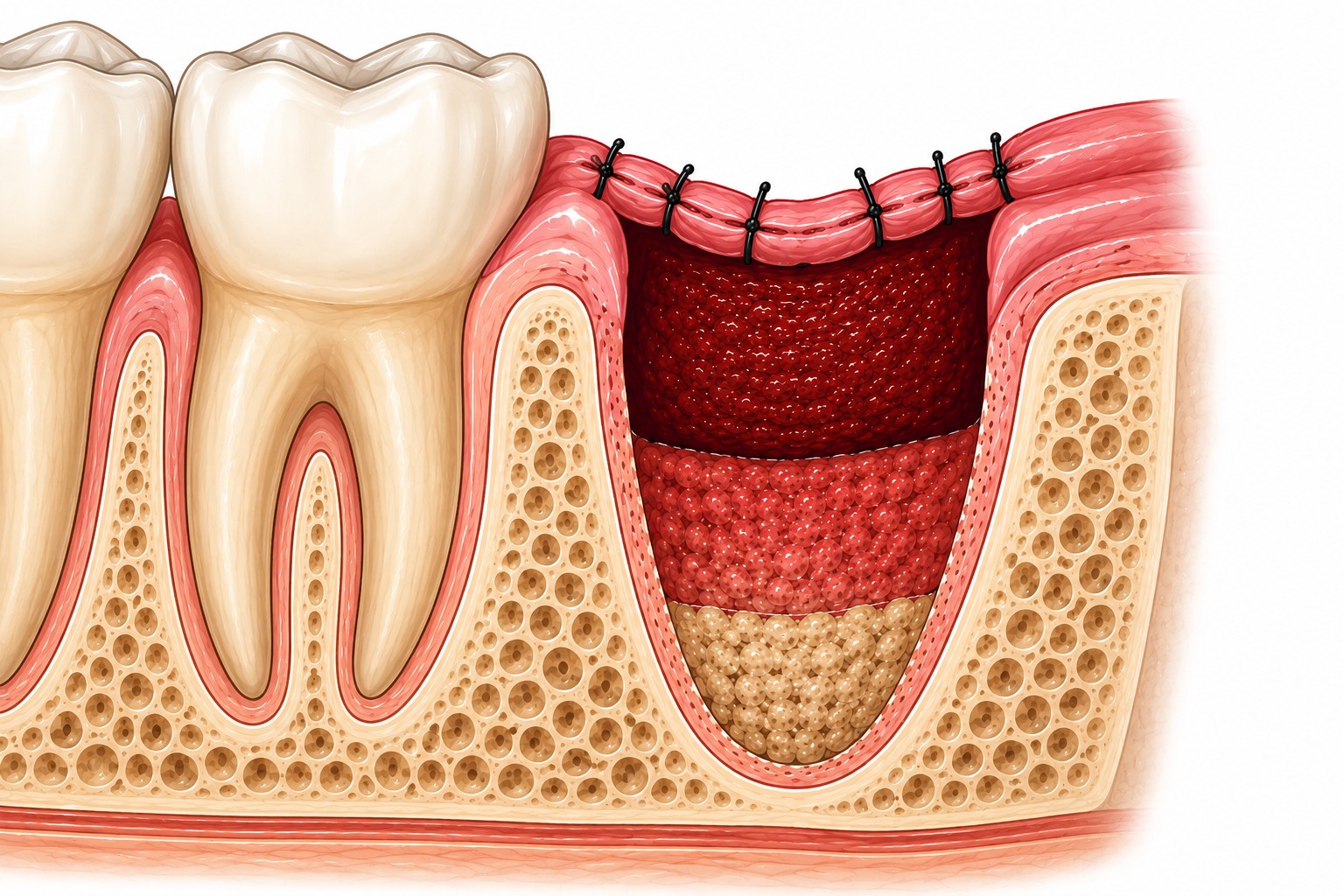
For anyone who has undergone wisdom tooth surgery, the first few days afterward can feel like a test of endurance: swollen cheeks, a stiff jaw that is difficult to open, and throbbing pain that refuses to go away. Much of this discomfort, it turns out, may be influenced by a technical decision made by the surgeon before the scalpel even touches the gum: the flap design, or the pattern of soft-tissue incision used to access the tooth.
Researchers from the Department of Oral and Maxillofacial Surgery at FKG UGM investigated a flap design modification that had not been widely reported previously: the reverse triangular flap. They compared it with two conventional designs commonly used in clinical practice.
Three Designs, Three Approaches
The study, published in Intisari Sains Medis (2018), was designed as a single-blind randomized clinical trial involving 30 patients equally divided into three groups: envelope flap, triangular flap, and reverse triangular flap. All patients had partially erupted mandibular third molars, and all procedures were performed at Prof. Soedomo Dental Hospital, FKG UGM.
The reverse triangular flap is a modification of the conventional triangular design. The difference is that the vertical releasing incision is made on the distal side, extending from the lingual to the buccal side across the external oblique ridge in the retromolar area. The result is a more conservative flap that still provides adequate surgical access and visibility.
Patients were evaluated on postoperative days 1, 7, and 14. The parameters assessed included facial swelling, trismus (limited mouth opening), wound dehiscence, pain based on the VAS, and the occurrence of alveolar osteitis (dry socket).
Cleaner Wounds, Better Healing
The most striking findings were observed in wound dehiscence. On postoperative days 7 and 14, the envelope flap group showed the greatest degree of dehiscence, averaging 5.83 mm on day 7—well above the triangular group (3.65 mm) and the reverse triangular group (3.03 mm). A post hoc ANOVA test confirmed that the envelope flap differed significantly from both other designs, whereas the triangular and reverse triangular groups did not differ significantly from each other.
For swelling and trismus, there were no significant differences between the groups at most measurement points. Interestingly, the triangular flap group showed the highest mean swelling value on day 14, suggesting that the additional vertical incision in this design may trigger a greater inflammatory response. None of the patients in any of the three groups developed alveolar osteitis during the observation period.
The study’s first author, drg. Pingky Krisna Arindra, concluded that the reverse triangular flap could serve as an alternative flap design because it produced outcomes comparable to the triangular flap while offering better wound healing than the envelope flap.
These findings are particularly relevant to partially erupted wisdom teeth, a condition frequently encountered in everyday dental practice. In such cases, flap design is not merely a matter of technical preference; it is a clinical decision that can directly affect how a patient feels when they wake up the following morning.
Reporter: Nanda Ayu – Andri Wicaksono