
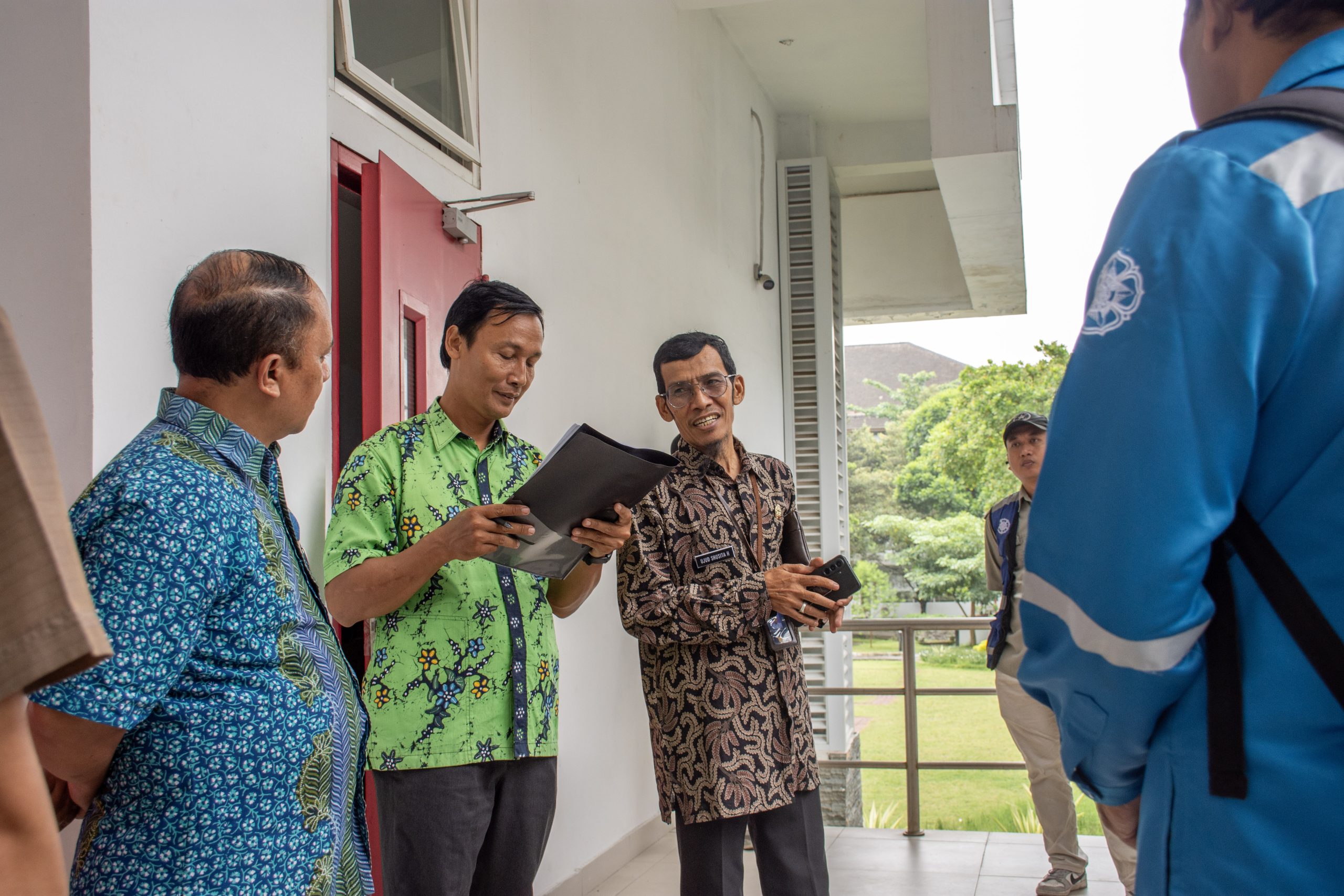
The Faculty of Dentistry, Universitas Gadjah Mada (FKG UGM), organized a Socialization and Monitoring–Evaluation Activity on Fire Management and Rescue Capacity on Thursday (30/10). The activity was accompanied by the Regional Disaster Management Agency of the Special Region of Yogyakarta (BPBD DIY) and was attended by educational staff who serve as room coordinators.
The main objective of this activity was to enhance the preparedness and capacity of the FKG UGM academic community in dealing with emergency situations, particularly fires. In addition, the activity also served as an effort to assess the capacity of faculty facilities and to strengthen coordination between UGM, through the K5L Unit, and BPBD DIY.
BPBD DIY, stated that the Special Region of Yogyakarta has a high level of disaster vulnerability. Based on data from the Indonesian Disaster Risk Index (IRBI), DIY is ranked 12th with a score of 165, placing it in the High Risk category. Another source, the 2022 Regional Resilience Index (IKD) study, indicates that DIY has 14 potential natural and non-natural disasters.
Furthermore, he explained that DIY has a significant history of disasters. Major disasters have been recorded, such as the 2006 earthquake, which caused more than 400,000 houses to collapse or suffer severe damage and resulted in 5,680 fatalities, as well as the eruption of Mount Merapi. “Research in various countries concludes that most disaster casualties are not caused by the disaster itself, but by the low level of individual capacity,” said the man commonly known as Ujud.
The activity then continued with an inspection of the Dental Learning Center (DLC) Building to directly observe the readiness of facilities available at FKG UGM. Several rooms were inspected, including laboratory rooms. The BPBD DIY team examined the completeness and functionality of the Fire Protection System, ranging from the availability of fire extinguishers (APAR), which are basic fire suppression tools, the suitability of evacuation routes, to the presence of smoke and fire detectors.
“Disaster management has now shifted from a responsive approach (acting after an incident) to a preventive–participatory approach (prevention and preparedness). This change demands cooperation from various stakeholders, starting from BPBD, the K5L Unit, academics, to the entire campus community,” he concluded.
Through this initiative, FKG UGM demonstrates its commitment to building a culture of safety and ensuring that the entire academic community can live in harmony amid potential disaster risks through continuous capacity building.
Author and Photographer: Fajar Budi Harsakti