
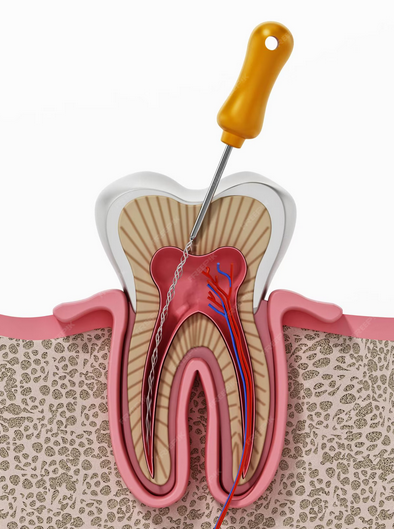
Root canal barrier materials play a crucial role in endodontic procedures by maintaining the integrity of periapical tissues, preventing leakage, and supporting healing. One of the key considerations in material selection is its biocompatibility with surrounding soft tissues, such as the periodontal ligament and mucosa.
Relevance of Hydroxyapatite and Carbonate Hydroxyapatite
Although the referenced study discusses bone implants, the biocompatibility principles examined are highly relevant to root canal barrier materials. Two materials commonly used in implant contexts are hydroxyapatite (HA) and carbonate hydroxyapatite (CHA), a more reactive and resorbable variant. Both materials were tested in interactions with soft tissues—similar to situations where endodontic materials may be exposed to periapical tissues.
UGM Study Findings
A study published in the MKGK Journal by dr. Dyah Listyarifah, M.Sc., D.Med.Sci, Gloria Fortuna, Ryan Christian Pramuditya, Dr. drg. Anne Handrini D., M.Kes., and Dr. drg. Retno Ardhani, M.Sc. reported no significant differences in the quantity and quality of capsule formation after CHA and HA implantation at the same and different time periods (p ≥ 0.05). The number of foreign body giant cells (FBGCs) in CHA after 14, 21, and 28 days of implantation was significantly lower than in HA, although there was no significant difference in the number of FBGC nuclei between HA and CHA.
Interpretation and Clinical Implications
- Comparable or better soft tissue response to CHA indicates high biocompatibility potential.
- Lower FBGC count in CHA suggests a milder inflammatory or foreign-body reaction compared to HA.
- No difference in fibrous capsule quality and FBGC nuclei number further supports that CHA does not trigger adverse tissue responses.
In the context of root canal barriers, endodontic materials may come into contact with periapical tissues. With biocompatibility profiles like CHA, the risk of inflammation or tissue reaction can be minimized, thereby supporting healing and long-term stability.
***
Although this study focuses on bone implants, the findings provide important insight that CHA has comparable or even superior biocompatibility to HA, particularly in soft tissue interactions. This is a valuable consideration in the design and development of safe, durable, and biologically friendly root canal barrier materials.
References
MKGK, dr. Dyah Listyarifah, M.Sc.., D.Med.Sci, Gloria Fortuna, Ryan Christian Pramuditya, Dr. drg. Anne Handrini D., M.Kes., Dr. drg. Retno Ardhani, M.Sc., Compatibility of Hydroxyapatite and Carbonate Hydroxyapatite Bone Implant Materials in Soft Tissue, https://jurnal.ugm.ac.id/mkgk/article/view/83547
Author: Rizky B. Hendrawan | Photo: Freepik