
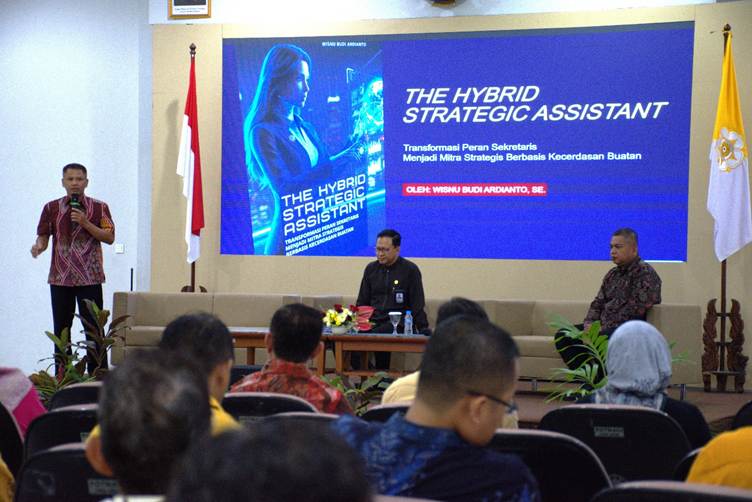
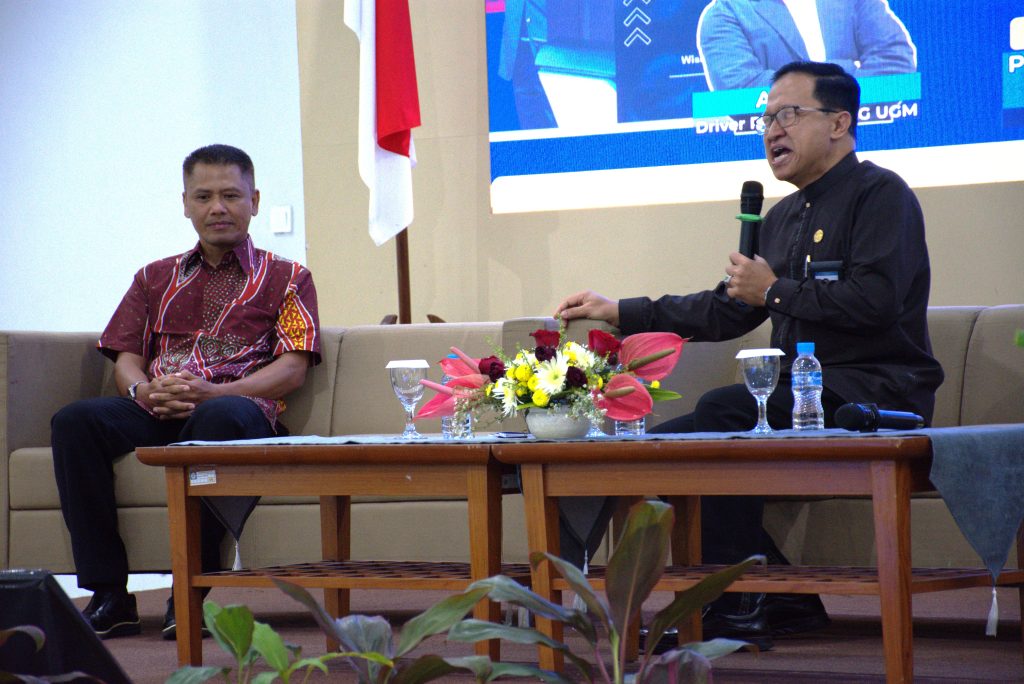
During the book discussion of The Hybrid Strategic Assistant, the debut work of Wisnu Budi Ardianto, SE, on April 9, 2026, a new horizon of literacy was opened: anyone can create their own version of a masterpiece like producing the “film” of their own life experiences. Inside an auditorium at the Faculty of Dentistry, Universitas Gadjah Mada, a conversation about the future of administrative work evolved into a profound reflection on humanity, technology, and the true meaning of secretarial work. What initially appeared to be a simple book discussion ultimately unveiled a new reality: a profession long perceived as purely technical—the secretary profession and its supporting systems—is undergoing a fundamental transformation. In daily life, Wisnu Budi Ardianto serves as an executive secretary at FKG UGM. Through his book, he captures the transformation of the secretarial profession as it races alongside the changing times.
Amid the rapid rise of artificial intelligence (AI), one major question emerged: will humans be replaced? The answer, according to Budi, is no. “Humans will not be replaced, but they are being forced to evolve,” emphasized Budi, as he is commonly called.
From Routine to Strategy: Changing the Paradigm
For decades, the role of a secretary was synonymous with administrative tasks: taking notes, arranging schedules, and preparing correspondence. According to Budi, secretaries were often viewed merely as “walking calendars.”
However, the landscape has now changed drastically. Technology—particularly AI powered by scientific databases and internationally reputable sources—has taken over much of the repetitive work. Processes that once required days can now be completed in minutes: summarizing documents, preparing presentations, and even designing communication concepts.
As the world accelerates through continuous shifts, this is precisely where the human role becomes increasingly important—not as technical executors, but as information filters, contextual decision-makers, and guardians of human values within organizations.
“Technology does not eliminate the human role; it forces humans to level up,” Budi stated firmly.
AI: A Fast Assistant, Not a Wise Replacement
The use of AI in daily practice became a major point of discussion. From drafting letters to preparing presentation materials within minutes, AI has undeniably accelerated work rhythms significantly. However, firsthand experiences from practitioners also revealed another side that is often overlooked: AI helps structure human thinking frameworks and systems to become more effective and efficient, but humans are still required to synchronize it with real needs and contexts.
In one simple case, AI only read part of a scheduling dataset and produced an incorrect conclusion. The mistake was only detected when a human conducted critical verification. There are affective dimensions that AI cannot replace. It does not know when someone is angry, anxious, or in need of a personal approach. It cannot “filter information without hurting others,” a communication skill that is highly crucial within organizations and requires experience and refined judgment.
Human Touch: An Irreplaceable Value
Amid optimism surrounding AI, the forum also revealed an interesting paradox. While humans sometimes forget to say thank you, AI can easily be programmed to behave politely. Yet such politeness remains mechanical, devoid of emotional meaning. Humans, on the other hand, possess qualities that cannot be replicated: trust, integrity, and interpersonal relationships. A secretary does not merely manage schedules, but also: understands the leader’s character, reads organizational dynamics, and maintains communication harmony. In this context, secretaries are no longer merely “behind-the-scenes workers,” but guardians of organizational stability.
Writing as a Path of Transformation
Interestingly, this transformation has not only occurred in workplace practices, but also in intellectual expression.
One figure in the forum admitted to having little interest in reading or writing. Yet everyday experiences, combined with critical reflection and technological assistance, eventually gave birth to a book.
This phenomenon demonstrates that inspiration does not come from grand theories, but from small experiences interpreted seriously. Writing becomes a tool to reflect on practice, share experiences, and build professional legitimacy.
An Unavoidable Evolution
Organizations that are slow to adapt will be left behind. Individuals unwilling to learn will be overtaken. Yet behind this pressure lies a tremendous opportunity to level up, expand one’s role, and discover new meaning in work.
This is no longer an era of complacency behind a “big name.” This is the era of transforming work methods because change is moving rapidly. Adaptive character, innovation, and agile mentality are what will survive in the professional landscape.
(Editorial & Photos: Andri Wicaksono, S.Sos., M.I.Kom)