
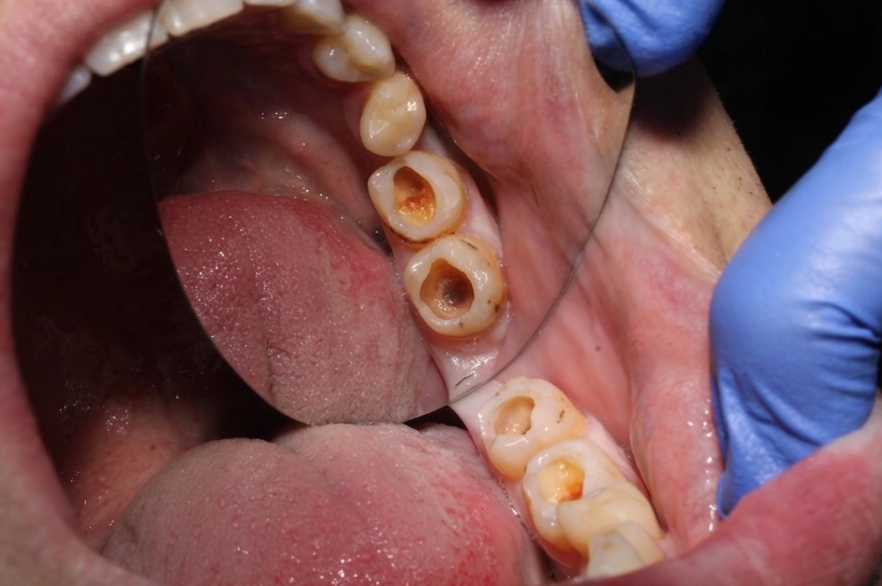
A team of dentists from the Department of Dental Conservation, Faculty of Dentistry, Universitas Gadjah Mada (FKG UGM), successfully restored the chewing function of a 47-year-old male patient who had irreversible pulpitis, or inflammation of the dental pulp that cannot heal on its own. Through a combination of one-visit root canal treatment and post-reinforced composite resin restoration, this complex dental treatment was completed quickly, efficiently, and economically.
The case was treated directly by UGM dental conservation specialist drg. Pribadi Santosa, M.S., Sp.KG.(K), together with drg. Gunawan Raharjo, Sp.KG, from the Dental Conservation Specialist Program at FKG UGM, at the Dental Conservation Clinic of RSGM Prof. Soedomo UGM.
The patient initially presented to RSGM Prof. Soedomo UGM on 26 February 2014 with a complaint he had endured for some time: his lower right back tooth had a cavity, food frequently became trapped in it, and he experienced pain whenever he drank something cold. The mandibular right second molar (tooth 47) had never been filled, and the sudden discomfort had significantly interfered with his daily eating activities.
Following a thorough examination, the dental team diagnosed irreversible pulpitis. Rather than applying conventional root canal treatment, which would require the patient to return several times for medication replacement, the FKG UGM team chose a one-visit approach in which the treatment was completed in a single session.
Radiographic examination showed a cavity extending to the pulp on the distal side of the tooth, but there was no dark area (radiolucency) around the root apex indicating that the infection had spread to the bone tissue. The root canal was also relatively straight and unobstructed. These conditions formed the basis for determining that the case was suitable for one-visit treatment. All stages, from cleaning and shaping of the root canal and medication to root canal filling (obturation), were completed in a single session to minimize the risk of bacterial contamination between visits.
Two weeks after the root canal treatment, on 14 March 2014, the patient returned to the clinic without any complaints of pain. To restore the function of the extensively damaged tooth, the dentist performed a direct composite resin restoration reinforced with a special metal post.
Because the cavity extended to the distal wall, a Radix Anchor parallel self-threading post from Dentsply was selected for reinforcement before placement of the composite resin. This type of post has a parallel shape with a threaded (lamella) system and is made of nickel-titanium. Its design allows chewing forces acting on the tooth to be distributed evenly toward the root, thereby increasing the tooth's resistance to fracture. In addition, the post has a venting system that prevents excessive pressure on the root canal walls during placement.
The selected restorative material was a packable type, placed layer by layer using an incremental technique to follow the patient's natural tooth anatomy. This type of restoration was selected because the remaining tooth structure was still sufficiently strong to support a direct restoration.
“The remaining hard dental tissue was the main consideration in selecting the type of restoration. In this case, sufficient tooth structure remained, making direct restoration with composite resin reinforced with a parallel self-threading post an appropriate and economical choice,” wrote Raharjo and Santosa in their case report published in Majalah Kedokteran Gigi Klinik (MKGK)..
At the final evaluation visit on 21 March 2014, the patient reported no pain at all when eating or drinking. Objective clinical examination confirmed that the dental restoration remained intact, there was no inflammation in the surrounding gingival tissue, and bite function (occlusion) was normal.
The successful management of this case at FKG UGM challenges the longstanding perception among the public that root canal treatment must always be time-consuming and painful. The combination of one-visit treatment and post-reinforced composite restoration demonstrated that even a severely compromised tooth can regain function and be preserved with only two visits to the dental hospital. This approach also provides a considerably more affordable and economical restorative alternative for patients compared with the fabrication of a full crown.
Author: drg. Achmad Zam Zam Aghasy, M.Kes., Annisa Dwi Noviyanti
Photo: FreePik
Source DOI: https://doi.org/10.4103/JCD.JCD_602_20