
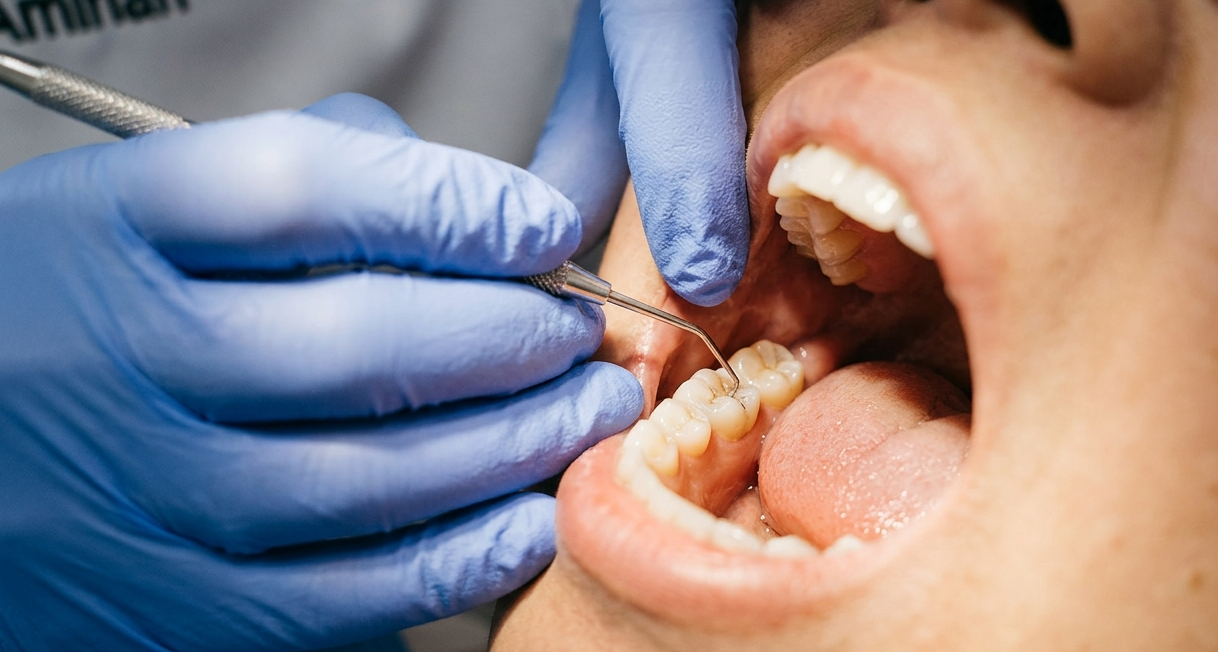
A patient visits the dentist complaining that a dental restoration has begun to crack and discolor. The dentist recommends not immediately removing the existing restoration, but instead adding new material over it, a procedure known as repair or composite restoration repair. But how strong is the bond between the old and new materials? This question prompted drg. Margareta Rinastiti, M.Kes., Sp.KG(K)., Ph.D., from the Department of Conservative Dentistry, Faculty of Dentistry, Universitas Gadjah Mada, together with her colleagues, to scientifically investigate the bond strength of repaired composite restorations. The findings were presented at an international conference in Bandung in November 2011.
Resin composite is one of the most commonly used dental restorative materials today, for both anterior and posterior teeth. However, like any other material, restorations can deteriorate over time. Their color may fade, their margins may wear away, and they may even crack or fracture. Rather than replacing the entire restoration, which would mean removing more of the original tooth structure, dentists can choose a more conservative approach by adding a new layer of composite over the existing one.
The problem is that composite material that has been present in the oral cavity for a long time has undergone aging due to continuous exposure to temperature changes, moisture, and chewing forces. Its old surface is no longer as fresh and reactive as it was when it was first placed. The bond between the old and new layers therefore becomes the most vulnerable point.
To address this issue, two surface-preparation methods are commonly used. The first is intermediate adhesive resin application (IAR), which involves simply applying a specialized adhesive. The second is silica-coating and silanization (SC), which involves coating the old surface with silica particles through sandblasting, followed by the application of a chemical coupling agent before the adhesive is applied. The question is: which method is more reliable, and what is the best way to measure it?
This study compared two commonly used methods for testing bond strength in dental laboratories. The first was the shear bond strength (SBS) test, which measures the strength of a bond against shear forces, or forces acting parallel to the bonded interface. The second was the microtensile bond strength (MTBS) test, which measures tensile strength at a very small bonded area (1 × 1 mm).
The research team used two types of composite materials: nanohybrid (Tetric EvoCeram) and nanofilled (Filtek Supreme XT). The specimens were then divided into two groups: those that did not undergo artificial aging and those that underwent thermocycling, a simulated aging process in which specimens are alternately immersed in water at 5°C and 55°C for 5,000 cycles, mimicking oral conditions over several years.
The results were quite surprising. The average shear bond strength ranged from only 7 to 28 MPa, whereas microtensile bond strength was considerably higher, ranging from 32 to 53 MPa. The difference was nearly threefold. So does this mean that the microtensile test is better? Not necessarily.
This is where the study offers a deeper perspective. The researchers did not only compare the mean bond-strength values but also analyzed the Weibull modulus, a statistical measure describing how consistent or reliable a bond is. A high Weibull value indicates that test results are uniform and reliable, whereas a low value indicates that the results are widely dispersed and difficult to predict.
Interestingly, the Weibull modulus values for both testing methods were similarly low. This means that although the average microtensile bond-strength values appeared more impressive, their reliability was not better than that of the shear test.
“Considering the high percentage of cohesive failures in the shear test and the low Weibull modulus values, this study indicates that the weakest link in the composite-to-composite bond is the composite material itself, rather than the adhesive interface.” — drg. Margareta Rinastiti, M.Kes., Sp.KG(K)., Ph.D., et al.
This finding is clinically important. Cohesive failure means that the composite material itself fractures rather than the adhesive portion. In other words, simply strengthening the adhesive may not provide much benefit if the restorative material itself represents the limiting factor in bond strength.
From a clinical perspective, teeth are subjected to more shear forces than tensile forces during chewing. This is why the study concluded that the shear test is more relevant for representing actual conditions in the oral cavity, despite its lower numerical values compared with the microtensile test.
Regarding surface-preparation methods, SC application generally produced slightly stronger bonds than IAR application, particularly in aged composite materials. However, when the Weibull values were taken into consideration, this advantage was not consistently observed under all conditions.
The most interesting finding for everyday clinical practice is that composite restoration repair can indeed be performed and preserves more tooth structure than replacing the entire restoration. However, dentists need to understand that the bond strength of a repaired restoration never reaches that of a new restoration placed on a fresh surface. Material aging is a real factor that cannot be overlooked.
This study also raises an unanswered question: if the composite material itself is the weak point, should innovation focus more on the formulation of composite materials rather than solely on bonding techniques? The answer may lie in the next generation of research.
Author: drg. Achmad Zam Zam Aghasy, M.Kes., Annisa Dwi Noviyanti
Photo: FreePik