
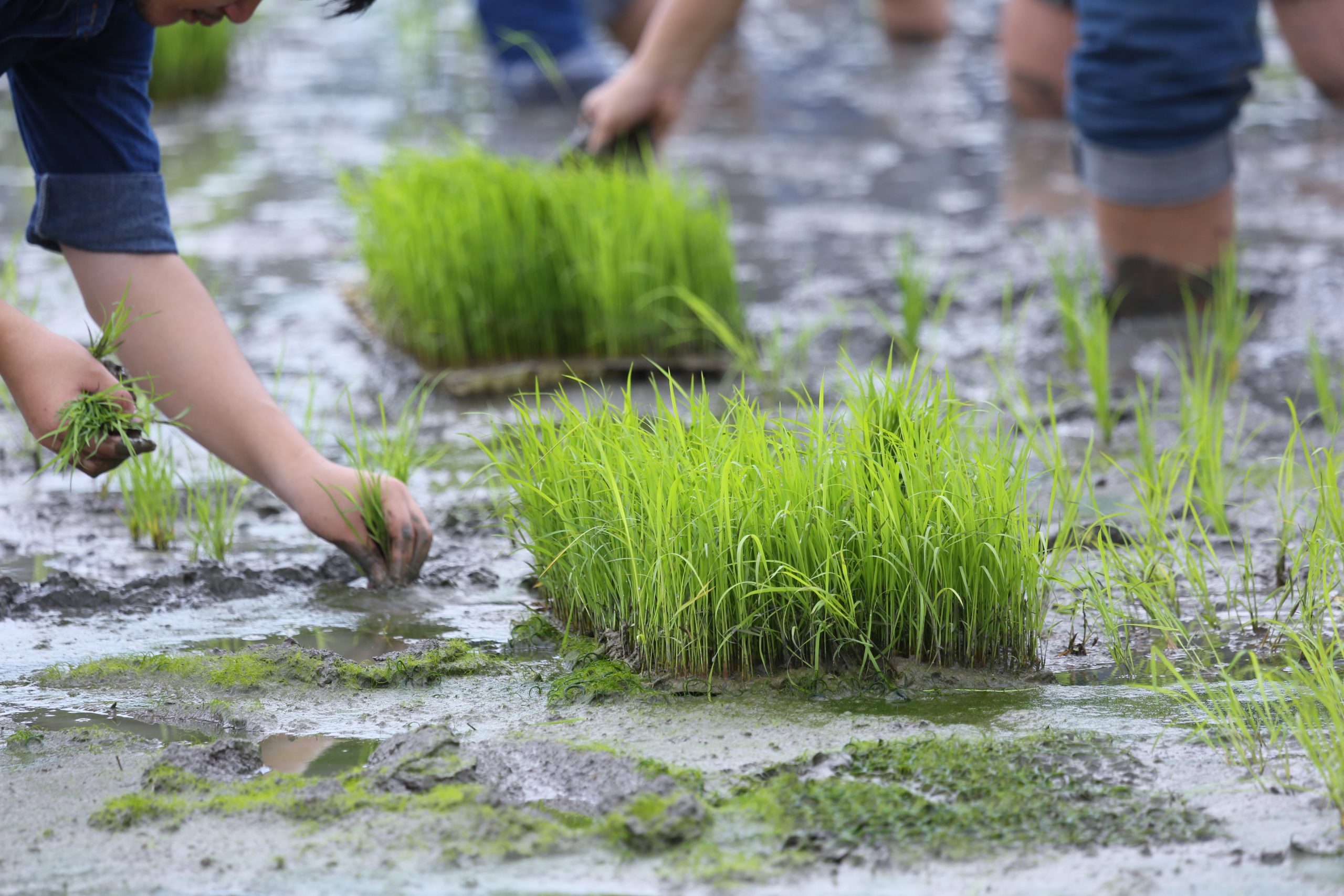
Imagine a lush green rice field bordering a busy highway, where a gentle breeze carries invisible vehicle emissions across the landscape. Beneath the surface of the irrigation water, something unseen is quietly at work—damaging cells one by one and gradually stripping rice leaves of the vibrant green color they need to thrive.
That unseen threat is lead (Pb), a heavy metal best known for its harmful effects on human health. However, a study conducted by Prof. drg. Supriatno, M.Kes., MDSc., PhD, together with Chairunnisa and Hafnati Rahmatan from Universitas Syiah Kuala, Banda Aceh, demonstrates that lead penetrates far deeper than previously understood. Their research revealed that lead directly alters both the anatomical structure and chlorophyll content of Inpari-32 rice, one of Indonesia's widely cultivated rice varieties.
What Happens When Rice Plants Absorb Lead?
The study was conducted between April and July 2018 in the laboratories of the Faculty of Mathematics and Natural Sciences and the Faculty of Teacher Training and Education at Universitas Syiah Kuala. Rice seedlings were grown hydroponically for 36 days under three experimental conditions: a control group without lead exposure, a group exposed to a 1,000 ppm lead solution from the beginning of germination, and a third group exposed to lead beginning on the tenth day after germination.
The results were striking. The control plants recorded a total chlorophyll concentration of 39.831 mg/L. When lead exposure began during germination, chlorophyll levels dropped dramatically to 16.294 mg/L. In plants exposed beginning on day 10, chlorophyll content declined even further to 10.815 mg/L. Analysis of variance (ANOVA) confirmed that these differences were highly significant, with the calculated F-value greatly exceeding the critical F-value (27,798,532.356 versus 3.40).
The implication is straightforward: the longer rice plants are exposed to lead, the more their green color fades, bringing them closer to chlorosis—a condition characterized by yellowing leaves and declining plant health.
Why Does the Green Color Disappear?
Behind these numbers lies a complex biochemical process. Lead acts as a highly effective molecular impostor. Once inside plant tissues, it displaces essential mineral elements—including iron (Fe), magnesium (Mg), and zinc (Zn)—from their critical roles in the chlorophyll biosynthetic pathway.
Magnesium serves as the central atom within the chlorophyll molecule, while iron functions as a cofactor for several key enzymes involved in chlorophyll synthesis. Zinc, meanwhile, is required for the enzyme δ-aminolevulinic acid dehydratase (ALAD), which catalyzes an essential step in the formation of the porphyrin ring—the structural backbone of chlorophyll. Lead replaces zinc at the enzyme's active site, rendering ALAD ineffective.
"Lead is more reactive than zinc, iron, and magnesium. These essential elements are readily displaced by lead. Consequently, even small amounts of lead can disrupt the entire chlorophyll biosynthesis pathway," the researchers explained.
As chlorophyll production declines, photosynthesis becomes impaired, gradually reducing the plant's ability to convert sunlight into the energy required for growth.
Damage Visible Under the Microscope
The effects of lead were not limited to biochemical changes. When researchers examined cross-sections of rice roots and leaves under a microscope at 400× magnification, clear structural abnormalities became apparent across the lead-treated groups.
In the roots, lead entered primarily through the apoplastic pathway, moving with water toward the endodermis. High concentrations of lead damaged the Casparian strip, the natural physical barrier that normally restricts the movement of heavy metals into the vascular tissues. Although the endodermal cells responded by thickening their cell walls as a protective adaptation, tissue damage still occurred. Researchers also observed irregular radial thickening of the cell walls—an anatomical abnormality indicating that the plants were actively responding to toxic stress.
Leaf tissues exhibited similar structural changes. The epidermal cells became smaller, while the diameters of both xylem and phloem vessels were reduced. Because the xylem and phloem serve as the plant's primary transport system—distributing water, minerals, and photosynthetic products throughout the organism—any narrowing of these vascular tissues compromises the plant's entire internal transport network.
From Rice Fields to the Dinner Table
The significance of these findings extends well beyond laboratory biology. Rice fields located alongside major highways—particularly busy transportation corridors such as the Banda Aceh–Medan Highway—face a tangible risk of heavy metal contamination. Previous studies cited by the authors reported the highest soil lead concentrations in rice fields located within 50 meters of major roads, reaching 0.059 ppm. As traffic volumes continue to increase, these concentrations may rise even further.
Lead-contaminated rice plants not only exhibit impaired growth; they also become a pathway through which heavy metals enter the human food chain. Lead accumulated within plant tissues—including rice grains—may ultimately reach consumers.
Published in the Proceedings of the International Graduate Conference (IGC) 2018, this study underscores the urgent need for continuous monitoring of agricultural land quality, particularly in urban and roadside farming areas. Rice is more than an agricultural commodity. It also serves as a silent indicator of environmental health, growing quietly amid the noise and pollution of expanding cities.
And when rice leaves begin to turn yellow without an obvious explanation, the problem may lie not only beneath the soil—but also in the air we all breathe.
DOI: https://doi.org/10.4108/eai.3-10-2018.2284289
Authors: Anny Anggraini; drg. Achmad Zam Zam Aghasy, M.Kes.
Photo: Freepik