
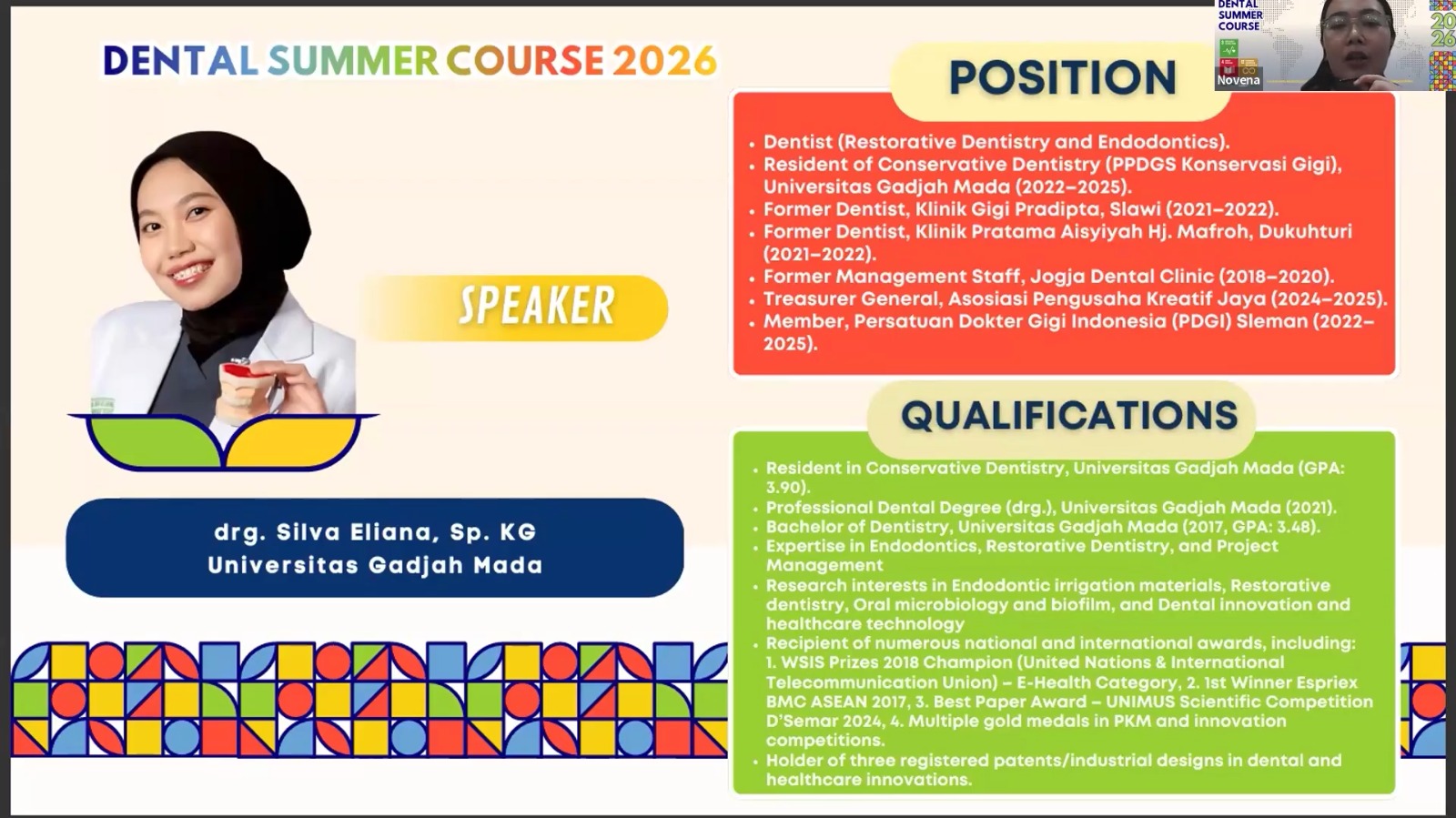
YOGYAKARTA (9/26) – The international dental community is currently undergoing a major paradigm shift, moving away from a traditional curative approach focused on the removal of hard dental tissue toward the philosophy of Minimal Intervention Dentistry (MID). This modern approach emphasizes early disease detection before cavitation occurs, comprehensive patient risk assessment, and preservation of natural tooth structure to support sustainable development goals.
In her presentation, drg. Silva Eliana Aspriyanti, Sp.K.G. shared a case study involving a 30-year-old patient who received a direct composite veneer restoration for a white spot lesion. Seven years later, the aesthetic restoration had completely failed due to discoloration, marginal leakage, gingivitis, and halitosis. The failure was attributed to the lack of a comprehensive diagnosis. The patient was found to have a history of bruxism caused by occupational stress, high caffeine and sugar consumption, and the effects of antihypertensive medication that reduced salivary flow. Reduced saliva eliminated the mouth's natural protective mechanisms and accelerated enamel demineralization.
“Every time a restoration is replaced, healthy tooth tissue is removed, enlarging the cavity and triggering the tooth death spiral. The primary goal is to preserve the natural tooth for life.” — drg. Silva Eliana Aspriyanti, Sp.K.G.
Five Key Pillars of Minimal Intervention Dentistry (MID)
1. Early Detection: Avoiding the use of sharp probes that can damage early carious lesions. Instead, the ICDAS visual system is used with objective illumination technologies, such as laser fluorescence or AI, to detect demineralization before cavitation occurs.
2. Caries Risk Assessment: Classifying patients according to their risk status—low, moderate, or high—using CAMBRA/ADA charts while considering dietary patterns, salivary flow, stress levels, and systemic disease history.
3. Prevention: Managing the oral microenvironment through professional topical high-concentration fluoride therapy, such as CleanPro, which penetrates rapidly within 15 minutes to halt the progression of demineralization.
4. Minimal Invasive Treatment: When an existing restoration fails, caries removal can be performed using polymer burs (smart prep burs) or chemomechanical agents such as Papacarie to remove only the infected dentin. Restoration is then performed using a universal adhesive containing the 10-MDP monomer to achieve stable chemical bonding.
5. Follow-Up: Because caries is a chronic biofilm-mediated infection, high-risk patients should undergo regular check-ups every 3–6 months to reassess their dynamic oral health risk status.
Reporter: Nanda, Andri
Photo: Zoom Meeting Screenshot