
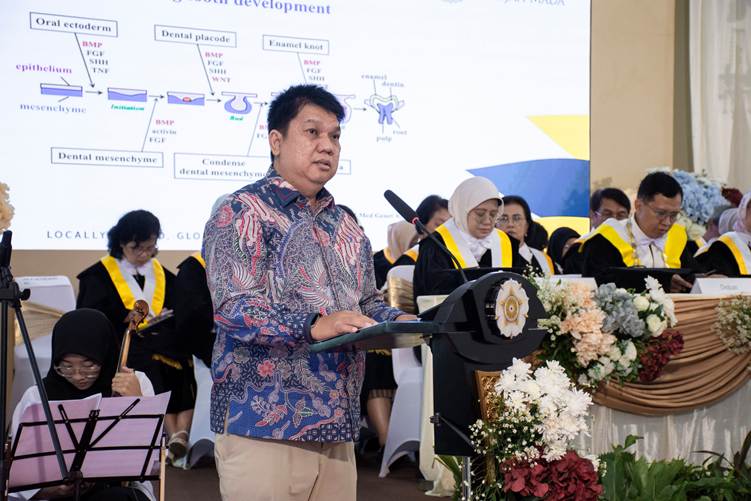
The 78th Anniversary of the Faculty of Dentistry, Universitas Gadjah Mada (FKG UGM) was not merely a ceremonial celebration. During the open senate meeting held on 5 March 2026, the scientific oration delivered by drg. Ivan Arie Wahyudi, M.Kes., Ph.D., emphasized a new direction in dentistry: a shift from conventional clinical practice toward approaches based on molecular biology and genetic engineering.
Carrying the theme “The Central Role of the SP6 Gene in the Regulation of Odontogenesis”, Ivan sharply examined how the process of tooth formation, which has long been understood structurally, is actually a complex orchestration controlled by highly precise genetic regulatory networks.
“Tooth development is not merely a structural biological process, but a precise molecular orchestration. The SP6 gene, or epiprofin, is one of the main conductors in this symphony,” said drg. Ivan in his oration.
The Complexity of Odontogenesis: More Than Just Tooth Growth
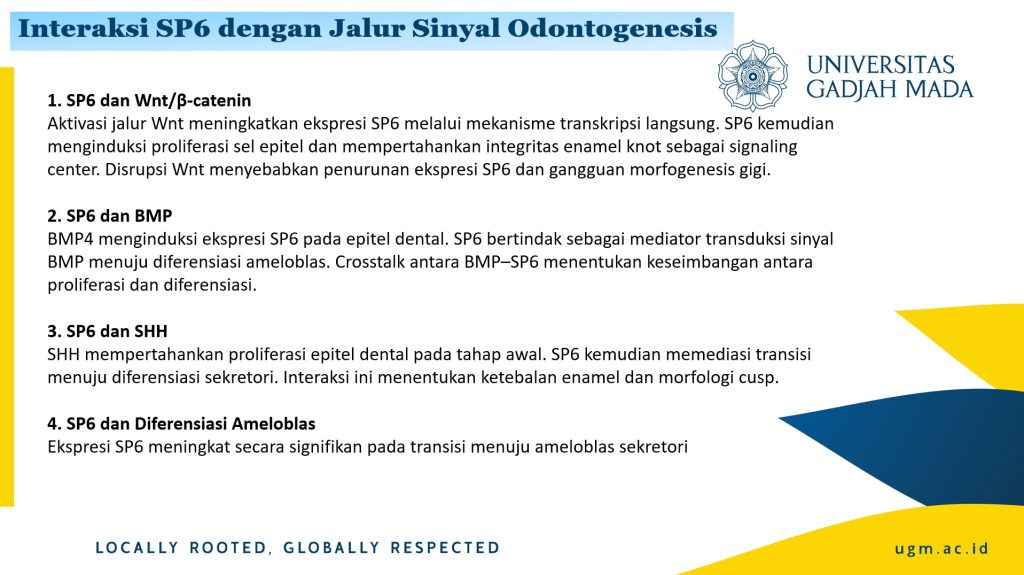
In his presentation, drg. Ivan explained that tooth formation (odontogenesis) begins in the sixth week of embryonic development and proceeds through five main stages: initiation, bud, cap, bell, and finally apposition and mineralization. Each phase is marked not only by morphological changes, but also by highly coordinated gene expression.
He further highlighted epithelial–mesenchymal interactions as the main foundation of this process. These interactions are mediated by several key signaling pathways such as Wnt/β-catenin, BMP (Bone Morphogenetic Protein), FGF (Fibroblast Growth Factor), Sonic Hedgehog (SHH), and Notch signaling.
However, according to drg. Ivan, the key to integrating all these pathways lies in the SP6 gene.
“SP6 functions as an important bridge between morphogenetic signaling and enamel structural gene activity. Without proper regulation, enamel formation and tooth morphology will be disrupted,” he explained.
SP6: The “Conductor” in the Molecular Symphony of Teeth
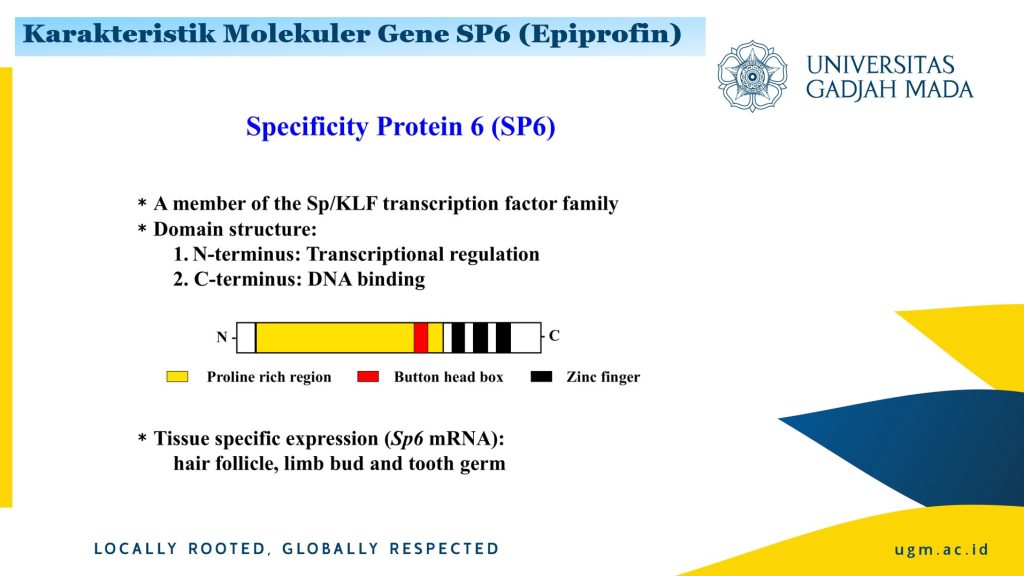
The SP6 gene, also known as epiprofin, is a transcription factor that plays a crucial role in dental epithelial cell proliferation, ameloblast differentiation, and enamel formation.
Scientific findings over the past decade have shown that abnormalities in this gene are directly associated with various dental disorders, ranging from hypodontia to amelogenesis imperfecta (a disorder affecting enamel formation).
In animal research models, SP6 deficiency has been proven to cause disorganization of enamel structure and failure of normal ameloblast formation.
“SP6 deficiency causes significant disruption in dental epithelial proliferation and crown morphogenesis,” Ivan explained, referring to recent molecular studies.
From Laboratory to Clinical Practice
What made this oration particularly remarkable was not only its theoretical depth, but also its boldness in drawing concrete clinical implications.
Ivan emphasized that understanding SP6 opens major opportunities in modern dentistry, including: Molecular diagnosis of enamel disorders, Development of genetic panels for amelogenesis imperfecta, CRISPR-Cas9-based gene therapy, and Enamel engineering using stem cells
“Mutations in SP6 have been identified as causes of enamel abnormalities in humans. This opens pathways for genetic-based diagnosis and precision therapy in the future,” he stressed.
In particular, gene-editing approaches such as CRISPR are considered to have the potential to revolutionize the treatment of congenital dental disorders, conditions that have traditionally been difficult to manage comprehensively using conventional methods.
Toward Precision Regenerative Dentistry
Ivan further positioned his findings within a broader context: the emergence of the era of precision regenerative dentistry. In this paradigm, dental treatment no longer merely repairs damage, but biologically regenerates tissue with precise genetic control.
He even mentioned the possibility of developing bioengineered teeth based on induced pluripotent stem cells (iPSC) and enamel organoid models as the future of odontogenesis research.
Nevertheless, Ivan acknowledged the many scientific challenges that still remain, ranging from the complexity of genetic networks and limitations in translating animal model findings to humans, to the long-term stability of gene expression.
From Local to Global
The oration also reflected FKG UGM’s position within the global landscape of dental science. By carrying the spirit of “locally rooted, globally respected”, molecular biology-based research such as Ivan’s is considered capable of positioning the institution within international scientific circles.
At the end of his oration, drg. Ivan emphasized the importance of interdisciplinary collaboration in accelerating this progress.
“The integration of molecular biology, tissue engineering, and biotechnology innovation will place dentistry in a new era — a regenerative era driven by precision,” he concluded.
The Transformation of Dental Science
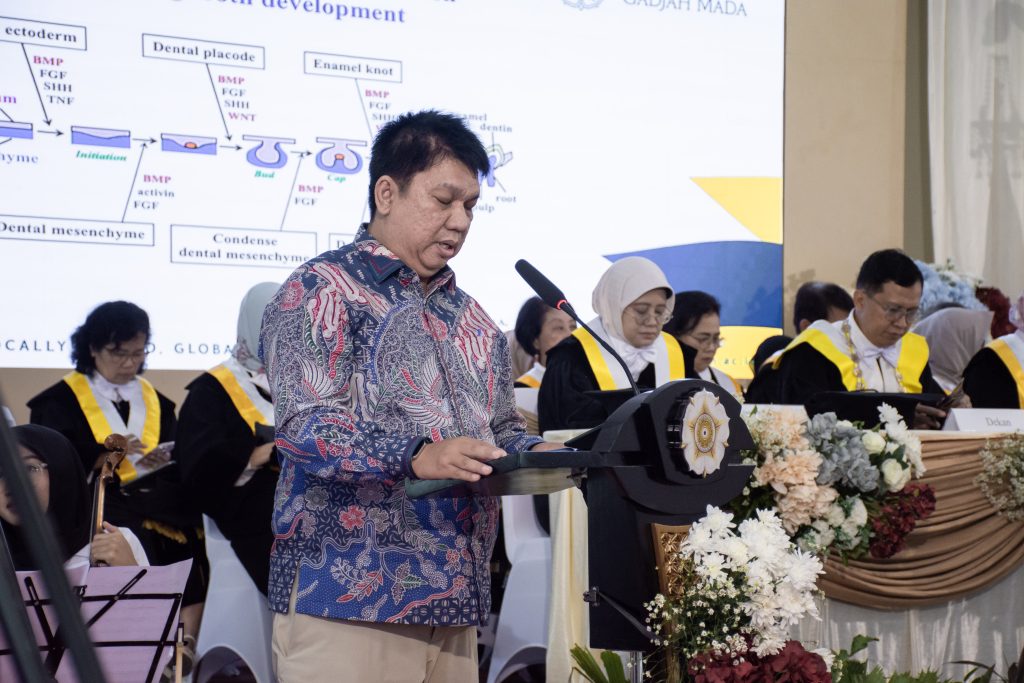
This scientific oration was not merely an academic presentation, but a strong signal that dentistry is undergoing a paradigmatic transformation. While the field once focused primarily on mechanical restoration, the future is shifting toward biologically based genetic reconstruction.
In the context of dentistry in Indonesia, this idea carries strategic implications: opening opportunities for translational research, strengthening independence in healthcare technology, and improving the quality of precision-based dental services.
The question now is no longer whether this technology is possible, but rather how quickly research ecosystems and clinicians can work together to implement it.
At this point, the role of higher education institutions such as FKG UGM extends beyond being centers of knowledge — they also become driving forces for change.
Reporter: Andri Wicaksono | Photographer: Fajar Budi Harsakti & screenshots from drg. Ivan’s presentation