
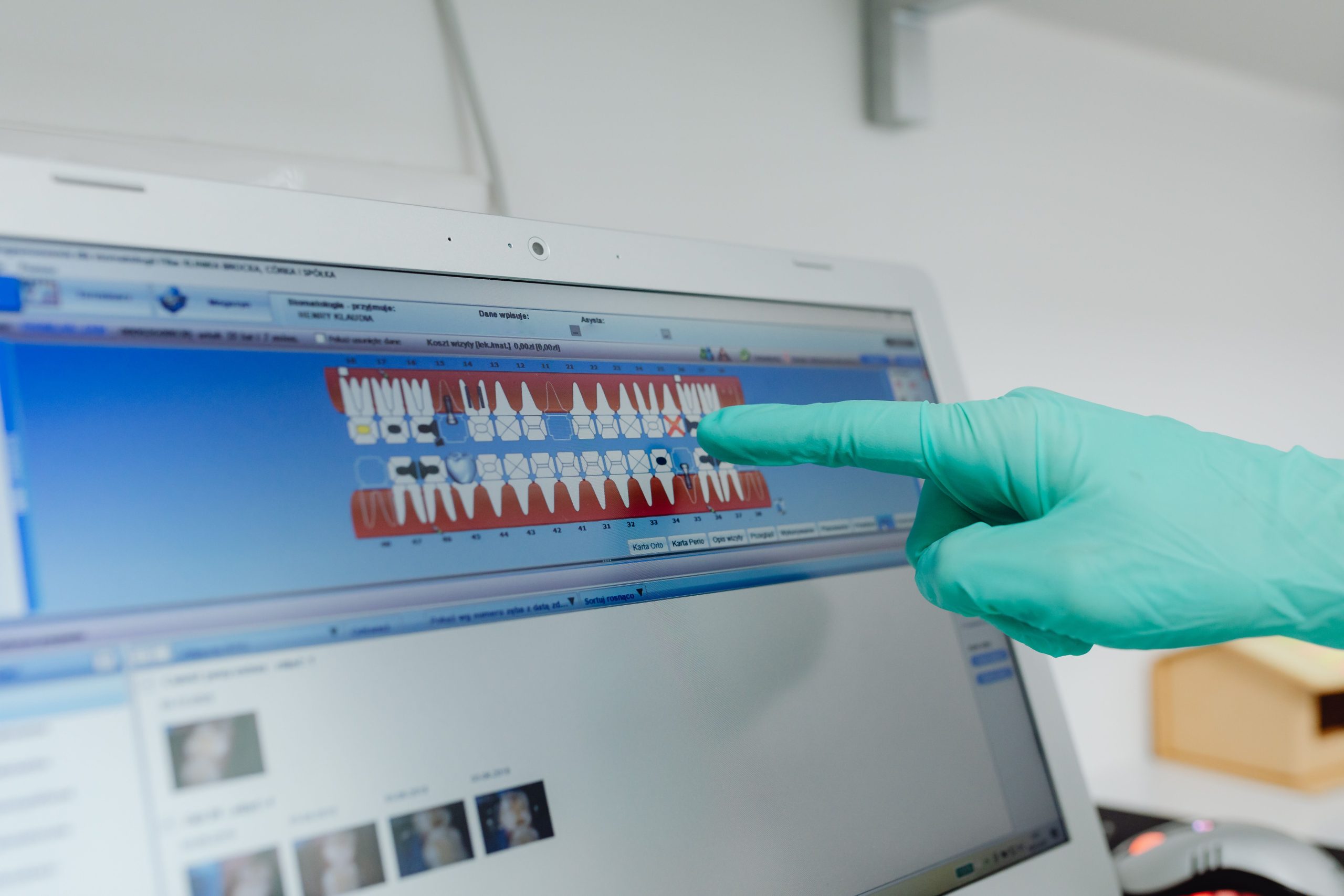
Imagine a dentist who never gets tired, never misjudges the location of dental caries, and can analyze thousands of radiographic images in a matter of seconds. Not a superhuman, but an algorithm. This is a scenario that is becoming increasingly plausible in modern dentistry, and a scientific article from Universitas Gadjah Mada (UGM) explores the extent to which artificial intelligence has permeated nearly every branch of dental specialization.
The paper, titled The Role of Artificial Intelligence in Many Dental Specialties, was written by Choirunisa Nur Humairo, Aquarina Hapsari, and Dr. drg. Indra Bramanti, M.Sc., Sp.KGA(K), from the Department of Pediatric Dentistry, Faculty of Dentistry, UGM, and was published in BIO Web of Conferences in 2021. Although concise, the paper provides a comprehensive overview of how artificial intelligence (AI) is transforming dentistry from root to crown.
An Artificial Brain That Learns to See Teeth
At the heart of this technology is the Artificial Neural Network (ANN), a mathematical model designed to mimic the way the human brain's neural networks function. When these network layers are arranged hierarchically, they form a deep learning system capable of recognizing patterns in images, sounds, and even text. Deep learning, yang mampu mengenali pola dalam gambar, suara, bahkan teks.
One of its derivatives, the Convolutional Neural Network (CNN), has become a mainstay in medical imaging. CNNs can detect anatomical structures, distinguish normal findings from pathological ones, and classify them. In dentistry, this means that CNNs can accurately identify the location of dental caries on radiographs while also improving the overall performance of radiological image interpretation.
A study by Lee et al. (2018), cited in this paper, evaluated the performance of CNNs using 3,000 periapical radiographic images covering premolars, molars, and both types of teeth. The results showed that caries detection accuracy exceeded 80% across all three categories. For an algorithm, this is a remarkable figure.
From Children to the Operating Room
The AI applications reviewed in this paper span nearly every dental specialty, with each field presenting its own unique challenges and opportunities.
In pediatric dentistry, the greatest challenge is not technical but behavioral. Children may be frightened, cry, refuse treatment, or become uncooperative. Here, AI offers an unexpected solution: 4D animation and virtual reality games as behavioral modification tools. CAD/CAM technology, traditionally associated with adult patients, is also beginning to attract attention for aesthetic treatments in children. AI-based pain-control devices are even being developed to make the dental-chair experience less frightening for young patients.
In restorative dentistry, AI serves as an tireless assistant. Dentists who work for long hours may overlook small carious lesions. AI software can highlight suspicious areas on bitewing radiographs, helping with early detection before the damage becomes more extensive.
In orthodontics, Expert Systems (ES) have been shown to recommend whether patients with malocclusion require tooth extraction, with accuracy of up to 80% in a study involving 200 adolescent subjects in Nanjing. Meanwhile, AI applications in prosthodontics assist dentists in digitally designing patients' smiles, reducing diagnostic time, and optimizing aesthetic considerations through 2D and 3D imaging.
Perhaps the most dramatic application of AI is in oral surgery. AI-assisted surgical robots have been successfully used for procedures in the head and neck region, including implant placement, tumor surgery, biopsies, and temporomandibular joint surgery. The advantages are clear: shorter operating times, more precise movements around delicate structures, and a reduced risk of revision procedures.
“The latest development of Artificial Intelligence is beneficial for dental practitioner in the near future. It is considered as a breakthrough of the 21st century to support the diagnostic procedure and decision making in clinical practice.” — Choirunisa Nur Humairo, Aquarina Hapsari, and Dr. drg. Indra Bramanti, M.Sc., Sp.KGA(K), Faculty of Dentistry, UGM
Smarter Clinics, Safer Education
Beyond clinical procedures, AI is also making its way into two areas that often receive less attention: clinical management and education.
In clinic management, AI can schedule patients, manage medical records, process insurance claims, and even assist with postoperative medication prescriptions. In dental emergencies, AI could potentially provide first-aid guidance before professional assistance arrives.
Meanwhile, dental students can now train using “virtual patients” that respond like real patients without exposing actual patients to the risks associated with mistakes. The integration of CBCT and MRI with AI also facilitates radiologists' interpretation of complex diagnostic images.
This is more than a matter of efficiency. It represents a paradigm shift—from education that depends on repeated procedures involving real patients toward a learning environment that is measurable and ethically safer.
Not a Replacement, but an Extension of Human Capability
The FKG UGM team does not claim that AI will replace dentists. Instead, the paper emphasizes AI's role as an assistive tool that expands human capabilities by addressing gaps caused by fatigue, time constraints, or limitations in visual perception.
The more relevant question is no longer, “Can AI be used in dentistry?” but rather, “How quickly are practitioners ready to adopt it?” In a not-too-distant future dental clinic, an algorithm may already be sitting beside the dentist, quietly reading radiographs, calculating risks, and preparing the best treatment options before the dentist even has a chance to lift their loupes.
Source DOI: https://doi.org/10.1051/bioconf/20214103005
Authors: Nanda Ayu, drg. Achmad Zam Zam Aghasy, M.Kes.
Photo: Pexels