

Indonesia produces a large number of high-quality research works, yet many of them end at publication and rarely progress to become products that can be utilized by the wider community. This situation is concerning, especially considering the substantial number of government-funded research projects each year. For example, in 2024, the Ministry of Education, Culture, Research, and Technology funded 11,980 research proposals and 2,651 community engagement proposals—a total of 14,631 proposals.
However, a high volume of research and publications does not necessarily translate into direct public benefit or tangible product outcomes, such as medical devices, pharmaceuticals, or innovative consumer products. Many studies remain confined to journals, academic reports, unpublished patents, or institutional archives.
This gap highlights the importance of downstreaming—a process of transforming research results into products that can be produced, marketed, and used by the public. Downstreaming ensures that research contributes meaningfully to society, rather than remaining solely theoretical or academic.
One example of this downstreaming effort is Propagel, developed by Prof. drg. Suryono, S.H., M.M., Ph.D., and his team through the PRIME SteP 2025 grant. Propagel is a gel formulated from propolis. In health sciences, propolis is known for its antibacterial, antifungal, and wound-healing properties. “This product is packaged in gel form so it is easy to use, both for the general public and dental practitioners,” explained Prof. Suryono (1/10).
While most similar products focus solely on wound healing, Propagel offers dual benefits. The propolis content serves as a natural antibacterial agent while also accelerating tissue regeneration. Thus, the gel not only helps heal wounds but also prevents infection simultaneously.
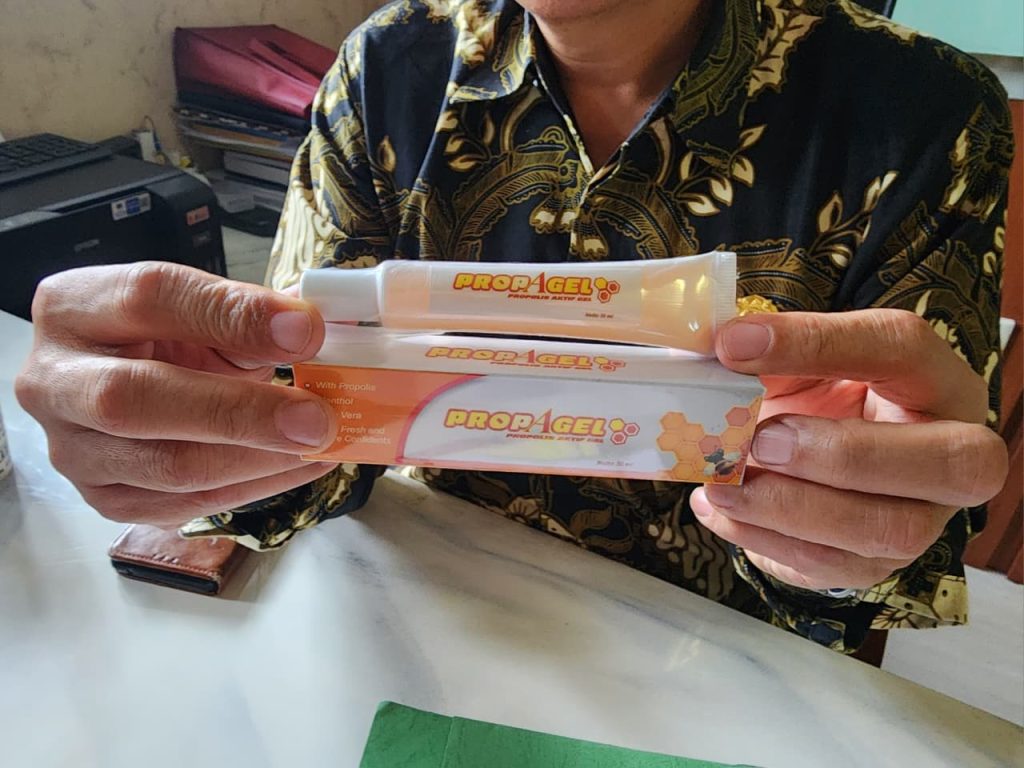
Propagel is designed for flexible use. For the general public, it can be applied to irritated or bleeding gum areas. For dental practitioners, Propagel can be applied post-scaling by inserting it into gingival pockets to promote healing and reduce inflammation.
For the initial stage, Prof. Suryono and his team have prepared 1,700 Propagel prototypes ready for market testing. The next challenge lies in determining effective marketing strategies to ensure the product reaches the broader community.
To address this, the team has partnered with the digital marketing company GeTI and Export Hub. Through this collaboration, Propagel will be introduced and tested through platforms such as TikTok, Instagram, and Facebook. According to Prof. Suryono, online online marketing allows quick analysis of market demographics and region-based demand. “Our target is not only domestic users but eventually entry into global markets,” he expressed.
Critical Reflection on the Research Ecosystem
Despite his optimism regarding Propagel, Prof. Suryono offered a candid critique of Indonesia’s research ecosystem. Many research projects fail to advance to downstream stages because industry partners are not involved from the beginning. Laboratory formulations often differ from those required for mass production, causing many projects to halt when reaching commercialization phases.
“If research is not collaborated with industry from the start, it will be very difficult for the product to enter the market,”he emphasized.
He also noted that academic performance evaluation still prioritizes international journal publications (Q1, Q2) over downstreaming outcomes. Meanwhile, producing publishable research often requires substantial funding—and the resulting data may later be commercialized abroad.
“You are the one who works hard, but others gain the greater benefit. Is that wise?” he remarked rhetorically.
For Prof. Suryono, publication is important for institutional reputation, but it should not be the ultimate goal. The primary objective is generating research that can truly benefit society. “Institutional reputation is important, but it is not the final goal. What matters most is how the university contributes to national self-reliance, including through research results,” he concluded.
Reporter: Andri Wicaksono, Author and Photo: Fajar Budi Harsakti

