
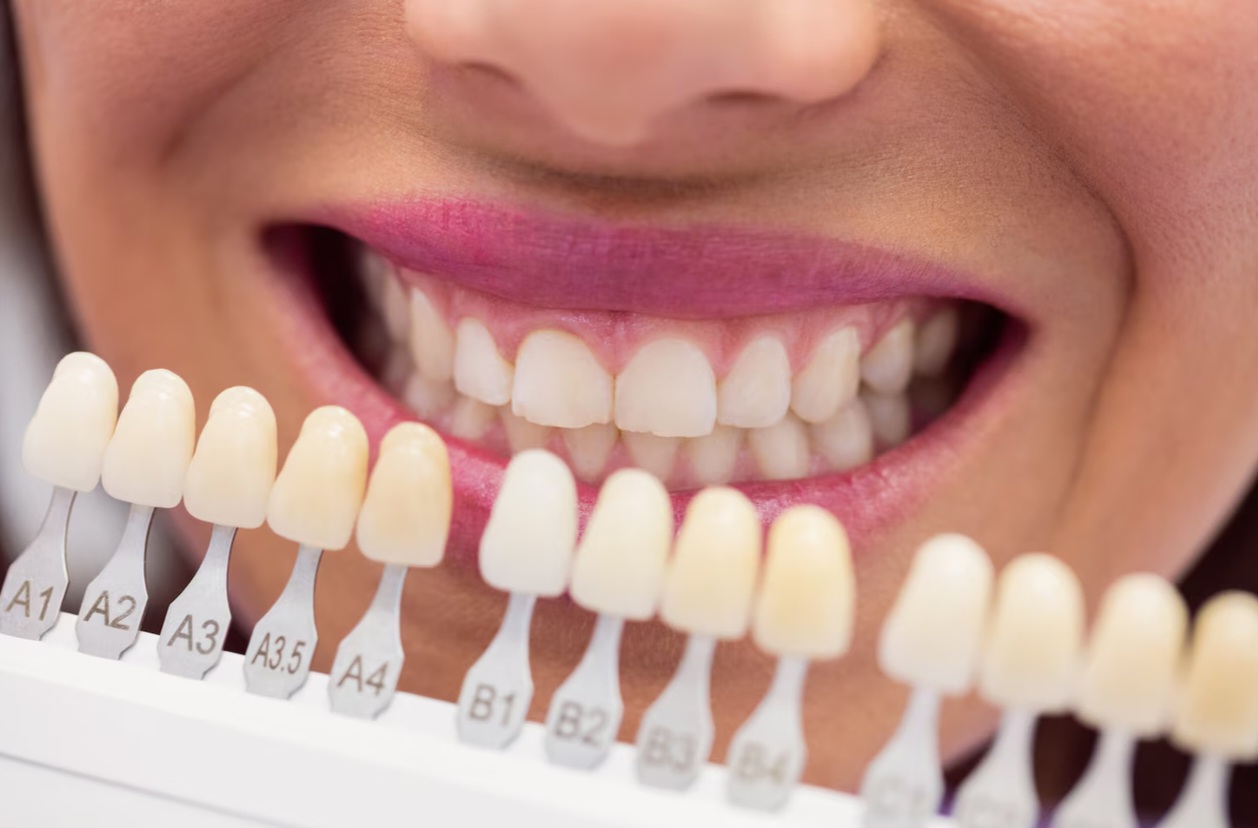
A bright white smile may be tempting, but there is a lesser-known cost behind tooth whitening procedures. After intracoronal bleaching with 35% hydrogen peroxide, dentists are advised not to immediately restore the tooth. Residual free radicals within the dentinal tubules remain active and can interfere with the polymerization of composite resin, potentially causing the restoration to fail before it can function properly.
Pertanyaannya bukan apakah penundaan itu perlu, melainkan apakah ada cara untuk mempersingkatnya.
Radikal Bebas yang Menjadi Penghalang
Hidrogen peroksida bekerja dengan melepaskan radikal bebas perhydroxyl dan oksigen nasent. Radikal-radikal ini memecah ikatan rangkap molekul kromogenik di enamel dan dentin, mencerahkan warna gigi. Masalah muncul ketika radikal bebas tersebut tidak habis terpakai: sisanya bersembunyi di antara matriks kolagen dan ruang interprismatik enamel, bertahan satu hingga tiga minggu.
Ketika resin komposit ditempelkan di atas permukaan dentin yang masih mengandung residu radikal bebas, hasilnya bisa ditebak. Radikal bebas bereaksi dengan monomer resin, menghentikan rantai polimerisasi lebih awal dari seharusnya. Polimer yang terbentuk pun lemah secara mekanis, daya rekatnya rendah, dan celah mikro (microleakage) pun terbuka. Ujung-ujungnya, kegagalan restorasi saluran akar menjadi ancaman nyata.
Solusi yang ditawarkan selama ini adalah menunggu. Namun bagi pasien, satu hingga dua minggu tanpa restorasi definitif bukan hanya merepotkan, melainkan juga meningkatkan risiko kontaminasi bakteri.
Antioksidan sebagai Jalan Pintas
Dr. drg. Tunjung Nugraheni, M.Kes., Sp.KG.(K) bersama tim peneliti dari Fakultas Kedokteran Gigi Universitas Gadjah Mada mencoba menjawab pertanyaan itu lewat pendekatan yang lebih aktif: menggunakan sodium askorbat sebagai agen antioksidan untuk menangkap sisa radikal bebas sebelum restorasi dilakukan.
Sodium ascorbate is the sodium salt of L-ascorbic acid. It is water-soluble, non-toxic, and has a pH of 6.5–8, making it relatively compatible with dental tissues. Chemically, it donates an electron to react with free radicals, converting them into more stable forms, namely water and dehydroascorbic acid.
The focus of this study was not simply whether sodium ascorbate was effective, but how many applications were needed to achieve optimal results. Previous studies generally used a 10% concentration, but this proved insufficient to neutralize the residual effects of 35% hydrogen peroxide, which produces substantially greater amounts of free radicals.
Dua Kali Lebih Baik dari Satu
Tim peneliti membagi 36 sampel dentin dari sembilan gigi premolar menjadi empat kelompok perlakuan. Semua sampel terlebih dahulu diblocking dengan hidrogen peroksida 35%, kemudian diperlakukan berbeda: kelompok A (kontrol) direndam dalam saliva buatan selama tujuh hari; kelompok B menerima satu kali aplikasi sodium askorbat 35%; kelompok C dua kali aplikasi; dan kelompok D tiga kali aplikasi. Seluruh sampel kemudian direstorasi dengan resin komposit dan diuji kekuatan geser (shear bond strength) menggunakan alat universal testing instrument Zwick.
The results were clear. Group C, which received two applications, recorded the highest mean shear bond strength at 13.40 ± 1.54 N/mm², followed by Group D at 13.34 ± 3.05 N/mm². Group B, which received only one application, produced the lowest value at 9.11 ± 2.14 N/mm², even lower than the control group that had been allowed to rest for seven days (10.68 ± 2.63 N/mm²).
“Aplikasi sodium askorbat 35% lebih dari satu kali terbukti meningkatkan kekuatan geser resin komposit pada dentin yang diblaching dengan H₂O₂ 35%, sehingga penundaan satu minggu sebelum restorasi tidak lagi diperlukan.” — Dr. drg. Tunjung Nugraheni, M.Kes., Sp.KG.(K), Dental Journal (Majalah Kedokteran Gigi), 2017
One-way ANOVA confirmed a statistically significant difference among the groups (p < 0.05). Further LSD testing revealed no significant difference between Groups C and D, meaning that increasing the number of applications from two to three provided no meaningful additional benefit. Two applications were sufficient.
Implikasi untuk Kursi Perawatan
The finding has direct practical implications for clinical dentistry. A single application of sodium ascorbate, it appears, is not sufficient to neutralize all the residual free radicals left behind by high-concentration hydrogen peroxide. In fact, this may be worse than simply waiting, because oxidized sodium ascorbate can rapidly lose its antioxidant capacity while residual free radicals continue to interfere with polymerization.
Dua kali aplikasi, masing-masing selama lima menit, tampaknya menjadi titik keseimbangan: cukup untuk menetralkan residu radikal bebas, cukup untuk memulihkan kualitas lapisan hibrid dentin, dan cukup untuk memungkinkan restorasi komposit yang kuat terbentuk tanpa harus menunggu berminggu-minggu.
The study also emphasized that sodium ascorbate in gel form is easier to control in clinical applications than a solution because its higher viscosity allows longer and more precise contact with the dentin surface.
Bagi jutaan pasien yang menjalani prosedur bleaching intrakoral setiap tahunnya, dua kali olesan antioksidan bisa menjadi perbedaan antara menunggu dan langsung selesai. Pertanyaannya kini berpindah ke praktisi: sudahkah protokol ini masuk ke dalam standar perawatan sehari-hari?
Referensi:
Nugraheni, T., Nuryono, N., Sunarintyas, S. and Mulyawati, E. (2017) ‘Composite resin shear bond strength on bleached dentin increased by 35% sodium ascorbate application’, Dental Journal (Majalah Kedokteran Gigi), 50(4), pp. 178–182. Available at: https://doi.org/10.20473/j.djmkg.v50.i4.p178-182
Penulis: drg. Achmad Zam Zam Aghasy, M.Kes, Annisa Dwi Noviyanti | Foto: Freepik