
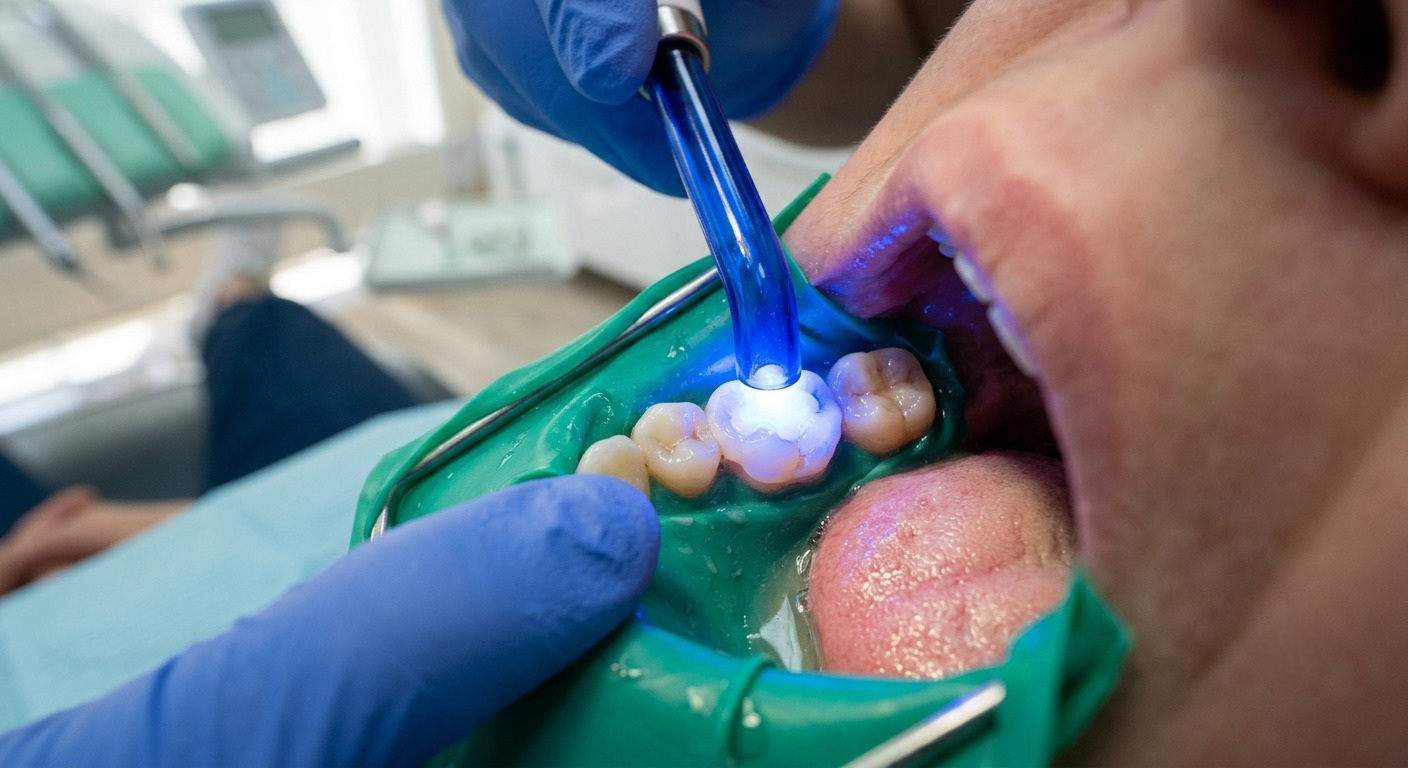
Researchers from the Faculty of Dentistry, Universitas Gadjah Mada, have demonstrated that the way dentists apply LED light to filling materials can determine how tightly the restoration bonds to the tooth. This finding emerged from a laboratory experiment published in the Jurnal Kedokteran Gigi (J Ked Gi, Vol. 7, No. 2, April 2016), involving 27 human premolar teeth. The study, conducted by Fitria Ayuningtyas Simamora under the supervision of two faculty members from the Department of Conservative Dentistry, FKG UGM—drg. Tunjung Nugraheni and Dr. drg. Yulita Kristanti, M.Kes., Sp.KG(K)—found that an intermittent light-curing technique known as the pulsed-delay technique produced the lowest level of microleakage compared with two other techniques.
Composite resin is currently one of the most widely used dental filling materials, primarily because its color closely resembles that of natural teeth. However, the material has a hidden drawback: when cured with light, it undergoes shrinkage. This shrinkage can create tiny gaps between the restoration and the cavity walls—gaps that are invisible to the naked eye but large enough for bacteria and oral fluids to penetrate. This condition, known as microleakage, is one of the main causes of long-term restoration failure.
Low-viscosity bulk-fill composite resin was developed to address this problem. Unlike conventional composite resin, which must be applied layer by layer, bulk-fill resin can be placed throughout the entire cavity in a single step. The product used in this study was Smart Dentin Replacement (SDR) from Dentsply, which is formulated with a polymerization modulator designed to reduce shrinkage. The remaining question was whether the curing technique would also make a difference.
The research team divided the 27 teeth into three groups, each restored with SDR and cured using a different light-curing technique. The first group received the conventional technique, in which the material was directly exposed to full-intensity light at 850 mW/cm² for 20 seconds without interruption. The second group used the ramped technique, in which the light intensity was gradually increased from 200 mW/cm² for the first 5 seconds before reaching the full intensity of 850 mW/cm² for the following 15 seconds. The third group used the pulsed-delay technique: curing was performed in 25 cycles, each lasting 0.8 seconds and consisting of 0.6 seconds of light followed by 0.2 seconds without light. The total energy delivered was therefore only 12.75 J/cm², lower than the 17 J/cm² delivered by each of the other two techniques.
After restoration, all teeth were immersed in a 2% methylene blue solution for 24 hours. They were then sectioned vertically from the buccal to the palatal direction and examined under a stereomicroscope at 50× magnification. The extent to which the blue dye penetrated the gap between the restoration and the cavity wall served as a direct measure of microleakage.
The results were clear. Statistical analysis using one-way ANOVA and the LSD test at a 95% confidence level showed that the pulsed-delay technique produced the lowest microleakage, with statistically significant differences compared with both the ramped technique (p<0.05) and the conventional technique (p0.05).
Why is that 0.2-second pause so important? The answer lies in how the material behaves before it fully hardens. When composite resin is first exposed to light, it enters a phase known as the pre-gel phase, during which the material remains sufficiently soft and capable of flowing to fill gaps. The longer this phase lasts, the better the material can adapt to the cavity walls before finally hardening.
The pulsed-delay technique extends the pre-gel phase precisely because of the pauses between light exposures. While the light is off, the polymerization reaction slows down, giving the resin molecules more time to move into empty spaces and release internal stresses. As a result, when the material eventually hardens, the stress stored within the restoration is lower, marginal adaptation is improved, and microleakage is reduced.
The ramped technique may seem promising in principle because it begins with a lower light intensity. However, because it does not include an actual interruption and delivers the same total energy as the conventional technique (17 J/cm²), its effect on microleakage was not significantly different.
“The pulsed-delay curing technique can be used to activate composite resin intended as a dentin replacement layer because it produces the lowest level of microleakage compared with the ramped and conventional curing techniques.”
These findings have direct practical implications. In clinical practice, dentists have full control over how they activate restorative materials. If the available light-curing unit supports a pulsed-delay mode, choosing this technique could be a simple yet meaningful step toward extending the lifespan of restorations and preventing secondary caries beneath existing fillings. The researchers also opened the door to further studies, including assessments of restoration microhardness and quantitative evaluation of marginal adaptation using different methods, to provide a more comprehensive understanding of the relationship between curing techniques and the quality of composite resin restorations.
Author: drg. Achmad Zam Zam Aghasy, M.Kes., Annisa Dwi Noviyanti
Photo: FreePik