
The general public has traditionally understood the dental profession largely in terms of drilling and filling patients' teeth. Yet behind the sterile walls of dental clinics lies a substantial ecological footprint. From high levels of water and electricity consumption to mountains of single-use plastic waste, dental practice has significant environmental impacts. Recognizing this reality, a transformative approach has emerged to redesign the environmental impact of dental practice through a radical transition toward a circular economy, or circular care.
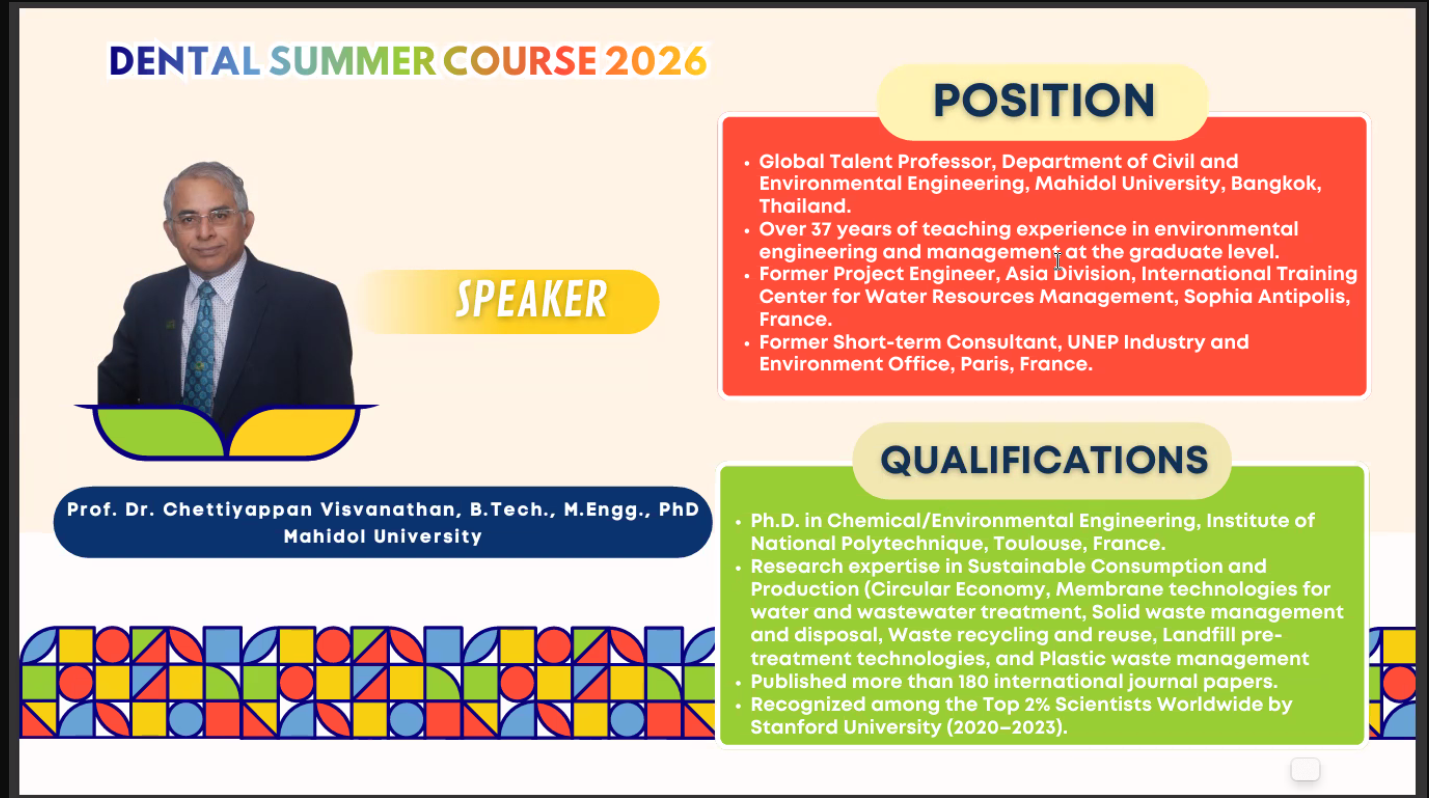
This urgency became a central topic in a public lecture held as part of the pre-event series of the International Kintar Summer Parcs 2026. Interestingly, this analytical presentation was not delivered by a dentist but by a leading environmental engineering expert, Prof. Dr. Chettiyappan Visvanathan, B.Tech., M.Engg., PhD. Listed among the world's top 2% of scientists according to Stanford University, he challenged the traditional paradigm of dental practitioners through a presentation entitled “From Grass to Circular Care: Redesigning the Environmental Impact of Dental Practice Drill, Fill, and Sustain.”
Waste Myths vs. Carbon Emissions
At the beginning of the session, an interactive survey using Mentimeter showed that most participants, consisting of dental students and academics, assumed that medical waste generation and plastic disposal were the most critical environmental impacts of their clinics. However, Prof. Dr. Chettiyappan Visvanathan, B.Tech., M.Engg., PhD, challenged this misconception by presenting surprising analytical data.
“Effective sustainability strategies in dentistry must not focus solely on waste management,” emphasized Prof. Dr. Chettiyappan Visvanathan, B.Tech., M.Engg., PhD. Based on a case study of dental practice at Mahidol University, Thailand, the primary contributors to the carbon footprint of the dental faculty and clinics actually came from two non-medical sectors: operational electricity consumption and transportation.
Intensive instrument sterilization, diagnostic imaging, and air-conditioning systems consume substantial amounts of electricity. Furthermore, analytical data from the clinical case study showed that the mobility and travel of patients and staff to and from the clinic were actually among the dominant contributors to greenhouse gas emissions.
Concrete Steps and the Single-Use Plastic Dilemma
Although carbon emissions are a major priority, Prof. Dr. Chettiyappan Visvanathan, B.Tech., M.Engg., PhD, emphasized that daily resource consumption in dental clinics also requires serious attention. A single routine patient examination procedure generally consumes approximately 320 grams of single-use plastic, such as masks and latex gloves, as well as around 20 liters of clean water.
To reduce these impacts, several research-based solutions are beginning to be implemented across Southeast Asia:
- GIS-Based Route Optimization: Inspired by a case study in Myanmar, the transportation of medical waste from more than a dozen dental clinics is now being organized using Geographic Information System (GIS)-based route optimization to minimize fuel emissions from waste-collection vehicles.
- Strict Source-Level Waste Segregation: Nurses and dental students are educated from their first year about the importance of waste segregation. Globally, approximately 80% of waste generated in healthcare facilities is actually general, non-medical waste that could be recycled if it were not contaminated through mixing.
- Energy Efficiency: Optimizing clinic ventilation systems and beginning to explore the transition toward renewable energy sources within clinical facilities.
Through the circular dentistry approach, future dentists are encouraged to rethink every aspect of their operations. Prof. Dr. Chettiyappan Visvanathan, B.Tech., M.Engg., PhD, emphasized that dentists' responsibilities may indeed include drilling and filling, but the shared responsibility across disciplines is to ensure that the entire chain of care is sustainable for the sake of the planet.
Reporter ( Nanda , Andri )
Photo: Zoom Meeting Screenshot