
2025 Dentomaxillofacial Radiology Training Based on Cone Beam Computed Tomography (CBCT)
Yogyakarta — The Interdisciplinary Dentistry Skills Development Center (iDSDC), Faculty of Dentistry, Universitas Gadjah Mada (FKG UGM), once again the Advanced Imaging in Dentomaxillofacial Radiology Course, featuring expert speaker Prof. Dr. drg. Ahmad Syaify, Sp.Perio, Subsp RPID(K), FISID. In his session entitled “Periodontal Considerations for Successful Dental Implants,” Prof. Syaify emphasised the importance of integrating biological, functional, and aesthetic aspects as the foundation for long-term implant success.
Criteria for Dental Implant Success
Prof. Syaify explained that implant success is not solely determined by the survival of the implant in bone, but also by the stability and health of the peri-implant tissues. The key criteria include:
- The implant is stable with no mobility.
- No radiolucency is present in the peri-implant area.
- Average bone loss is less than 0.2 mm per year after the first year of function.
- No pain, discomfort, or infection.
- The design supports proper crown placement and aesthetics.
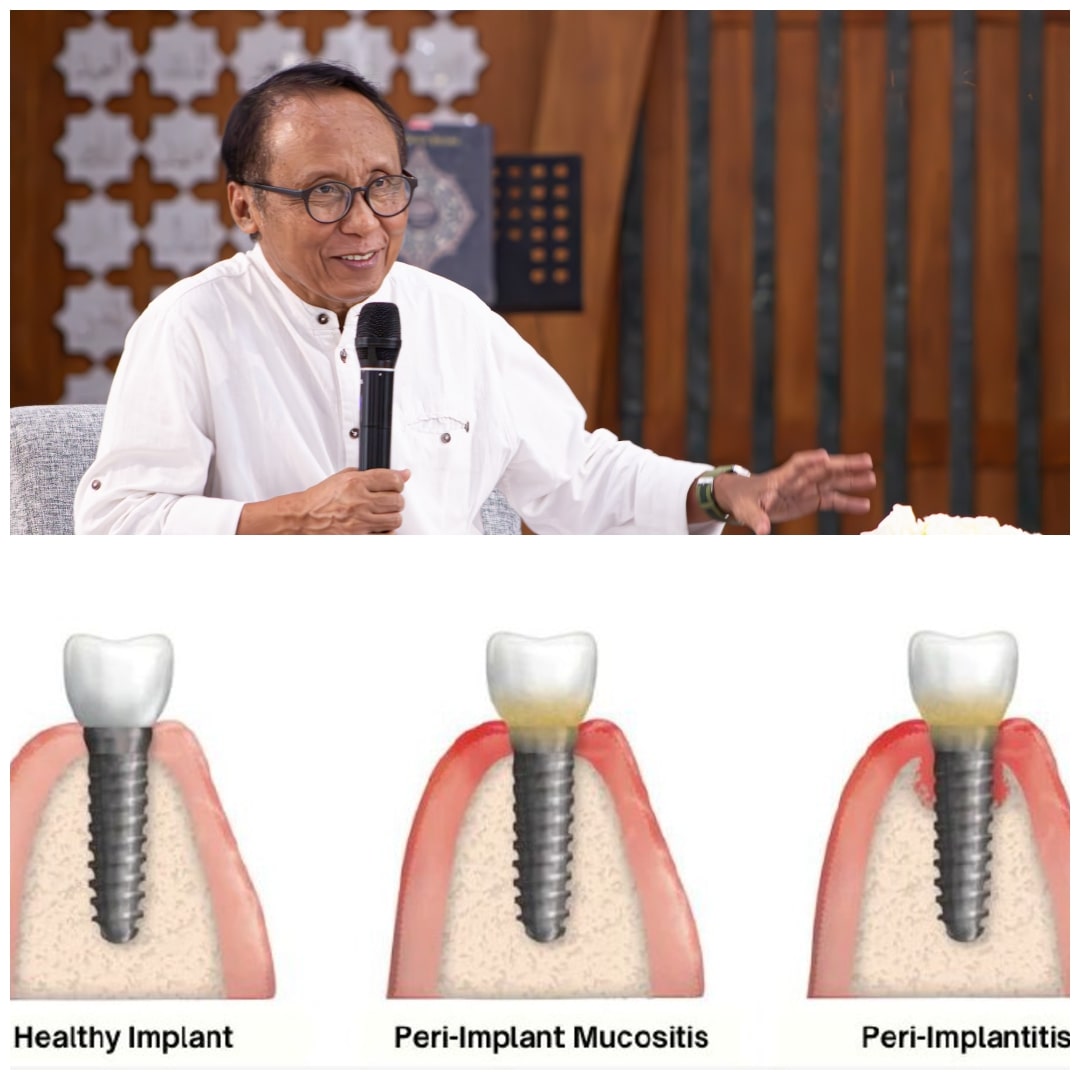
- No occurrence of peri-implantitis or peri-implant mucositis.
Adequate attached gingiva and the absence of signs of infection were highlighted as important indicators of biological success.
Primary and Secondary Stability
Prof. Syaify underlined that achieving osseointegration as the ultimate goal is strongly influenced by two phases of implant stability:
- Primary stability, referring to initial mechanical fixation without mobility at placement.
- Secondary stability, which depends on blood supply from trabecular bone and load distribution to cortical bone.
Both forms of stability are fundamental to long-term implant function.
Determinants of Implant Success
Several clinical factors affecting implant prognosis were discussed, including:
1. Bone Quality
Implants placed in type 1–3 bone generally show better outcomes than those in type 4 bone, which has lower primary stability.
Prof. Syaify highlighted the “1–2–3–7” principle as a guideline for implant placement:
1 mm buccolingual space, 2 mm distance from adjacent teeth or vital structures, 3 mm distance between implants, and 7 mm distance to the opposing tooth
2. Bone-Implant Contact and Implant Surface
Roughened titanium surfaces are known to increase bone contact and support osseointegration. Techniques such as aluminium oxide blasting have been reported to significantly improve bone attachment quality.
3. Transmucosal Attachment and Biological Width
Unlike natural teeth, peri-implant tissues have fewer fibre types and more limited vascularisation, making them more susceptible to inflammation. Repeated removal and reattachment of the abutment may trigger biological width adaptation and lead to bone resorption.
4. Microgap Between Implant and Abutment
Microgaps in two-piece implants can serve as sites for bacterial accumulation, trigger inflammatory reactions, and contribute to crestal bone loss, even when the gap is extremely small (<10 microns).
The Role of Radiography in Implant Planning and Evaluation
Prof. Syaify stressed that radiography is an integral component throughout all stages of implant treatment, from planning to maintenance. Radiographic examinations are used to:
- Assess the quality and quantity of alveolar bone.
- Identify vital anatomical structures such as the maxillary sinus and inferior alveolar nerve.
- Detect potential pathologies affecting implant prognosis.
- Monitor osseointegration and detect complications.
- Determine accurate implant size and position.
He also explained the radiographic evaluation workflow, including the identification of residual cement, marginal bone defects, retrograde peri-implantitis, and detection of bone particles trapped in peri-implant soft tissues.
iDSDC FKG UGM’s Commitment to Strengthening Clinical Competence
Through this scientific session, iDSDC FKG UGM reaffirmed its commitment to enhancing the competence of dental professionals through continuous, technology-based, and evidence-driven education. The insights shared by Prof. Syaify are expected to strengthen participants’ understanding of the importance of periodontal considerations and radiographic planning in achieving long-term dental implant success.
(Andri Wicaksono)