
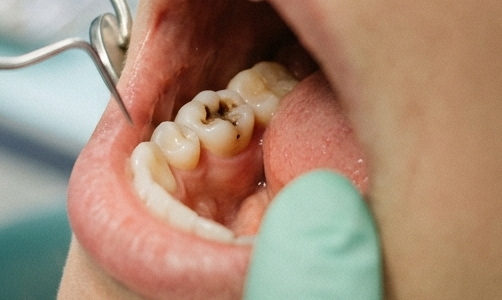
Researchers from the Faculty of Dentistry, Universitas Gadjah Mada, published an interesting finding in the December 2025 issue of Jurnal Teknosains: when a decayed tooth is restored with chitosan-enriched composite resin, the size of the cavity turns out to have a much greater influence on the structural strength of the tooth than the concentration of the antibacterial agent added to the material. The study was conducted by drg. Andina Widyastuti, Sp.KG(K), together with a research team from the Department of Conservative Dentistry, Faculty of Dentistry, UGM. The researchers used a three-dimensional computer simulation method known as Finite Element Analysis (FEA) to answer a question that is difficult to investigate directly in patients: how is stress distributed within a restored tooth?
Dental caries remains one of the most common diseases worldwide. More than two billion people live with untreated caries in their permanent teeth. In Indonesia and globally, composite resin restorations are a primary treatment option because their color closely resembles natural teeth and they require minimal removal of healthy tooth structure.
However, one problem continues to arise: composite resin restorations do not have antibacterial properties. Bacteria can still adhere to and proliferate around the margins of restorations, triggering secondary caries, in which new decay develops around an existing filling. The incidence of secondary caries in composite restorations is even twice as high as that observed with amalgam restorations among patients at high risk of caries.
Chitosan, a natural compound derived from chitin and commonly found in shrimp and crab shells, has long been investigated as a potential antibacterial agent that can be incorporated into composite resin. Its non-toxic, biocompatible, and biodegradable properties make it particularly attractive.
The research team used extracted human mandibular first molars that were caries-free, free of cracks, and had complete root formation. The teeth were scanned using a micro-CT scanner to generate anatomically accurate three-dimensional models. The digital models were then reconstructed and redesigned using SolidWorks and ANSYS to simulate two types of cavities: conservative cavities (small cavities, 2 mm in diameter and 2 mm deep) and extensive cavities (large cavities, 4 mm in diameter and 3 mm deep).
For each cavity type, simulations were conducted using four different concentrations of chitosan in the composite resin: 0%, 0.5%, 1.0%, and 2.0%. The teeth were then subjected to an occlusal load, or biting force, of 565 Newtons, corresponding to the average biting force of a molar. A total of 48 simulations were performed, with each group repeated three times.
“FEA demonstrated a clear influence of cavity geometry on biomechanics: in extensive cavities, the restorative material provided superior structural reinforcement, resulting in a composite unit with greater stiffness, high stress, low strain, and limited cusp deformation.” — drg. Andina Widyastuti, Sp.KG(K), lead researcher Statistical analysis showed significant differences between treatment groups in both stress and strain distribution. However, closer examination revealed that the dominant factor was not the concentration of chitosan, but the size of the cavity. In extensive cavities, the composite resin filled a much larger volume. The restorative material therefore became the primary structural component responsible for bearing and distributing the load. The result was high stress, low strain, and minimal cusp deformation. In other words, teeth with large cavities actually became stiffer after restoration because the composite took over the structural function of the lost tooth tissue.
Hasil statistik menunjukkan perbedaan yang signifikan antar kelompok perlakuan, baik pada distribusi tegangan (stress) maupun regangan (strain). Namun saat ditelusuri lebih dalam, faktor yang paling dominan bukanlah konsentrasi kitosan, melainkan ukuran kavitas. Pada kavitas ekstensif (lubang besar), resin komposit mengisi volume yang jauh lebih besar. Material tambalan menjadi komponen struktural utama yang menanggung dan menyebarkan beban. Hasilnya: tegangan tinggi, regangan rendah, dan deformasi cusp yang minimal. Artinya, gigi yang berlubang besar justru menjadi lebih kaku setelah ditambal karena komposit mengambil alih fungsi struktural jaringan gigi yang hilang.
By contrast, in conservative cavities, most of the original tooth structure remained intact. The composite filled only a small space, allowing the tooth-restoration system to behave more flexibly, with lower stress and higher strain. This does not necessarily indicate a poor condition; rather, it shows that restorations in small cavities move more freely when subjected to load.
Interestingly, in extensive cavities, changes in chitosan concentration produced no statistically significant differences in stress distribution. The strong influence of cavity size effectively “overpowered” any effect that chitosan might have had. In conservative cavities, however, changes in chitosan concentration consistently produced significant differences, indicating that restorations in smaller cavities were more sensitive to changes in material composition.
One finding was consistent across all simulation groups: the highest stress concentration always occurred in the cervical region of the tooth, specifically around the cementoenamel junction (CEJ), the boundary between the enamel and dentin at the neck of the tooth. Anatomically, this area is particularly vulnerable because of the abrupt change in geometry between two structures with different stiffness properties. This condition is recognized as a potential contributor to abfraction lesions and restoration margin damage.
The practical message of these findings is clear: when designing cavities for composite restorations, dentists need to consider that the size and shape of the cavity they create will determine the long-term biomechanical behavior of the restoration, potentially even more than the choice of restorative material.
For researchers developing chitosan-based antibacterial composite formulations, the findings serve as a reminder that in vitro mechanical testing should be complemented by simulations of functional conditions inside the oral cavity. Chitosan remains promising as an antibacterial agent, but its contribution to mechanical strength depends on the clinical context in which the material functions.
The study was funded by the Indonesia Endowment Fund for Education (LPDP) under the Ministry of Finance of the Republic of Indonesia and received ethical approval from the Research Ethics Committee of the Faculty of Dentistry, UGM. The researchers also noted that FEA simulations are simplifications of clinical reality because they do not account for polymerization shrinkage or variations in the material’s microstructure. The next step is to validate these findings through experimental testing and clinical studies.
Author: drg. Achmad Zam Zam Aghasy, M.Kes., Annisa Dwi Noviyanti
Photo: FreePik
Source DOI: https://doi.org/10.22146/teknosains.111732