
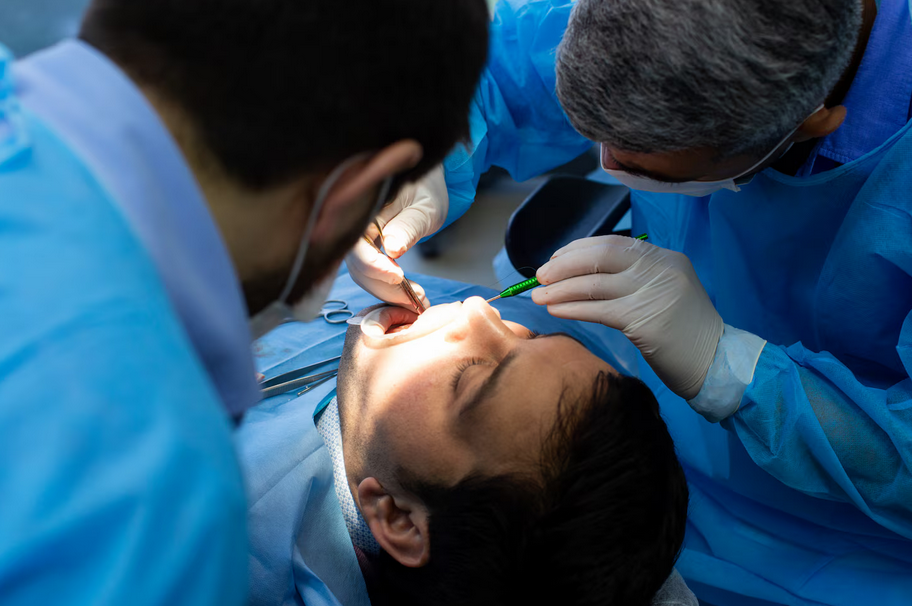
Infection in immature permanent teeth (with incompletely developed roots) that are non-vital presents a major challenge in the field of endodontics. This condition is often accompanied by weakened root walls, an increased risk of root fracture, loss of root length, and limited regenerative capacity. To address these challenges, Regenerative Endodontic Treatment (RET) has been developed as a technique that not only eliminates infection but also stimulates further root development and healing of periapical tissues.
One narrative review conducted by a student of the Faculty of Dentistry, Universitas Gadjah Mada (FKG UGM), Intan Fatimatuzzahra, under the supervision of Dr. drg. Ema Mulyawati, M.S., Sp.KG(K) and drg. Tri Endra Untara, M.Kes., Sp.KG(K), entitled “Perbandingan Penggunaan Blood Clot, Platelet-rich Plasma (PRP), dan Platelet-rich Fibrin (PRF)”, examined the advantages and disadvantages of these three regenerative approaches in cases of immature non-vital permanent teeth.
Regenerative Approaches: Blood Clot, PRP, and PRF
In regenerative therapy, several methods are used to induce regeneration (tissue growth and root formation) and to supply biological elements that support healing:
| Methods | Main Mechanism | Advantages | Disadvantages |
|---|---|---|---|
| Blood Clot | Utilizes a blood clot formed after induced bleeding from the root; the clot provides a scaffold, vascular cells, and natural growth factors. | Low cost, simple procedure, no additional materials required. | Root growth may take longer; apical closure is less consistent than with PRP/PRF; variability of the clot is difficult to control. |
| Platelet-Rich Plasma (PRP) | Platelet-enriched plasma, a source of growth factors such as PDGF, TGF-β, and others; helps accelerate tissue regeneration. | Faster apical closure; potentially quicker healing; additional growth factors. | More complex procedure; requires careful preparation; relatively higher cost; variability in material quality. |
| Platelet-Rich Fibrin (PRF) | A new-generation platelet concentrate forming a three-dimensional fibrin matrix with sustained release of growth factors. | Good potential for apical closure; more stable scaffold; no anticoagulant required; more “natural” fibrin matrix with longer retention. | Preparation techniques vary; scaffold density and strength may differ; long-term clinical evidence is still limited. |
Comparative Outcomes and Clinical Indications
Based on the cited narrative review:
- Although Blood Clot, PRP, and PRF all demonstrated success in stimulating root growth and periapical tissue healing, no significant differences were found in most outcomes except for apical closure.
- PRP and PRF showed higher success rates in achieving apical closure compared to blood clot.
- The indication for each method depends on clinical conditions, such as the stage of root development, availability of periapical tissue, patient compliance, and laboratory/clinical resources.
Practical Techniques in Managing Complex Infections
Several endodontic strategies may be considered when managing immature non-vital permanent teeth with complex infections:
- Optimal Infection Elimination
- Use of appropriate irrigation (e.g., NaOCl, EDTA) and disinfectants.
- Thorough canal debridement and the use of intracanal medicaments (e.g., calcium hydroxide) prior to regenerative procedures.
- Blood Induction / Biological Scaffold
- Induction of bleeding to generate a blood clot scaffold.
- Use of PRP or PRF as an alternative or adjunct, when available, to accelerate and improve regeneration, particularly apical closure.
- Coronal Seal / Protection
- Proper coronal sealing with well-adapted restorative materials to prevent recontamination.
- Ensure a stable coronal restoration free from microleakage.
- Long-Term Monitoring
- Periapical radiographic and clinical evaluation to assess root growth, apical closure, and periapical healing.
- Assessment of sensitivity and potential complications such as root resorption or canal calcification.
- Protocol Selection Based on Tools and Biological Resources
- Use PRF/PRP when available and supported by facilities, especially when apical closure is a primary objective.
- Blood clot remains a valid option when resources are limited due to its simplicity and effectiveness.
***
Regenerative endodontic techniques (RET) offer new hope for immature non-vital permanent teeth with complex infections. Based on the UGM narrative review comparing Blood Clot, PRP, and PRF, each method has distinct advantages and limitations. PRP and PRF demonstrate superiority in apical closure, although many other outcomes are not significantly different from blood clot. Method selection should consider clinical conditions, facility availability, and therapeutic goals (such as apical closure) to achieve optimal outcomes in complex endodontic restorations.
References
INTAN FATIMATUZZAHRA, Dr. drg. Ema Mulyawati, M.S., Sp.KG(K); drg. Tri Endra Untara, M.Kes, Sp.KG(K), Perbandingan Penggunaan Blood Clot, Platelet-rich Plasma (PRP), dan Platelet-rich Fibrin (PRF) terhadap Regenerative Endodontic Treatment pada Gigi Permanen Imatur Non Vital (Narrative Review), https://etd.repository.ugm.ac.id/home/detail_pencarian_downloadfiles/648780
Author: Rizky B. Hendrawan | Photo: Freepik

