
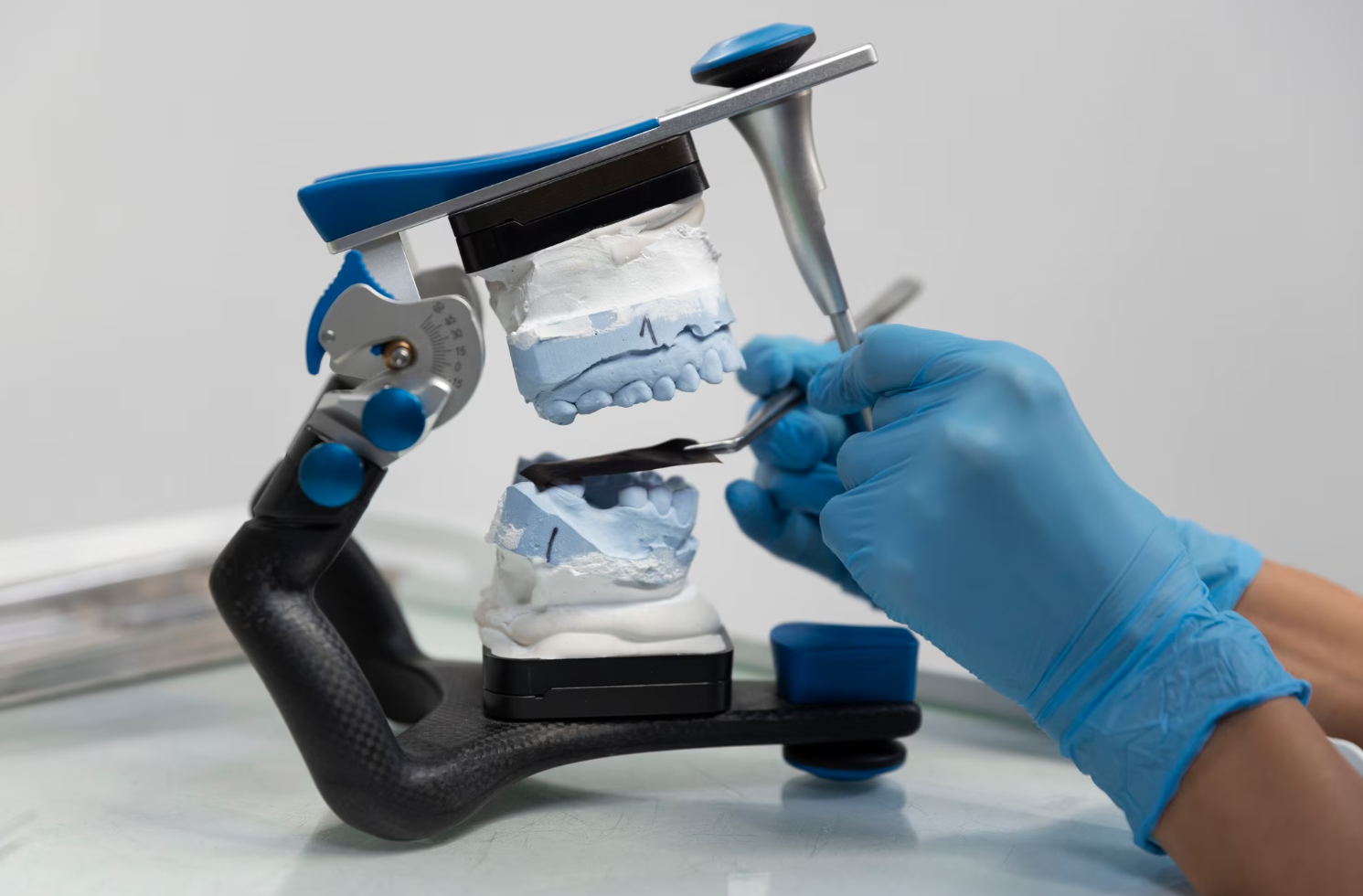
In fixed prosthodontic treatment (Fixed Partial Denture / FPD), the accuracy of the working model is essential to ensure that the final restoration fits properly, maintains the health of supporting tissues, and achieves long-term aesthetics and function. One of the key factors influencing this accuracy is the dimensional stability of the impression material—particularly the finishing line and the distance between finishing lines—which is affected by the impression technique and the time interval before pouring the cast.
Research Method
A study was conducted by FKG UGM student Pambudi Santoso Tanzil, under the supervision of drg. Maria Theresia Esti Tjahjanti, M.Kes., Sp.Pros(K) and drg. Herijanti Amalia Kusuma, SU, Sp.Pros(K), using 36 working model samples for FPD fabricated with Polyvinyl Siloxane (PVS) impression material and Type IV gypsum. The samples were divided into six groups: three groups using the one-step technique and three using the two-step technique. Each technique group was poured at 2 hours, 30 hours, and 58 hours after impression-making. After casting, the models were scanned using a 3D laser scanner, and the finishing line and inter-finishing line distances were measured using 3D analytical software. Data were analyzed using two-way ANOVA and Post-Hoc LSD tests.
Key Findings
- Significant differences (p < 0.05) were found among several pouring times and impression techniques when compared to the master model in measurements of the finishing line and inter-finishing line distances.
- Specifically, the two-step technique with a 2-hour images revealed that the pouring time demonstrated the best dimensional stability for both finishing line and inter-finishing line distances in the FPD models.
- Longer pouring intervals (such as 30 or 58 hours), particularly in the one-step technique, resulted in notable dimensional shrinkage compared to the master model.
The study concludes that the two-step impression technique with PVS material provides better dimensional stabilitythan the one-step technique when the pouring time is 2 hours, particularly for finishing line and inter-finishing line accuracy. A 2-hour pouring time produced the most stable dimensions in the FPD model.
Clinical Implications
- Utilizing the two-step impression technique with a short pouring interval (approximately 2 hours) can improve the accuracy of restorations, reduce margin discrepancies, and extend the longevity of fixed prosthodontic restorations.
- Better finishing line stability helps prevent marginal leakage, reduces periodontal irritation, and supports optimal aesthetic outcomes.
References
Jurnal Kedokteran Gigi FKG UGM, Pambudi Santoso Tanzil, drg. Maria Theresia Esti Tjahjanti, M.Kes., Sp. Pros(K), drg. Herijanti Amalia Kusuma, SU, Sp.Pros(K), Effect of Polyvinyl Siloxane Impression Techniques and Pouring Time on Dimensional Stability of Finishing Line and Inter-Finishing Line in Fixed Partial Denture Models, https://jurnal.ugm.ac.id/jkg/article/download/29077/17425
Author: Rizky B. Hendrawan | Photo: Freepik

