
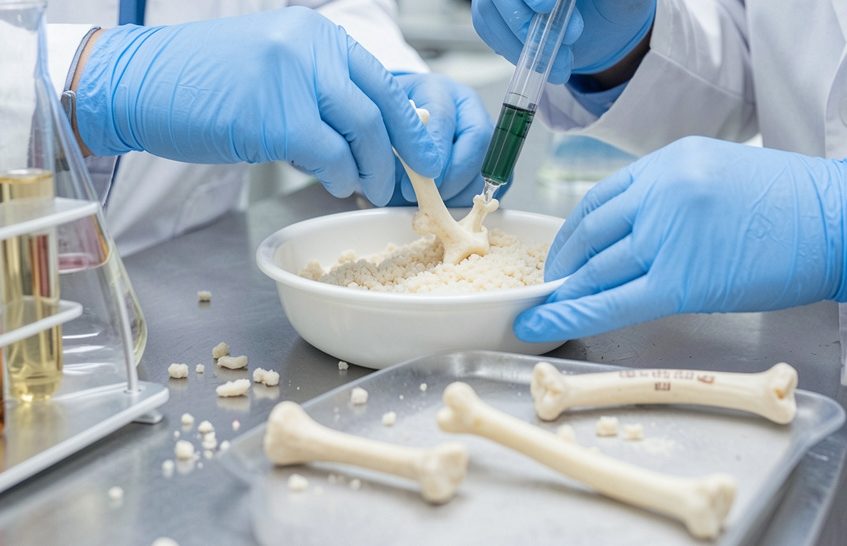
Imagine a bone defect caused by surgery or injury healing faster simply because the filling material has been reformulated. That is the essence of a finding published by Dr. drg. Anne Handrini Dewi, M.Kes. and a team of researchers from the Department of Biomedical Dentistry, Faculty of Dentistry, Universitas Gadjah Mada. In a study published in the Journal of Biomedical Materials Research Part A, they tested a combination of two simple materials — calcium sulfate, known as plaster of Paris (POP), and calcium carbonate — as a bone substitute material. The results were striking: the combination not only slowed the rate of material degradation but also accelerated new bone formation at the defect site during the first week of observation.
The Longstanding Problem of Bone Materials That Dissolve Too Quickly
Calcium sulfate is not a new material in medicine. It has been used for years to fill bone defects in both orthopedic surgery and oral and maxillofacial surgery. Its advantages are clear: it can harden on its own when mixed with water, does not trigger severe inflammatory reactions, and can naturally be resorbed by the body.s
However, it has one fundamental drawback. POP is absorbed by the body too quickly. Before new bone has enough time to grow and fill the space left behind, the material has already disappeared. As a result, the defect area may become filled with fibrous tissue or fat cells rather than the bone that is actually needed.
The researchers attempted to overcome this problem by adding calcium carbonate to the POP mixture. Calcium carbonate itself is not an unfamiliar material; it is a major component of marine coral and has long been known for its biocompatibility and ability to chemically bond with bone tissue.
Three Formulations, One Goal
The research team prepared three different compositions: POP-100 (100% pure calcium sulfate), POP-075 (75% calcium sulfate and 25% calcium carbonate), and POP-050 (50:50). Small cylindrical samples measuring 2.5 mm in diameter were implanted directly into the femoral condyle — the end portion of the thigh bone — of 24 five-month-old male Sprague Dawley rats.
After one and four weeks, the tissue surrounding the implants was collected and examined histologically. In addition to the animal study, the materials were immersed in simulated body fluid — an artificial fluid designed to mimic the chemical conditions of human blood — to observe their degradation behavior outside the body.
The results were consistent: the more calcium carbonate was added, the slower the material was resorbed and the faster new bone began to form during the first week.
“The addition of CaCO₃ to POP not only reduces the degradation rate of the cement but also induces faster bone formation, thereby providing promising properties for this material.” — Dr. drg. Anne Handrini Dewi, M.Kes. and the research team, in the Journal of Biomedical Materials Research Part A
What Happens Inside the Bone
Histologically, during the first week, all groups showed early signs of bone formation along the walls of the defect, with the appearance of woven bone — immature bone that has not yet become fully organized, indicating that the healing process was underway. Inflammatory cells such as neutrophils and multinucleated cells were observed at the interface between the material and the defect wall, but there was no concerning chronic inflammatory response.
Interestingly, during the first week, the POP-075 and POP-050 groups showed statistically higher bone formation scores than POP-100. This indicates that the presence of calcium carbonate made a meaningful contribution during the early stage of healing. The calcium ions released inhibited osteoclast activity, while carbonate ions helped organize the mineral structure of newly formed bone.
By the fourth week, the differences among the groups were no longer statistically significant — all materials had been almost completely resorbed, and the defect areas were largely filled with fibrous tissue. This indicates that although the new formulations performed better than pure POP, further refinement is still needed, particularly regarding the optimal composition so that material degradation can be better synchronized with the rate of bone formation.
Clinical Potential and Next Steps
Temuan ini relevan langsung untuk praktik kedokteran gigi, terutama dalam prosedur augmentasi tulang alveolar sebelum pemasangan implan gigi, bedah periodontal, maupun rekonstruksi defek rahang pasca pengangkatan kista atau tumor. Material yang bisa dibuat dari bahan baku relatif terjangkau seperti kalsium sulfat dan kalsium karbonat membuka kemungkinan pengembangan substitusi tulang yang lebih aksesibel secara ekonomi.
These findings are directly relevant to dental practice, particularly in alveolar bone augmentation procedures before dental implant placement, periodontal surgery, and reconstruction of jaw defects following the removal of cysts or tumors. Materials that can be produced from relatively affordable raw ingredients such as calcium sulfate and calcium carbonate offer the possibility of developing bone substitutes that are more economically accessible.
The researchers acknowledge that this study is only an initial step. Higher calcium carbonate compositions, longer observation periods, and testing in larger animal models still need to be conducted. There is also an important consideration: degradation results obtained in simulated fluids do not always reflect actual conditions inside the body, as blood proteins can also influence the behavior of the material.
Authors: Achmad Zam Zam Aghasy, DDS, M.Kes.; Hazra Alifia Muharam
Photo: Freepik
DOI Source: 10.1002/jbm.a.34513