
As dentistry moves increasingly toward precision and personalization, two longstanding disciplines continue to serve as its most vital foundation: epidemiology and biostatistics. Behind technological advances such as artificial intelligence, big data, and genomics, these fields remain the key to interpreting information and shaping policies that are fair, safe, and evidence-based.
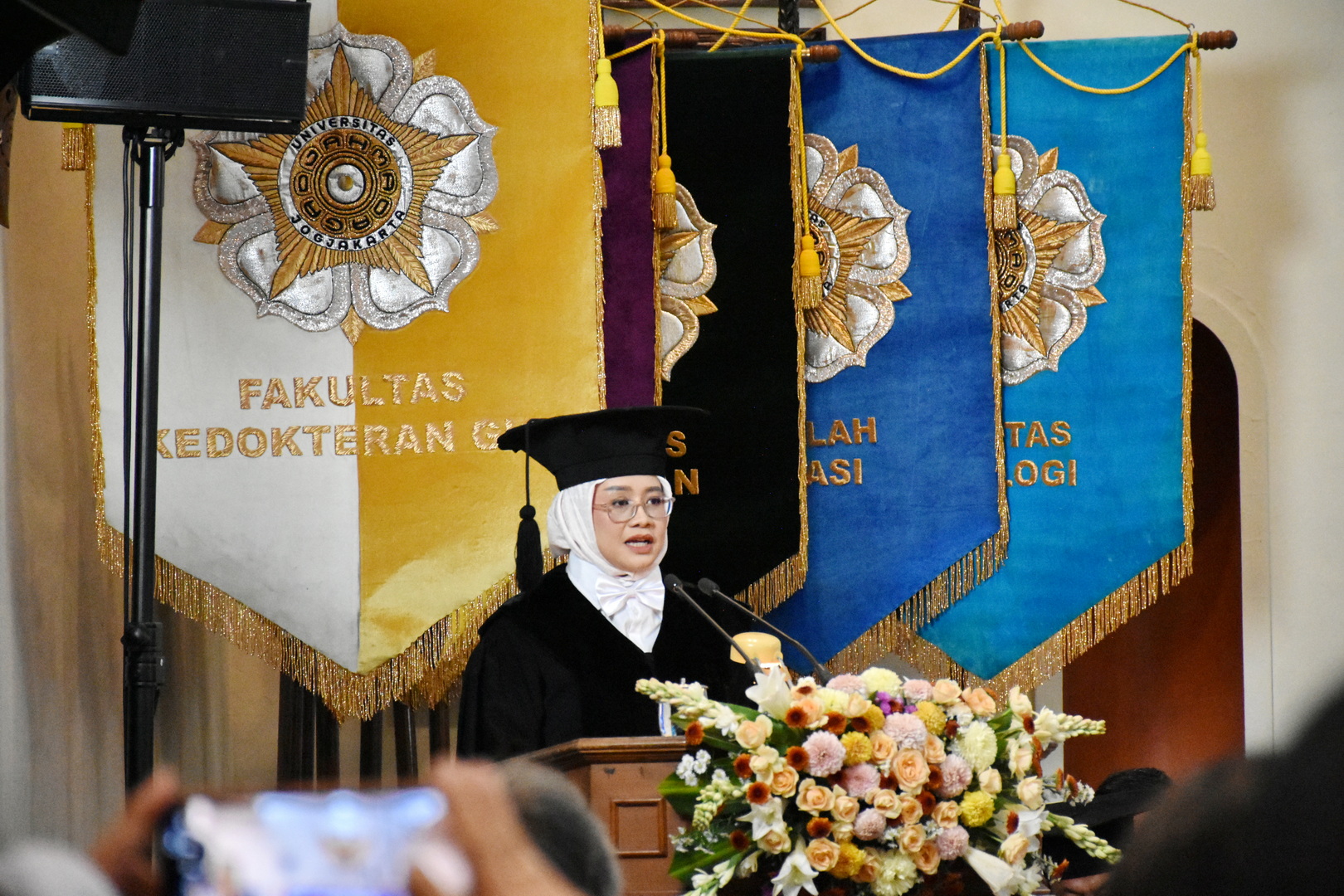
This perspective was presented by Prof. Dr. drg. Rosa Amalia, M.Kes., during her inaugural address as Professor of Epidemiology and Biostatistics in Dentistry at the Faculty of Dentistry, Universitas Gadjah Mada (UGM), held on Tuesday, 24 June 2025 at the Senate Hall, UGM Main Building. In her lecture titled Exploring Numbers, Reading the Future: The Role of Epidemiology and Biostatistics in the Era of Precision Dentistry, she underscored the importance of integrating scientific approaches with modern technology for more proactive and participatory healthcare.
“Without a solid epidemiological framework and accurate biostatistical analysis, the application of precision dentistry risks generating bias, misclassification, or invalid clinical recommendations,” she emphasized.
Prof. Rosa explained that epidemiology and biostatistics are no longer merely tools for mapping diseases; they have evolved into bridges linking data to policy. In the context of P4 Dentistry (Predictive, Preventive, Personalized, Participatory),they connect genetic vulnerability, environmental factors, and effective health interventions.
She cited her team’s research on salivary biomarkers in children in Yogyakarta, which has resulted in two patents. This work forms the basis for developing more accurate and personalized early caries detection tools. “We believe saliva data can be used to design prevention strategies that truly match each child’s unique condition,” she said
Prof. Rosa also highlighted the importance of advancing smart dentistry through Artificial Intelligence (AI) and Machine Learning (ML). However, she warned that technology is only valuable if supported by robust analytical frameworks. “AI without a solid biostatistical foundation can instead produce algorithmic bias that disadvantages certain groups,” she cautioned.
She stressed the need for cross-sector collaboration. For researchers, the challenge lies in producing complex data-based studies that can be applied directly. For policymakers, data must become the basis of equitable preventive strategies. And for clinicians, P4 Dentistry serves as a guide to deliver more humane, proactive, and risk-based care.
Concluding her address, Prof. Rosa stated that integrating epidemiology and biostatistics paves the way for more predictive, personalized, and preventive dental healthcare. “Through this approach, we are not only reading the future of health but also rewriting the way we protect, care for, and honor life,” she concluded.
Author: Fajar Budi Harsakti
Photographer: Dody Hendro W.

