
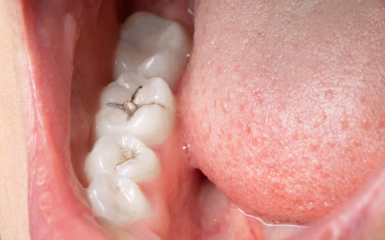
Dental caries is the destruction of hard dental tissues caused by bacterial activity and demineralization and remains a major problem in dentistry. Carious tooth restoration aims not only to cover structural damage but also to restore esthetics, function, and long-term durability. Innovations in restorative techniques and materials continue to evolve to achieve optimal clinical outcomes and minimize complications such as cracks or restoration failure.
One study conducted by Zuhana Fitri Harahap, under the supervision of drg. Endang Retnowati, MKes., SpKG(K), entitled “Restorasi estetik kompleks pada gigi insisivus lateralis kanan maksila, insisivus sentralis kanan maksila dan insisivus sentralis kiri maksila karies”, describes a complex restorative approach for anterior teeth using a combination of modern techniques and composite materials.
Case Description and Restorative Methodology
The case report revealed the following findings:
- A 15-year-old female patient presented with extensive caries affecting three maxillary anterior teeth:
• Right maxillary lateral incisor (superficial caries, Class VI cavity) → restored using a direct composite resin veneer
• Right maxillary central incisor (moderate caries, Class IV and V cavities) → restored with composite resin using a hollow ground bevel technique and nanofiller layering
• Left maxillary central incisor (non-vital, post–root canal treatment) → remaining crown structure limited to the cervical third, restored with a jacket crown (Adoro jacket crown) using a fiber post and composite resin core
The restorative procedure included model planning and mock-up, cavity preparation, bevel application and composite layering techniques, fiber post fabrication, and cementation of the jacket crown using composite resin cement. Evaluation after three months showed favorable outcomes: no pain, stable restoration color, and normal function.
Restorative Techniques and Innovations Applied
From this case, several advanced or “new” techniques suitable for complex caries restoration can be identified:
- Direct Veneers for Thin Tooth Morphology
- For superficial defects, the use of thin composite veneers (0.25–0.3 mm), combined with a base layer and color-gradient layering, helps preserve esthetics without excessive tooth reduction.
- Hollow Ground Bevel Technique with Nanofiller Layering
- The hollow ground bevel helps distribute stress and minimize stress concentration at the margins of Class IV and V restorations.
- Nanofiller composites are applied in multiple layers (base shade and outer shade) to create natural color gradation and superior esthetic outcomes.
- Fiber Post, Composite Core, and Jacket Crown
- For non-vital teeth with substantial structural loss, fiber posts provide internal support and help distribute restorative forces more evenly.
- A jacket crown is then cemented using resin cement to complete the external restoration while maintaining esthetics.
- Mock-Up and Esthetic Treatment Planning Models
- Diagnostic models and mock-ups assist in visualizing esthetic outcomes and treatment direction before definitive procedures, improving predictability and restorative design accuracy.
Considerations of Strength, Esthetics, and Durability
When designing complex caries restorations, several factors must be optimized:
- Strength and Crack Resistance
Proper beveling, layering techniques, and the use of materials with high mechanical properties are essential to prevent cracking or marginal failure. - Marginal Adaptation
Restoration margins must be well sealed to avoid gaps that may cause microleakage and secondary caries. - Color Esthetics and Translucency
Nanofiller composites allow excellent color gradation, translucency, and refined esthetics, especially in anterior teeth. - Minimization of Tooth Preparation
Conservative approaches such as direct veneers and fiber posts help preserve as much natural tooth structure as possible. - Long-Term Stability
Mid- to long-term evaluations are necessary, as complex restorations must withstand thermal cycling, masticatory loads, and occlusal stress.
***
Recent techniques for restoring carious teeth—particularly complex anterior cases—include innovative combinations of thin direct veneers, bevel techniques, nanofiller layering, fiber post application, and esthetic jacket crowns. The reported case demonstrates that with proper planning, complex restorations can achieve satisfactory functional and esthetic outcomes with stable performance over at least a three-month period.
References
HARAHAP, Zuhana Fitri, drg. Endang Retnowati, MKes., SpKG(K), Restorasi estetik kompleks pada gigi insisivus lateralis kanan maksila, insisivus sentralis kanan maksila dan insisivus sentralis kiri maksila karies, https://etd.repository.ugm.ac.id/penelitian/detail/42540
Author: Rizky B. Hendrawan | Photo: Freepik

