
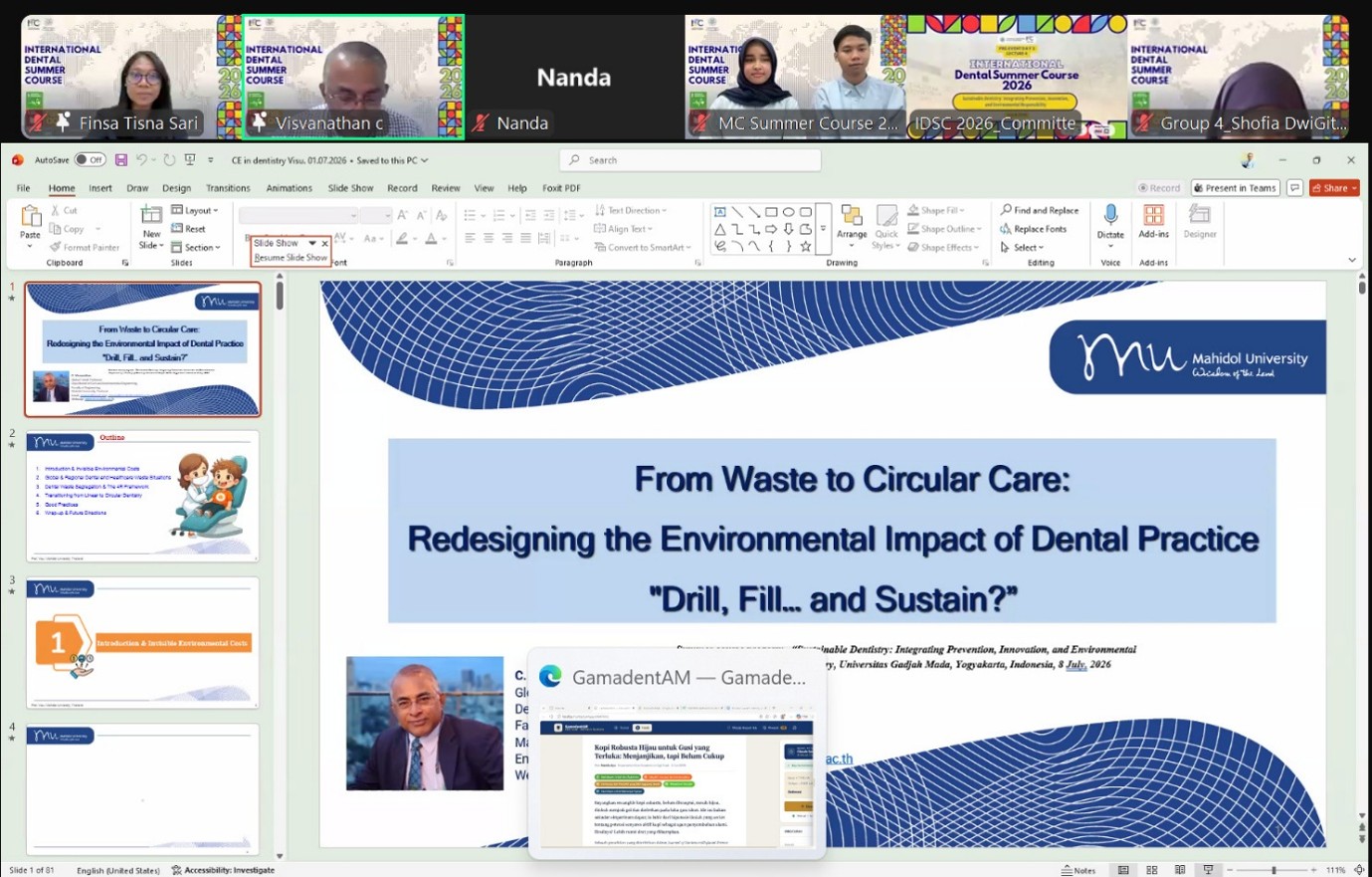
Environmental sustainability and medical waste management have become growing global concerns as the use of single-use medical equipment continues to rise, along with the volume of waste generated by the healthcare sector. Addressing these challenges, environmental and technology expert Prof. Dr. Chettiyappan Visvanathan, B.Tech., M.Engg., Ph.D., from the Asian Institute of Technology (AIT), Thailand, encouraged academics and healthcare practitioners to begin applying circular economy principles across various aspects of healthcare and dentistry.
Speaking at an international seminar attended by lecturers, students, and healthcare professionals, Prof. Chettiyappan explained that sustainability in healthcare is not only about providing the best possible care to patients, but also about ensuring that the delivery of such care does not cause harm to the environment.
According to him, healthcare is one of the sectors that generates large amounts of waste, particularly plastic waste from single-use medical devices, medical packaging, and various sterilized equipment. The use of disposable materials increased sharply during the COVID-19 pandemic because of heightened requirements for safety and infection prevention. This has created new challenges for medical waste management in many countries.
Prof. Chettiyappan noted that much of the material used in healthcare still retains value and could potentially be recovered through recycling. However, because of strict regulations and safety standards, such materials cannot simply be reused as medical devices. As an alternative, plastic waste can be processed and repurposed into products for nonmedical sectors, allowing it to retain economic value while reducing the amount of waste released into the environment.
He also explained that the circular economy is not limited to recycling. More broadly, it is about keeping products and materials in use for as long as possible, reducing the need for new resources, and minimizing waste generation. A number of institutions and organizations around the world have begun adopting these principles through innovations in waste management, material reuse, and the development of more environmentally friendly technologies.
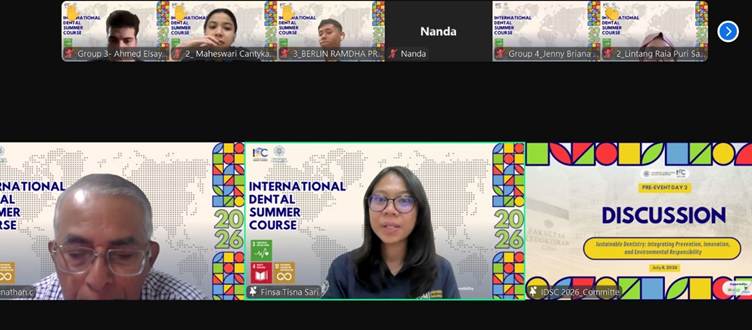
During the discussion, participants also explored opportunities to apply sustainability principles in dentistry. Topics included medical waste management, the use of more sustainable materials, and the development of healthcare technologies that can reduce environmental impacts. According to Prof. Chettiyappan, dentistry has significant potential to become a pioneer in sustainable healthcare practices through innovation and interdisciplinary collaboration.
He also emphasized that developing countries, including Indonesia, continue to face major challenges in expanding access to and improving the equitable distribution of basic healthcare services. Therefore, sustainability initiatives need to be implemented gradually and in balance with other priorities, without compromising the fundamental goal of providing high-quality healthcare that is accessible to all segments of society.
Prof. Chettiyappan stressed that higher education institutions have a strategic role to play in driving the transition toward a more sustainable healthcare system. Universities can serve as centers for innovation, research, and community engagement focused on finding solutions to environmental challenges. Through education and international collaboration, younger generations can become agents of change in creating a healthier and more sustainable future.
At the end of the session, he encouraged participants to begin making changes through simple steps, such as reducing unnecessary material use, raising awareness of proper waste management, and developing innovations that support sustainability. In his view, the future of healthcare should not be measured solely by advances in medical technology, but also by humanity’s ability to maintain a balance between health and the environment. “For healthier people on a stronger planet.”
Reporters: Nanda Ayu, Any & Andri Wicaksono