
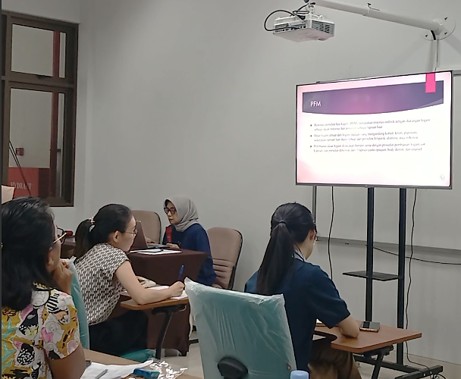
The success of dental implant treatment depends not only on the surgical procedure and implant placement but also on selecting the appropriate restorative material. This was emphasized by drg. Murti Indrastuti, M.Kes., Sp.Pros., Subsp.PIKG(K) during the Dental Implant Course held on the second floor of the Margono Soeradji Building, Faculty of Dentistry, Universitas Gadjah Mada (FKG UGM), on Wednesday (24 June 2026).
In her presentation, Drg. Murti explained that advances in dental technology have introduced a wide range of restorative materials for implant dentistry. However, because each material possesses unique characteristics, its selection must be tailored to the individual clinical needs of each patient.
"There is no single ideal material for every case. Dentists must consider strength, precision, aesthetics, fracture resistance, and the patient's overall condition before determining the most appropriate type of restoration," she said.
As a prosthodontics specialist, Drg. Murti emphasized the importance of understanding the mechanical and biological properties of each restorative material. She explained that materials such as porcelain, zirconia, resin, and various modern ceramics each offer distinct advantages and limitations that should be carefully evaluated.
According to her, aesthetics are often a primary concern for patients, particularly when restoring anterior teeth. Nevertheless, material strength and the ability to withstand masticatory forces must remain top priorities to ensure long-term durability.
During the session, participants were also introduced to the latest developments in digitally assisted restorative technologies, which are increasingly being adopted by dental laboratories and clinical practices. These technologies enable restorations to be fabricated with greater precision, improving both implant placement accuracy and patient comfort.
Drg. Murti also discussed the use of various modern ceramic materials, including zirconia zirconia, which has become one of the most popular options in implant restorations. She noted that the material offers an excellent combination of strength and aesthetics, although proper design and fabrication techniques remain essential to minimize the risk of restoration failure.
"Material selection should never be based solely on current trends. Every decision must ultimately be guided by the patient's clinical needs, overall condition, and the treatment objectives," she emphasized.
She further reminded participants that restorative treatment should be evaluated comprehensively by considering biomechanical factors, masticatory function, aesthetics, and potential long-term complications.
Through this session, participants in the Dental Implant Course were expected to gain a comprehensive understanding of implant restorative principles, enabling them to plan patient rehabilitation more accurately, effectively, and with a focus on long-term success.
Reporter: Anny Anggraini, Photographer: Anny Anggraini