
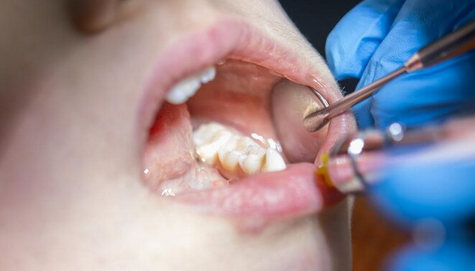
Oral wounds, particularly those involving the gingiva, often experience delayed healing due to the moist environment, high microbial load, and continuous mechanical activity such as eating and speaking. To accelerate healing, various approaches have been developed. One such method is the use of Platelet-Rich Fibrin (PRF) membranes with releasate, which is expected to stimulate early cellular responses in wound healing, especially during the inflammatory phase and the recruitment of responder cells such as macrophages.
Aim and Methods
An in vivo study conducted by an FKG UGM student, Paramitha Dewi Anggraini, under the supervision of Prof. Dr. drg. Ahmad Syaify, Sp.Perio(K), and Dr. drg. Rezmelia Sari, M.Sc., Sp.Perio(K), used rabbits (Oryctolagus cuniculus) to evaluate the effect of PRF membrane application with releasate on macrophage counts during gingival wound healing. Wounds were created on the labial gingiva of the mandible and divided into two groups:
- Control group: no application of PRF with releasate
- Treatment group: application of PRF membrane with releasate
Macrophage counts were observed on days 1, 3, 5, and 7 post-injury and compared between groups. Statistical analysis was performed using Two-Way ANOVA followed by LSD post hoc testing.
Research Findings
- On days 1 and 3, the PRF with releasate group showed a significant increase in macrophage counts compared with the control group.
- On days 5 and 7, macrophage counts in the treatment group decreased, approaching or even falling below those observed in the control group.
- These findings indicate that PRF with releasate modulates the inflammatory response by increasing macrophages during the early healing phase and reducing their number as the initial inflammatory phase subsides.
Discussion
An increase in macrophages during the early stages of healing is critical because macrophages:
- remove debris and bacteria,
- release cytokines and growth factors that stimulate new tissue formation, angiogenesis, and tissue repair.
The subsequent decrease in macrophage numbers at later stages indicates controlled inflammation, which is essential to prevent prolonged inflammation, tissue damage, or excessive fibrosis.
PRF, as an autologous biological material containing platelets, fibrin, and releasate (a fluid rich in growth factors and signaling molecules), appears to be an effective natural stimulant in oral wound healing.
Clinical Implications
Based on the study results:
- PRF with releasate may serve as a safe and effective adjunctive method to accelerate early gingival wound healing.
- Proper macrophage modulation may promote faster healing and reduce complications such as infection or chronic inflammation.
- PRF is expected to be applied in periodontal or oral surgery clinical practice as part of wound management protocols, particularly in patients with delayed healing (e.g., due to immune status or certain medical conditions).
***
The use of PRF membranes with releasate showed a significant effect on macrophage counts during the early stages of gingival wound healing, with increases on days 1 and 3 followed by decreases on days 5 and 7. This suggests that PRF not only accelerates healing initiation through immune and inflammatory responses but also helps regulate inflammation to prevent pathological progression.
References
PARAMITHA DEWI ANGGRAINI, Prof. Dr. drg. Ahmad Syaify, Sp.Perio (K), Dr. drg. Rezmelia Sari, M.Sc., Sp.Perio(K), PENGARUH APLIKASI MEMBRAN PLATELET-RICH FIBRIN DENGAN RELEASATE TERHADAP JUMLAH MAKROFAG PADA PROSES PENYEMBUHAN LUKA GINGIVA (Kajian in vivo pada Oryctolagus cuniculus), https://etd.repository.ugm.ac.id/penelitian/detail/167799
Author: Rizky B. Hendrawan | Photo: Freepik

