
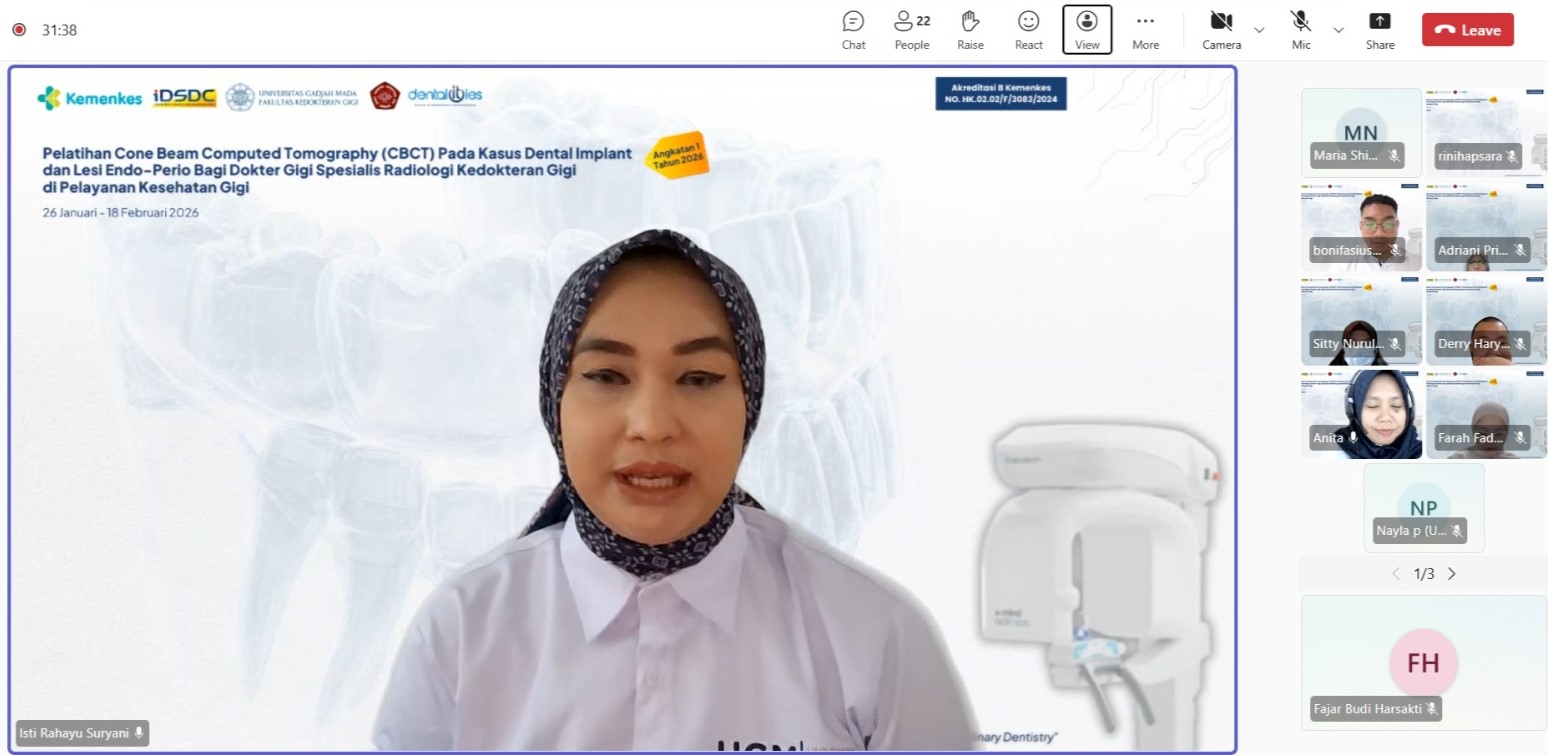
The Faculty of Dentistry at Universitas Gadjah Mada (FKG UGM), through its Department of Dentomaxillofacial Radiology, organized the second batch of the Cone Beam Computed Tomography (CBCT) Training on Dental Implant Cases and Endo-Perio Lesions for Specialist Dentomaxillofacial Radiologists (RKG) working in dental healthcare services. The program officially began online on Monday (1/26).
The head of the organizing committee, drg. Isti Rahayu S, M.Biotech., Sp.Rad.O.M (K)., Ph.D., explained that this training marks the second batch following the positive response from participants in the first batch held in October 2025. The second batch is attended by 14 participants not only from Java but also from various regions across Indonesia, including Kalimantan, Sulawesi, and Aceh.
“The participants come from diverse regions, demonstrating the high demand for enhanced CBCT competency across the country,” Isti stated in her report.
She added that the training is supported by 13 speakers—12 national experts and one international speaker—and involves interdisciplinary presenters from Oral Surgery, Prosthodontics, Periodontics, and Conservative Dentistry. This cross-disciplinary collaboration is expected to enrich participants’ clinical perspectives in comprehensively understanding and interpreting CBCT results.
The training materials focus on in-depth discussions of dental implant cases, including CBCT-based implant planning, management of complex cases, and implant design. Additionally, the program covers the use of CBCT in diagnosing and planning treatment for endo-perio lesions that require high diagnostic precision.
The online sessions are held from January 26 to February 3, 2026, with daily classes. Participants will then attend in-person sessions scheduled for February 6–8, 2026.
Meanwhile, the Vice Dean for Research, Community Service, and Cooperation, drg. Trianna Wahyu Utami, MDSc., Ph.D., expressed hope that the program would continue beyond the second batch. She encouraged further development of similar training programs with additional clinically relevant topics. “I hope this training will continue with other topics and not be limited to specialist radiologists. It could also be designed for radiographers,” she said.
Trianna noted that the training plays an important role in enhancing the competencies and clinical capabilities of specialist dentomaxillofacial radiologists, particularly in addressing increasingly complex cases in dental healthcare services amid advances in imaging technology.
Bekti Nur Aini, S.Kp.G., M.P.H., Coordinator of the iDSDC Training Institute at FKG UGM, stated that this CBCT training is a continuation of the 2025 CBCT program, which received a positive response from participants. Therefore, iDSDC, in collaboration with the Department of Dentomaxillofacial Radiology, is once again organizing the training as part of an ongoing effort to strengthen CBCT-based dentomaxillofacial imaging competencies for dental specialists.
Author: Fajar Budi Harsakti

