
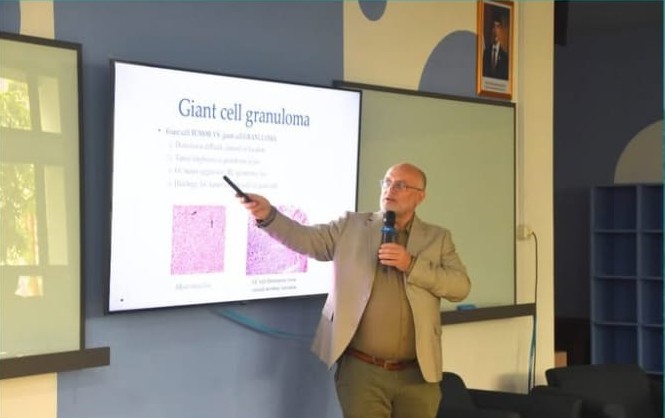
Prof. Dr. Witjes delivered a lecture on bone pathology in maxillofacial oncology, highlighting the importance of understanding bone diseases and their management. He discussed various types of bone pathology, including developmental cysts, inflammatory cysts, and odontogenic tumors, emphasizing the need for accurate diagnosis through imaging techniques such as panoramic X-rays, cone beam CT, CT scans, and MRI. He also explained the role of metabolic scanning in detecting inflammation and discussed case examples illustrating the complexity of diagnosis and management of bone pathology in the head and neck region.
Bone Metabolism and Pathological Conditions
The complex process of bone metabolism, focusing on the roles of osteoblasts and osteoclasts in bone growth, resorption, and remodeling. He explained how various factors, including hormones, genes, and medications such as corticosteroids, can affect bone health and cause conditions such as osteoporosis, osteopetrosis, and giant cell granuloma. The lecture also explored mechanisms underlying bone resorption in infection and cancer, highlighting the role of osteoclasts and signaling molecules involved. Prof. Dr. Witjes concluded by explaining rare genetic disorders affecting bone metabolism and introducing new drugs such as romosozumab, which target specific pathways in bone formation and resorption.
Jaw Lesions: Classification and Management
Prof. Dr. Witjes delivered a detailed lecture on the classification and characteristics of various jaw lesions, focusing on radiographic features and clinical management. He explained the differences among fibrous dysplasia, cemento-osseous dysplasia, ossifying fibroma, and other mixed lesions, stressing the importance of recognizing patterns on X-rays. He also discussed challenges in managing these lesions, including decision-making processes between biopsy, removal, or observation, and shared insights from previous cases. The lecture concluded with a short Q&A session, where drg. Zaki asked about the management of potentially aggressive tumors, to which Prof. Dr. Witjes responded by highlighting the complexity involved in such decision-making.
Maxillary Reconstruction and Implant Therapy
Maxillary reconstruction techniques, focusing on the challenges of maxillectomy due to complex anatomy and invisible tumor margins. He explained that although obturation with prosthetics remains the standard approach, implant-supported prosthetics offer better retention and stability, especially for edentulous patients. He highlighted the importance of preoperative planning, patient selection, and the use of dental implants to improve prosthetic rehabilitation outcomes in maxillary defects.
3D Advances in Maxillofacial Surgery
Advances in maxillofacial reconstructive surgery, highlighting the use of 3D technology and surgical navigation to improve outcomes. He discussed various flap reconstruction options, including fibula and iliac crest, emphasizing the importance of implant placement in bone flaps, particularly for patients undergoing radiation. He introduced a new HoloLens-based surgical navigation system that allows surgeons to visualize and interact with 3D models of patient anatomy during surgery, expected to enhance surgical precision and patient outcomes. Maxillary Reconstruction: Traditional to Modern
An overview of maxillary reconstruction techniques, highlighting the evolution from traditional methods to modern 3D technologies. He discussed various approaches including obturator prostheses, free flap surgeries, and zygomatic implants, stressing the importance of precise surgical planning and execution. The session also covered the use of 3D printing, optical scanning, and other advanced technologies in creating customized prosthetics and implants. The presentation concluded with a discussion on the benefits and limitations of different reconstruction methods, recommending obturator procedures as the standard of care while acknowledging the role of secondary reconstruction and zygomatic implants in certain cases.
Challenges in Maxillofacial Reconstruction and Care
Prof. Witjes addressed maxillofacial oncology reconstruction, noting that implants are generally not used in the Netherlands due to cost issues, unlike in the U.S. where patients must pay for implants themselves. He explained that 3D navigation is only used in complex cases where tumor margins are difficult to see, and he does not support placing implants on reconstruction plates due to infection risks. Prof. Dr. Witjes presented a case study of an oral cancer patient who received palliative care, including surgery and radiation, despite having lung metastases, raising questions about the appropriateness of such an approach.
Review of Jaw Tumor Surgery Complications
The team discussed a complex surgical case involving resection of a large tumor in a patient’s jaw, with the operation lasting 8.5 hours. Postoperative survival and pain management were reviewed, while drg. Fajar raised concerns about the extent of the surgery. The team debated whether an aggressive approach was necessary, with some suggesting radiotherapy might have been a better option. Prof. Dr. Witjes shared insights on minimizing bleeding during surgery and managing potential complications, including the use of pedicled flaps if free flaps failed. The patient reportedly improved postoperatively, with minimal pain and the ability to communicate through eye movements and hand responses.
Author: Andri Wicaksono | Photo: Doc. Department of Oral and Maxillofacial Surgery FKG UGM

