

Orientation for Newly Graduated Dentists
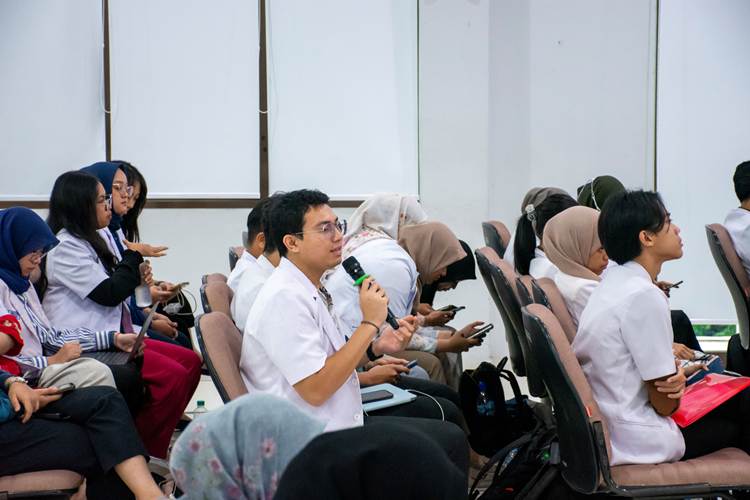
Yogyakarta, December 5, 2025 — In one of the lecture halls at FKG UGM, the morning atmosphere felt different. Professional program students sat closer together, some preparing notes on their laps, while others activated voice recorders. Everyone understood that the day’s Expert Lecture was more than a routine session—it was an opportunity to grasp the realities awaiting them immediately after graduation: a dental practice environment that is increasingly complex, fast-paced, and governed by constantly evolving regulations.
The speaker, drg. Muhammad Fahmi Alfian, MPH, an FKG UGM academic and health law practitioner, opened the session with a remark that prompted many nods of agreement: “In Indonesia, regulations change all the time. Even I struggle to keep up.” The statement, though delivered lightly, reflected a central challenge facing modern healthcare professionals: navigating an ever-shifting legal landscape.
Law as Protection, Not a Threat
In his presentation, he emphasized that the law is not meant to intimidate healthcare professionals. “In fact, healthcare workers are protected by the law,” he said, stressing that every legal obligation is always paired with professional rights inherent to medical and healthcare personnel.
To help students understand, he explained legal principles in a simple and relevant way: lex specialis, lex superior, and lex posterior.
While these Latin terms may sound daunting, the examples he provided were closely aligned with future dentists’ realities—such as healthcare worker wages that do not automatically follow regional minimum wages, or clinical authority that cannot be unilaterally determined by institutions without legal grounding.
The Omnibus Health Law and a “Major Wave” of New Regulations
One of the most engaging segments was his discussion of the newly enacted Health Law formulated under an omnibus concept. With more than a thousand articles and numerous implementing regulations still being developed, this law represents one of the most dynamic regulatory frameworks in Indonesia’s healthcare sector.
He explained how these changes affect healthcare governance, from professional authority and educational standards to licensing mechanisms. It is therefore unsurprising that multiple judicial reviews have been filed—an indication of strong public concern over the direction of healthcare reform in Indonesia.
Professional Discipline Council: A New Gateway for Case Resolution
A key highlight of the lecture was the discussion of the Professional Discipline Council (Majelis Disiplin Profesi / MDP). “Now, cases cannot go directly to criminal proceedings. They must go through the council first,” he explained, capturing students’ attention as they realized that professional errors are no longer treated simplistically.
The MDP now serves as the initial gatekeeper in determining whether an alleged violation falls under disciplinary, ethical, administrative, or criminal domains. Within 14 days, the council is required to issue a decision and recommendation. This new mechanism reflects a shift in how the state views medical practice—professional, science-based, and not solely reliant on criminal law approaches.
He then outlined 17 common forms of disciplinary violations, ranging from practicing beyond one’s competence, performing procedures without adequate informed consent, neglecting standards of care, to failure to refer patients appropriately. The moral message was clear: in clinical practice, even minor negligence can carry long-term consequences.
Moral and Professional Readiness: A Lifelong Identity
As the session drew to a close, the classroom atmosphere became more reflective. Looking at the students, the speaker stated, “Once you take the professional oath, your identity as a dentist stays with you—anywhere, anytime.”
The statement captured the essence of the dental profession: not merely the ability to perform clinical procedures, but also moral maturity, social responsibility, and a lifelong commitment to learning. Even outside the clinical setting, healthcare professionals carry their competence as an inseparable part of their identity.
The session ended with students leaving not only with pages of notes, but also with a renewed awareness that they are entering an era of dentistry demanding multidimensional competence—clinical excellence, ethical integrity, and legal awareness.
A formidable challenge, yet also a profound honor.
(Reporter: Andri Wicaksono | Illustration: iStock & Sozo Dental)

