
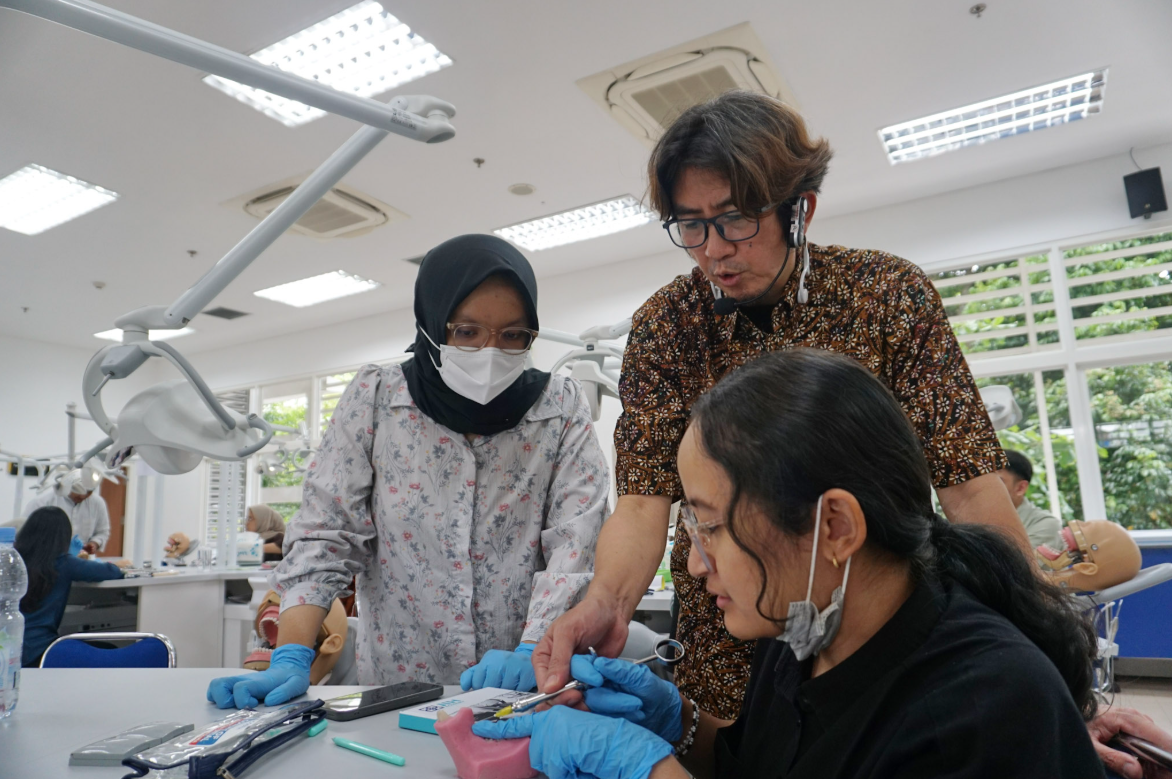
Hands-on session by drg. Dhanni Gustiana, Sp.BMM, Subs TM–TMJ(K) at FKG UGM emphasizes the importance of precision, empathy, and patient safety
For many people, the phrase “tooth extraction” sounds frightening. Images of pain, bleeding, and post-procedure swelling often haunt patients’ minds even before sitting in the dental chair. However, in the hands of a skilled and empathetic dentist, tooth extraction can now be far safer and more comfortable—thanks to atraumatic techniques (open method), which were the focus of the hands-on session by drg. Dhanni Gustiana, Sp.BMM, Subs TM–TMJ(K) at the Faculty of Dentistry, UGM.
“There is no medical procedure that is completely risk-free. Our task is to minimize trauma, not eliminate risk,” — drg. Dhanni Gustiana
This statement reflects a humanistic medical philosophy: dentists not only treat disease, but also preserve patient dignity and comfort.
This hands-on session was part of a collaborative program between the Faculty of Dentistry UGM through iDSDC (Interdisciplinary Dentistry Skills and Development Center) and KAKGIGAMA (the Alumni Family of Dentistry, UGM). Through this collaboration, FKG UGM reaffirmed its role as an academic institution actively promoting learning based on real clinical practice. iDSDC provided scientific support and advanced technological facilities, while KAKGIGAMA contributed professional networks that enriched participants’ experiences. This collaboration represents a concrete step in enhancing the competence and quality of dental professionals with a focus on procedural safety and patient well-being.
Why Atraumatic Techniques Matter?
According to drg. Dhanni, many post-extraction complications result from overly aggressive techniques—ranging from bone fractures and excessive bleeding to delayed healing. Through the open method approach, dentists carefully create tissue access using planned flap designs, minimal osteotomy, and root sectioning to facilitate extraction without damaging surrounding tissues. open method, dokter gigi membuka akses jaringan secara hati-hati dengan desain flap yang terencana, osteotomi minimal, serta sectioning akar gigi untuk mempermudah pencabutan tanpa merusak jaringan sekitarnya.
“Primum non nocere — First, do no harm” he emphasized, reiterating the fundamental principle of medicine.
Precision and Instrument Readiness
During the hands-on practice session, participants were introduced to various instruments such as desmodont cutters (desmotomes), which function to gently separate periodontal tissue without causing gingival tearing.
According to drg. Dhanni, these instruments are particularly useful in cases involving multiple roots, impacted teeth, or patients with a high bleeding risk. Beyond technical skills, he emphasized the importance of pre-procedural analysis: reviewing radiographs, understanding tooth position, patient age, and systemic conditions. “Each patient carries a different story. Do not assume that all extractions are the same,” he stated.
Saving More Than Just Teeth
The atraumatic approach also offers long-term benefits: protecting the alveolar bone and the temporomandibular joint (TMJ) from excessive stress. In practice, drg. Dhanni taught participants not to restrain the patient’s head, to use a pen grip, and to apply gentle movements to maintain structural stability.
“Save the TMJ. Save the nerves. Save the bones,” became the motto of the hands-on session.
This approach makes the extraction process more controlled, reduces the risk of post-procedural pain, and accelerates natural healing.
Patient Comfort as the Top Priority
This hands-on session was not merely technical training, but also character education for future dentists: humility in every case and respect for one’s own limitations. drg. Dhanni reminded participants not to rush or force complete tooth extraction when it risks tissue damage. “This is not delivering a baby,” he said humorously yet meaningfully. “What matters is not speed, but safety.” This scientific approach reflects the philosophy of Avicenna, which he quoted during the session: “There is no perfect medical action, because medical truth is always dynamic.”
A Humanistic Message from Clinic to Life
This hands-on session taught that true medical skill is measured not by how fast hands work, but by how calm the heart remains when facing risk. Through training in precision, patience, and empathy, participants learned that atraumatic techniques are not merely methods of tooth extraction, but a philosophy of patient-centered care.
Author & Photo: Dody Hendro W

