
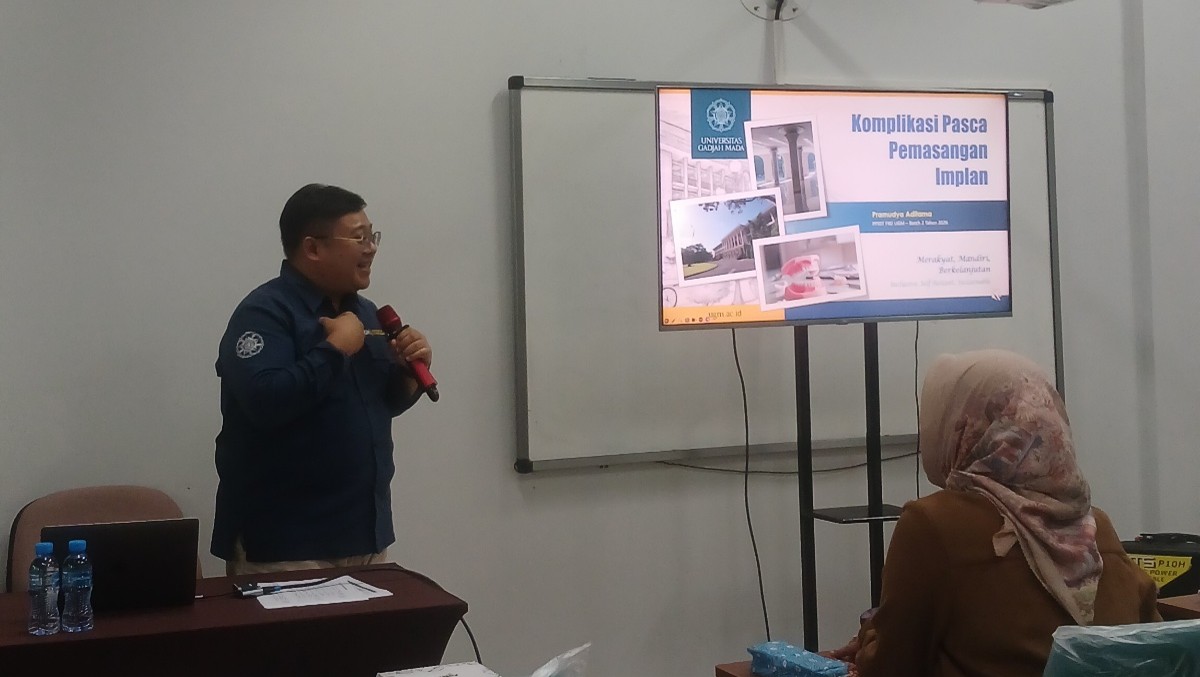
Understanding the complications that may occur during and after dental implant placement is one of the essential competencies every dentist must possess. This was emphasized by drg. Pramudya Aditama, M.D.Sc., Sp.Pros., during the Dental Implant Course held at the Margono Soeradji Building, Faculty of Dentistry, Universitas Gadjah Mada (FKG UGM), on Wednesday (24 June 2026).
During the concluding session of the course, Drg. Pram shared a range of clinical experiences regarding the challenges commonly encountered in implantology practice. Rather than focusing primarily on theory, he centered his discussion on real-world clinical cases frequently encountered by practitioners.
"Complications in implantology are not solely related to the implant placement procedure itself. Numerous factors must be considered, ranging from treatment planning and the patient's biological condition to surgical techniques and postoperative care," he explained.
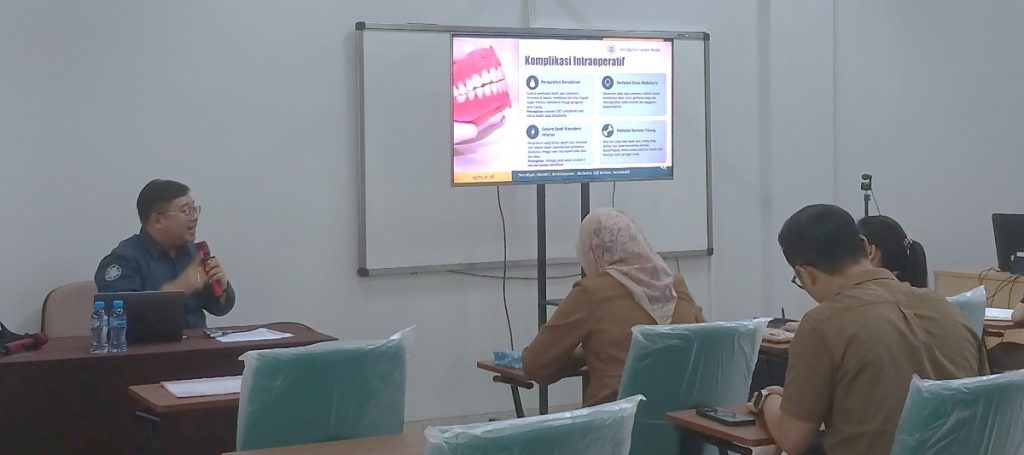
He outlined several complications that may arise during surgery, including bleeding, injury to the inferior alveolar nerve, perforation of the maxillary sinus, and cortical bone damage caused by excessive pressure during implant placement. He stressed the importance of a thorough understanding of anatomy before performing implant procedures.
According to him, technologies such as Cone Beam Computed Tomography (CBCT) & surgical guide can significantly improve implant placement accuracy while minimizing the risk of complications. Nevertheless, the clinician's ability to properly assess each patient's clinical condition remains the primary determinant of treatment success.
In addition to discussing intraoperative complications, participants also learned about factors affecting primary implant stability, which is considered a critical indicator of successful osseointegration between the implant and surrounding bone.
"Primary stability is the cornerstone of implant success. If adequate initial stability is not achieved, the risk of implant failure increases, even when all other procedures have been performed according to established standards," he explained.
drg. Pram also highlighted the importance of maintaining strict sterility throughout implant procedures. He cautioned that bacterial contamination can lead to infection, inflammation, and implant failure if not managed appropriately.
Participants were further introduced to the management of postoperative complications, including edema, hematoma, soft tissue infection, implant component exposure, and impaired tissue healing. According to him, early detection and regular follow-up evaluations are essential for preventing these complications from progressing into more serious conditions.
Through this course, participants were expected not only to acquire the technical skills required for proper dental implant placement but also to develop the competence to prevent, recognize, and manage the various complications that may arise throughout the course of treatment.
Reporter: Anny Anggraini, Photographer: Anny Anggraini, Editor: Andri Wicaksono