
The number may appear small: 1.23 CFU/cm². However, behind this measurement of bacterial colonies per square centimeter lies a question that has long remained unanswered in orthodontic clinics: how clean is a dentist’s face shield after brushing a patient’s orthodontic brackets?
Dr. drg. Andi Triawan, Sp.Ort., from the Department of Orthodontics, Faculty of Dentistry, Universitas Gadjah Mada, attempted to answer this question through a measurable scientific approach. Together with Belladina Yusi Lasara from the UGM Academic Hospital, he designed a study whose findings were published in the Indonesian Dentistry Magazine August 2022 edition. The main finding was simple yet important: the distance between aerosol suction equipment and the patient’s oral cavity determines how many bacteria are deposited onto the dentist’s face shield.
Invisible Aerosols in the Air
Whenever a high-speed dental bur, ultrasonic scaler, or rotating bracket brush operates inside a patient’s mouth, thousands of aerosol particles are released into the air. These particles carry microorganisms originating from saliva, blood, and dental plaque. Some bacterial species commonly associated with dental aerosols are particularly concerning, including Staphylococcus aureus, MRSA (methicillin-resistant Staphylococcus aureus), Streptococcus pneumoniae, and Mycobacterium tuberculosis.
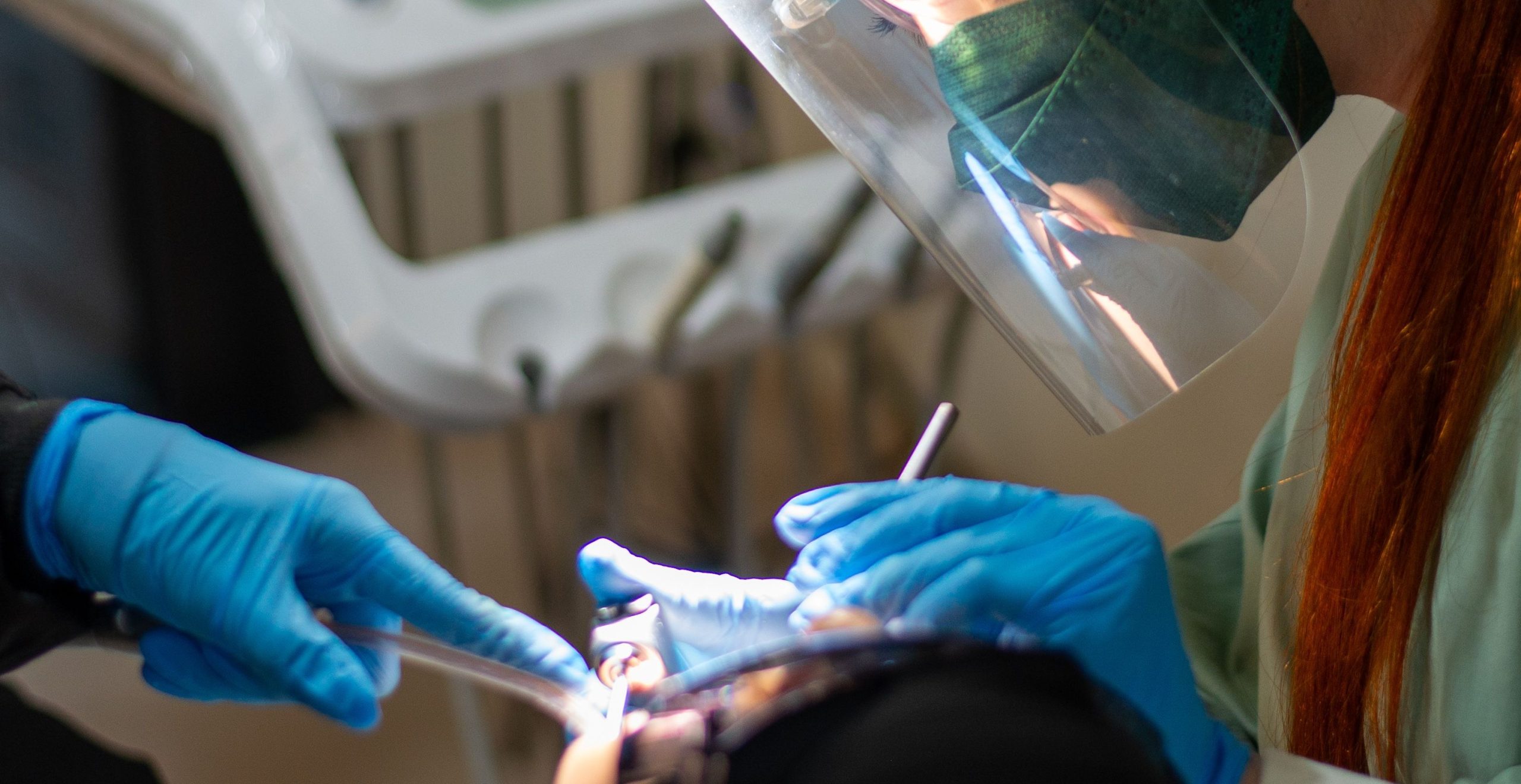
In orthodontic treatment, brushing brackets using a microbrush powered by a low-speed handpiece is considered an aerosol-generating procedure. Dentists stand very close to the patient, directly facing the source of these airborne particles. The face shield serves as the final protective barrier before aerosols reach the mucous membranes of the eyes, nose, and mouth.
The question is no longer whether aerosol suction should be used, but rather: At what distance is the device most effective?
Three Distances, One Answer
This study was conducted at the Dental Clinic of UGM Academic Hospital, involving five orthodontic patients aged 17–22 years. All participants were free from dental caries and had moderate oral hygiene scores. Each patient underwent four different treatment conditions: without aerosol suction, with aerosol suction positioned 10 cm from the oral cavity, with aerosol suction positioned 15 cm from the oral cavity, with aerosol suction positioned 20 cm from the oral cavity.
Swab samples were collected from the surface of the face shield after the bracket-cleaning procedure was completed. The samples were then incubated and analyzed at the Integrated Research and Testing Laboratory (LPPT) of UGM to determine the total plate count (TPC) and identify the presence of Streptococcus and Staphylococcus species.
The results were clear. Face shields without aerosol suction showed the highest TPC value: 7.25 ± 0.03 CFU/cm². This value remained within the upper limit of the standard established by the Indonesian Ministry of Health Decree No. 1204/MENKES/SK/X/2004, which sets an acceptable threshold of 5–10 CFU/cm². When aerosol suction was used at a distance of 20 cm, contamination decreased to 3.15 CFU/cm². A distance of 15 cm resulted in 2.78 CFU/cm². Meanwhile, positioning the suction tip 10 cm from the oral cavity produced the lowest contamination level: 1.23 ± 0.01 CFU/cm².
A one-way ANOVA statistical test confirmed that the differences among groups were statistically significant (p < 0.05). The closer the suction tip was positioned to the patient’s oral cavity, the fewer bacteria escaped and reached the dentist’s face shield.
Staphylococcus Present, Streptococcus Absent
Beyond bacterial colony counts, the study also revealed interesting findings regarding the identity of captured microorganisms. Across all treatment groups, not a single Streptococcus colony was detected on the face shield surface. In contrast, Staphylococcus sp. was found in all groups, including the group using aerosol suction positioned at 10 cm.
“The presence of Staphylococcus sp. in the face shield indicated that some orthodontic patients had moderate OHIS with plaque around the orthodontic bracket.”
The explanation is logical. Patients wearing fixed orthodontic appliances tend to experience plaque accumulation around brackets, and this plaque provides a suitable environment for Staphylococcus aureus and other Staphylococcus species. The absence of Streptococcus, on the other hand, corresponds with the condition of the participants, who were free from dental caries. This is because Streptococcus mutans, a major contributor to dental caries, thrives in environments associated with cariogenic conditions.
Bacterial identification was performed using the catalase test. Colonies producing oxygen bubbles (O₂) when exposed to hydrogen peroxide were confirmed as Staphylococcus sp. Colonies showing negative reactions were classified as Streptococcus sp., and all samples in this study showed negative results.
One Centimeter That Can Make a Difference
The findings of Dr. drg. Andi Triawan, Sp.Ort., and his team may sound highly technical. However, the clinical implications are highly practical. In orthodontic clinics, the position of the aerosol suction tip is often adjusted based on convenience rather than measurable guidelines. This study provides a concrete reference point: A distance of 10 cm from the oral cavity is the most effective position for reducing bacterial contamination on dental face shields.
Of course, this is not the only layer of protection. The use of pre-procedural mouth rinses containing 1% hydrogen peroxide or 0.2% povidone iodine, the combination of intraoral and extraoral suction systems, and complete level 3 personal protective equipment (PPE) protocols remain important components of a comprehensive infection-control strategy.
What changes is the understanding that distance is not a minor technical detail. A difference of just one centimeter, multiplied across hundreds of procedures each year, may significantly influence cumulative bacterial exposure for dentists working on the front lines of patient care.
Source DOI: http://doi.org/10.22146/majkedgiind.77444
Authors: Nanda Ayu, drg. Achmad Zam Zam Aghasy, M.Kes.
Photo: Pexels