
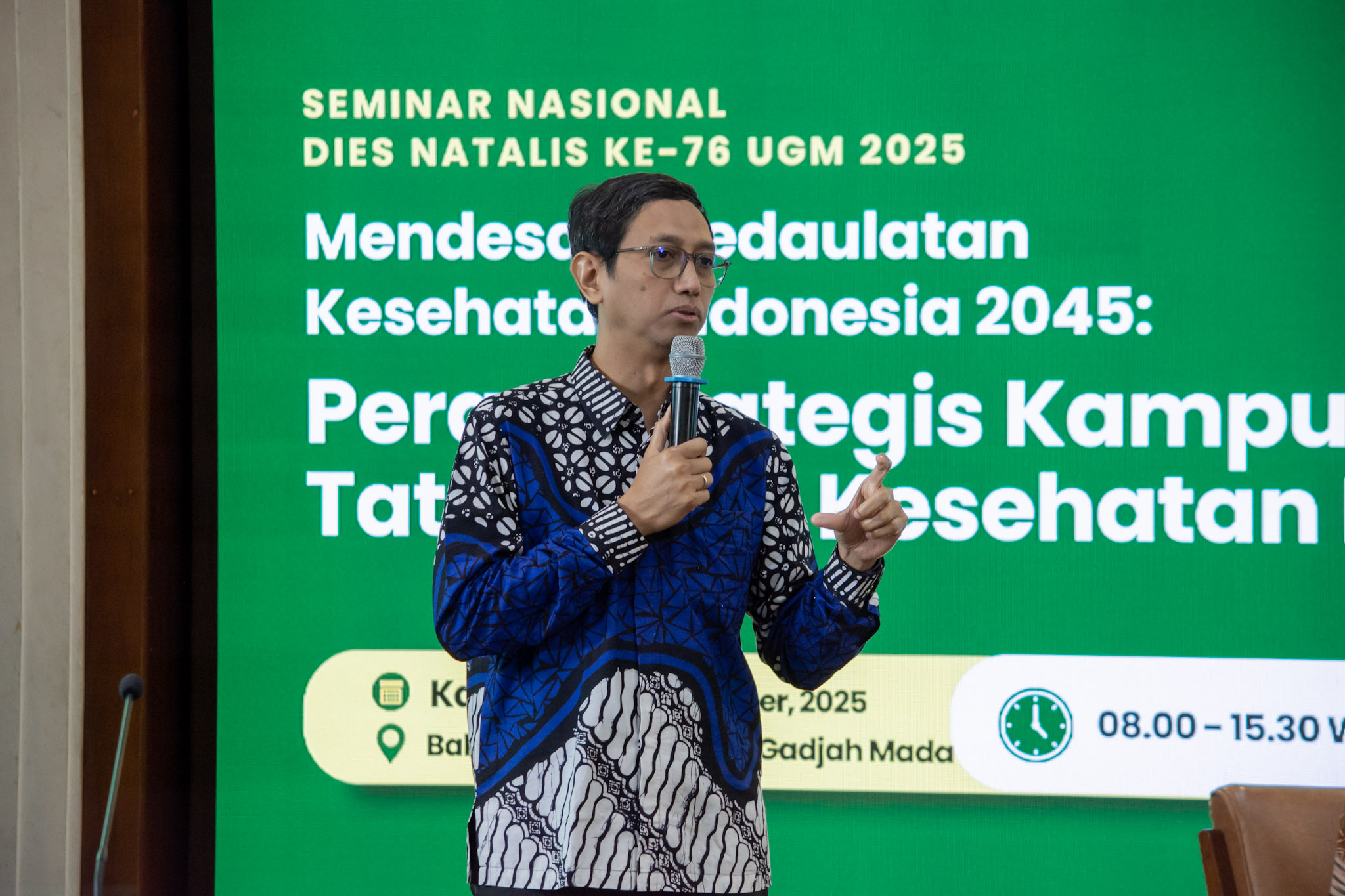
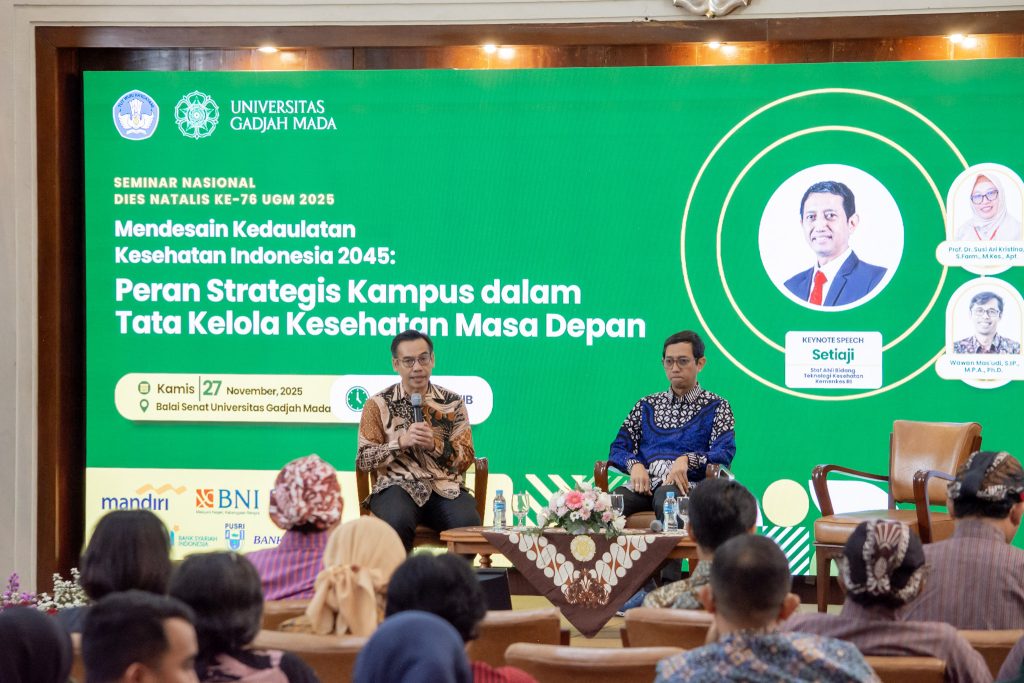
The Expert Staff for Health Technology at the Ministry of Health of the Republic of Indonesia, Setiaji, S.T., M.Si., emphasized that Indonesia must establish health data sovereignty as the foundation for a predictive and precision-based healthcare system by 2045. He conveyed this message during his keynote speech at the National Seminar titled “Designing Indonesia’s Health Sovereignty 2045: The Strategic Role of Universities in Future Health Governance”, held at the UGM Senate Hall on Thursday (27/11/2025).
According to Setiaji, achieving Indonesia’s health sovereignty by 2045 requires a major shift from a curative, illness-based system toward a proactive, preventive, and data-driven healthcare system. Through this approach, the state not only treats individuals who are already ill but also maintains population health through early monitoring and evidence-based decision-making.
Data sovereignty is a fundamental requirement to ensure that Indonesia’s healthcare system does not rely on foreign technologies, but instead develops an independent and integrated health ecosystem.
Pillars of Digital Health Sovereignty
Setiaji outlined three main pillars of digital health sovereignty: human resource sovereignty, data sovereignty, and technology sovereignty. Human resource sovereignty emphasizes the nation’s ability to produce, train, and retain digital talent capable of designing and auditing national healthcare systems. “It is not enough for us to merely be technology users; we must become developers and controllers,” he stated.
The second pillar, data sovereignty, requires that Indonesian citizens’ health data be stored and managed within Indonesia’s legal jurisdiction. Such data are strategic assets that will determine health policy direction, budget efficiency, and the development of precision-based healthcare services.
The third pillar is technology sovereignty, referring to Indonesia’s independence in developing, using, and controlling healthcare technology. “If core technologies remain dependent on external parties, health sovereignty will not be achieved,” he added.
Looking toward the 2045 vision, Setiaji emphasized that predictive technology and precision medicine will serve as the main drivers. Through the integration of Big Data from SATUSEHAT, Artificial Intelligence (AI) can predict disease risks at both population and individual levels. Precision medicine becomes feasible when an individual’s health data are collected comprehensively and continuously, including genetic information (DNA), biological markers, daily lifestyle habits, and medical and treatment history stored in electronic medical records.
According to him, SATUSEHAT is a critical national infrastructure that unifies Indonesia’s health data ecosystem. It operates based on one standard, one data, and one nation, symbolizing digital unity from Sabang to Merauke.
Setiaji also explained how AI will play roles at three levels. At the macro level, AI assists governments in designing risk-based public policies by predicting specialist workforce needs and budget allocation. At the meso level, AI supports public health monitoring to detect potential outbreaks faster than manual reporting. At the micro level, AI serves as a clinical assistant for frontline doctors, particularly in regions with limited specialist availability, through tele-radiology and tele-ophthalmology.
Challenges
However, he acknowledged that the journey toward a predictive and precision healthcare system is not without challenges. One major issue is the digital divide, especially in remote areas still experiencing internet blank spots. This condition hinders real-time data transmission based on Fast Healthcare Interoperability Resources (FHIR) standards to SATUSEHAT. FHIR is a global standard for efficient health data exchange. “Currently, the Ministry of Health has collaborated with Komdigi to provide satellite access in healthcare facilities located in 3T areas (Tertinggal, Terdepan, dan Terluar),” Setiaji added.
Another challenge lies in human resource readiness. The role of Medical Record and Health Information personnel (PMIK) has evolved from mere administrators to Data Quality Controllers and FHIR Analysts. General medical personnel also need to be equipped with data-driven clinical understanding, AI, and health informatics. “The shift in mindset from paper-centric to digital-first is the greatest challenge in the public sector,” he concluded.
Writer and Photographer: Fajar Budi Harsakti

