
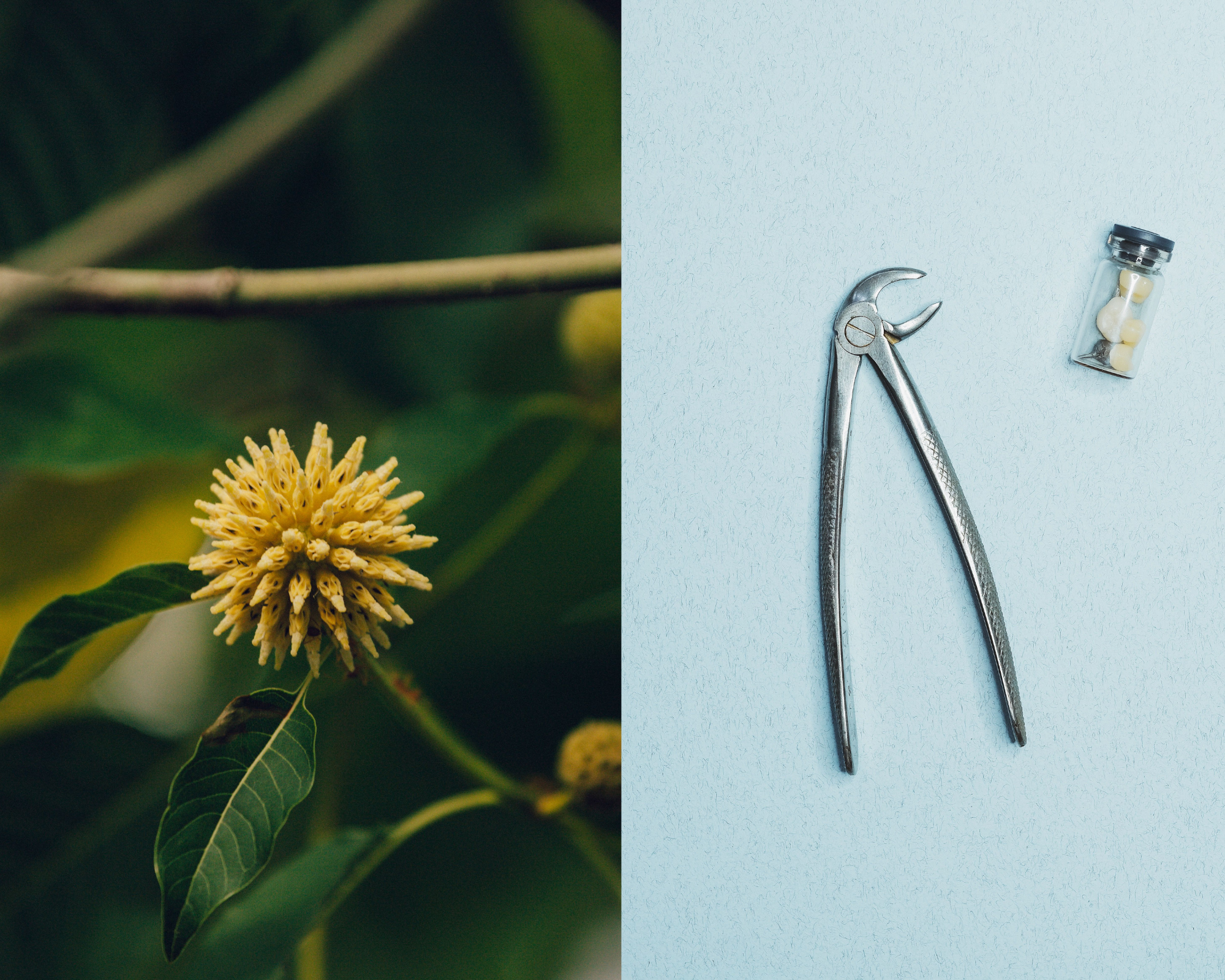
To most people, kirinyuh is nothing more than a nuisance plant growing wild along the edges of rice fields and farmland. But in Acehnese communities, this sharp-smelling member of the Asteraceae family has long been relied upon for wound care. Now, research from the Faculty of Dentistry, Universitas Gadjah Mada, has shown that this ancestral practice may be more than just folklore.
A study published in the Journal of International Dental and Medical Research (Volume 13, No. 4, 2020) found that ethanol extract of kirinyuh leaves (Chromolaena odorata) significantly increased collagen fiber density in post-extraction wounds. The higher the concentration of the extract, the faster the wound healed.
From the Tooth Socket to the Microscope
The study involved 60 male guinea pigs (Cavia cobaya) aged 9 to 10 weeks and weighing 300 to 350 grams. The animals were divided into five groups: a negative control group, a positive control group treated with 10% povidone-iodine, and three treatment groups receiving ethanol extract of kirinyuh leaves at concentrations of 2.5%, 5%, and 10%.
The first mandibular incisor of each guinea pig was extracted, after which the extract was applied topically to the wound socket once a day. On days 3, 7, 10, and 14 after extraction, tissue specimens were collected and stained using Mallory trichrome staining before being examined under a microscope at 400× magnification.
The results were striking. All treatment groups showed greater collagen fiber density than the control groups. The 10% extract group recorded the highest mean collagen density at every observation point, from day 3 through day 14. Statistical analysis using the Kruskal-Wallis and Mann-Whitney tests confirmed the findings, with significant differences between groups (p < 0.05).
Three Compounds, One Purpose
Behind kirinyuh's ability to accelerate wound healing are three active compounds that work synergistically: flavonoids, saponins, and tannins.
Saponins appear to play the most direct role in collagen formation. They stimulate fibronectin synthesis, which in turn promotes the migration and proliferation of fibroblasts into the wound area. Fibroblasts are mesenchymal cells responsible for producing large amounts of collagen, particularly from the third day after injury, with activity peaking around days 5 to 7. Saponins also have anti-inflammatory activity by inhibiting prostaglandin production, thereby shortening the inflammatory phase and allowing the proliferative phase to begin sooner.
Flavonoids, through their antioxidant properties, help maintain the integrity of vascular endothelial cells and reduce the risk of aggregation. Tannins, meanwhile, are high-molecular-weight polyphenolic compounds that act as natural astringents, helping precipitate proteins and strengthen tissue undergoing the healing process.
The lead researcher, drg. Yosaphat Bayu Rosanto, MDSc, Sp.BMM, from the Department of Oral and Maxillofacial Surgery, Faculty of Dentistry, UGM, and his team emphasized that the concentrations used in the study were considered toxicologically safe.
“The ethanol extract of kirinyuh leaves can increase collagen fiber density in post-extraction wounds, and the 10% kirinyuh extract produces the highest rate of increase in collagen fiber density.”
Previous toxicity testing showed that the lethal dose 50 (LD50) of kirinyuh leaf extract was 14.1416 g/kg body weight. This means that the 2.5%, 5%, and 10% concentrations used in the study were still well below the dangerous threshold.
Day 14: When Collagen Begins Preparing for Bone Formation
Histological observations on day 14 revealed another interesting finding. In the 10% treatment group, the collagen fibers were not only denser but had also undergone more extensive mineralization than those in the other groups. This marked the beginning of the first stage of alveolar bone regeneration, in which mature collagen begins to transform into a harder bone matrix.
This process is consistent with established biological mechanisms. Osteoblasts, which also originate from mesenchymal cells, synthesize type I collagen and glycosaminoglycans as part of the bone mineralization process. Collagen maturation itself begins approximately two to three weeks after an injury, when the balance between collagen deposition and degradation starts to stabilize.
Tooth extraction may appear to be a simple procedure, but it leaves behind a wound that requires a complex, multilayered healing process. Complications such as dry socket, infection, and delayed healing remain real challenges in everyday clinical practice. These findings raise the possibility that a plant long regarded as a weed may actually possess therapeutic potential that has yet to be fully explored. Kirinyuh may not be appearing in dental clinic medicine cabinets anytime soon, but its journey from weed to therapeutic gel has already begun.
Authors: Nanda Ayu, drg. Achmad Zam Zam Aghasy, M.Kes.
Photo: Pexels