
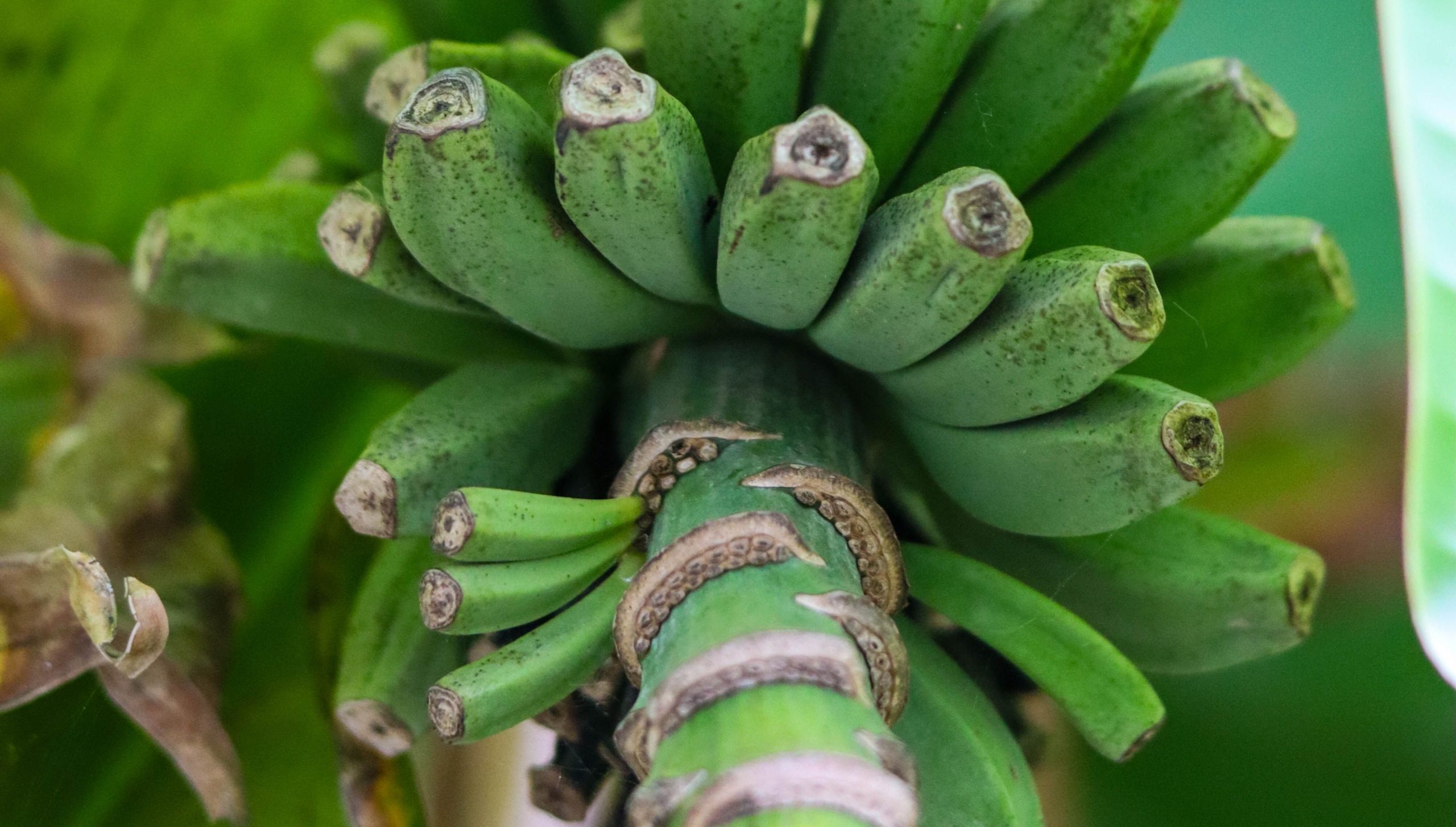
In Javanese villages, older generations have long applied banana stem sap to wounds as a form of first aid. Some in the medical community have dismissed the practice as superstition. But research from the Faculty of Dentistry at Universitas Gadjah Mada has shown that this generations-old belief has a strong biological basis, at least when it comes to wounds following tooth extraction.
drg. Yosaphat Bayu Rosanto, MDSc, Sp.BMM, together with Juni Handajani and Heni Susilowati from the Department of Oral Biology at FKG UGM, published their findings in the July 2012 issue of Dentika Dental Journal. The results were striking: an 80% concentration gel made from Raja banana (Musa sapientum) stem sap, applied topically to guinea pig tooth sockets, significantly accelerated collagen fiber formation compared with glycerin iodine, which has traditionally been used as the clinical standard.
From Grandma’s Kitchen to the Laboratory
Raja bananas were chosen for a reason. Compared with other banana varieties, their stems produce a greater volume of sap. The sap contains four major compounds: saponins, flavonoids, vitamin C, and tannins. These are more than just chemical names on a list of ingredients. Each plays a specific role in the cascade of wound healing.
Tannins accelerate the migration of inflammatory cells and stimulate the proliferation of new cells. Saponins help promote red blood cell coagulation and stimulate the formation of new blood vessels. Flavonoids act as both anti-inflammatory and antibacterial agents. Vitamin C, meanwhile, acts as an antioxidant and inhibits the expression of MMP-1 in fibroblasts, an enzyme that can degrade collagen when left unchecked.
The researchers designed a quasi-experimental study involving 54 male guinea pigs (Cavia cobaya) aged 3–4 months. The animals were divided into three groups: a treatment group receiving 80% banana sap gel, a positive control group receiving glycerin iodine, and a negative control group receiving CMC-Na. The left mandibular central incisor was extracted. After treatment, socket tissue was collected on days 1, 3, 5, 7, 14, and 24 and processed into histological specimens using Mallory staining before being examined under a light microscope.
The Seven Days That Made the Difference
On the first day, no collagen fibers had yet formed in any of the three groups. This was expected: the body was still in the early inflammatory phase, working to stop bleeding and clear away tissue debris.
By the third day, differences began to emerge. Thin collagen fibers had started to appear in the sockets, and the group treated with banana sap gel showed greater fiber thickness than either control group. The difference continued to widen through day seven, when collagen fiber density in the treatment group reached the highest score on the observation scale.
“Topical application of 80% banana sap gel can accelerate collagen fiber formation during the healing process of guinea pig tooth sockets following tooth extraction.”
This was the researchers’ conclusion. Kruskal-Wallis and Mann-Whitney tests confirmed statistically significant differences (p < 0.05) between the treatment group and both control groups on days 3, 5, 7, and 14.
By day 14, collagen density in the three groups had begun to converge. This did not indicate a setback, but rather that the remodeling process was underway: matrix metalloproteinases (MMPs) began degrading excess collagen to create tissue with optimal size and strength. By day 24, collagen density had decreased across all groups, indicating the final consolidation phase of tissue healing.
A Natural Scaffold for a Healing Socket
Why is accelerated collagen formation so important? Collagen fibers are more than simply “flesh covering a wound.” In an extraction socket, collagen serves as a scaffold—a structural framework that allows new cells to migrate, fibroblasts to proliferate, and eventually osteoblasts to deposit bone minerals. Without sufficient collagen forming quickly enough, alveolar bone regeneration may be delayed, potentially increasing the risk of complications such as dry socket.
The researchers proposed that saponins in banana sap stimulate the synthesis of TGF-β, a growth factor that recruits fibroblasts to the wound site. Once the fibroblasts arrive, vitamin C inhibits MMP-1, preventing newly formed collagen from being immediately degraded. Meanwhile, flavonoids help suppress excessive inflammation, which can otherwise damage healthy tissue surrounding the socket.
Together, these four compounds may create a microenvironment conducive to faster and more orderly healing.
Traditional Wisdom Waiting to Be Formulated
This research is not the end of the story. The study was conducted in experimental animals, and clinical trials in humans are still needed before banana stem sap gel can be recommended as a standard post-extraction procedure. Nevertheless, the findings open a door that has long been knocked on by village elders.
There is something intriguing about the fact that a plant growing in people’s backyards, often overlooked, may contain healing mechanisms sophisticated enough to be demonstrated histologically. Perhaps the more appropriate question is not, “Does banana sap work?” but rather, “How long did it take us to start paying attention?”
Authors: Nanda Ayu, drg. Achmad Zam Zam Aghasy, M.Kes.
Photo: Pexels