
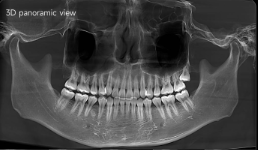
Bone grafts are frequently used in maxillofacial dentistry to repair bone defects following conditions such as cysts, trauma, tumors, or tooth loss. The success of grafting is strongly influenced by the available bone volume, graft stabilization, and surrounding anatomy. Accurate assessment of bone volume and graft space characteristics is essential prior to bone graft procedures to ensure proper integration, accelerate regeneration, and minimize complications.
References Case
In a case report published in Majalah Kedokteran Gigi Klinik UGM, written by FKG UGM students Sariyani Pancasari Audry Arifin together with Menik Priaminiarti, Chairunnisa Amarta, and Heru Suryonegoro, a synthetic bone graft made of Ceraform was found to radiographically resemble a compound odontoma in the anterior maxillary region. The patient was a 63-year-old male with a fistula at the apical area of several teeth and the presence of a bone graft and cyst wall identified two years earlier. CBCT examination was used to evaluate the mass prior to curettage. The CBCT revealed a rounded hyperdense–hypodense mass with well-defined borders, surrounded by a radiolucent band, corticated, with an internal hyperdense structure resembling denticles. These findings indicate that CBCT is capable of revealing internal characteristics, margins, and the interaction of the graft with surrounding tissues in three dimensions.
The Role of CBCT in Bone Volume Assessment Prior to Bone Grafting
Based on this case and supporting literature, the following aspects highlight the importance of CBCT:
- Determining Graft Space Volume and Dimensions
CBCT enables three-dimensional measurement of bone space—height, width, and depth—and accurate placement of the graft with appropriate orientation. - Characteristics of Surrounding Bone
CBCT allows evaluation of the condition of cortical bone (buccal and palatal), the presence of discontinuities or surrounding bone defects, and bone density. - Evaluation of Internal Graft Structure
This case demonstrates that graft granules may remain intact with a hard internal structure, appearing similar to denticles or odontoma-like structures. This is important so clinicians recognize that radiopaque or hypodense masses are not always pathological lesions but may represent old graft material that has not yet been resorbed. - Surgical / Curettage Planning
Information obtained from CBCT assists in defining surgical boundaries, determining whether graft removal is necessary, or identifying portions of graft affected by secondary infection that need to be cleaned. - Prediction of Complications and Success
Volume compatibility, absence of infection, and graft integration can be assessed through CBCT. This case illustrates that cyst recurrence and secondary infection may hinder graft integration.
Challenges and Accuracy
- CBCT offers the advantage of three-dimensional visualization without structural overlap, although cost and access may be limiting factors.
- Adequate resolution and voxel size are required so that small structures (such as graft granules) can be clearly visualized.
- Radiation exposure must be controlled according to the ALARA principle.
***
CBCT is a superior diagnostic tool for assessing bone volume prior to bone grafting. The case of a bone graft resembling a compound odontoma emphasizes that radiographic appearances can be misleading without three-dimensional information. With CBCT, dentists can plan graft procedures more accurately, assess graft space and surrounding bone conditions, and anticipate factors that may influence graft integration. The use of CBCT as part of surgical planning for bone grafting supports better clinical outcomes and aligns with principles of health, innovation, and sustainability.
References
MKGK, Sariyani Pancasari Audry Arifin, Menik Priaminiarti, Chairunnisa Amarta, Heru Suryonegoro, Radiographic appearance of a bone graft resembling a compound odontoma in the anterior maxillary region, https://jurnal.ugm.ac.id/mkgk/article/download/81953/40088
Author: Rizky B. Hendrawan | Photo: Freepik

